

Target the Map Pack in 90 Days with Local Keyword Research for Arizona
Local keyword research means finding the exact phrases nearby customers type when they need a business like yours, then confirming Google treats those phrases as local before you build a page around them. Start today by writing down ten seed phrases built from your services and neighborhoods, then run one through Google to see if a map or Local Pack shows up. That single check tells you more than any tool report, and the full process below usually takes a focused afternoon per service category.
TL;DR:
- Verifying local search intent in Google’s SERP is crucial, as tool data alone may suggest targeting terms with no actual local relevance.
- Focusing on neighborhood-level keywords often reduces competition and justifies pages, even if search volume appears low or zero.
- Utilizing real customer language from reviews and social platforms helps identify keywords that actual searchers use, increasing local relevance.
- Proper placement of keywords in dedicated service or location pages, along with unique local content, boosts rankings and avoids penalties from templated pages.
- Monitoring local rankings, GBP actions, and traffic monthly guides ongoing optimization, rather than relying solely on search volume or daily fluctuations.
Table of Contents
- What Is Local Keyword Research, and How Do You Start?
- Where Do You Find the Phrases Local Customers Actually Use?
- Where Do Local Keywords Belong on Your Website?
- Which Local SEO Metrics Actually Tell You It’s Working?
- What Local Keyword Mistakes Cost You the Most?
- How Webtechs Applies This Workflow for Arizona Clients
- What Most Guides Get Wrong About Local Keyword Research
- Get a Local Keyword Audit Built for Your Arizona Business
- Sources
- FAQ
What Is Local Keyword Research, and How Do You Start?
Local keyword research is the process of finding, verifying, and prioritizing the search terms people in a specific city, neighborhood, or zip code use to find a business like yours. It differs from general SEO keyword research because every phrase gets tested against one extra question: does Google actually show local results for it? Skip that check and you’ll build pages targeting terms Google treats as purely informational, no matter how the tool labels them.
Here’s a workflow that works whether you’re a Scottsdale plumber or a Tempe hair salon, broken into six steps you can repeat for every service you offer.
- Brainstorm seed keywords. List every service you offer, then pair each one with local modifiers: your city, your neighborhood (“Old Town Scottsdale,” “Arcadia”), your zip code, and phrases like “near me” or “open now.” Add the words your customers actually use on the phone. A homeowner doesn’t say “residential HVAC repair services.” They say “AC guy” or “my air conditioner stopped working.”
- Expand with tools and location filters. Feed your seed list into Google Keyword Planner, Semrush’s Keyword Magic Tool, or Ahrefs, and set the location filter to your city or metro. These tools surface variations you’d never think of, and long-tail phrases with three or four words tend to convert better because they signal a searcher closer to hiring someone.
- Verify local intent in the live SERP. This step gets skipped more than any other, and it’s the one that saves the most wasted effort. Open an incognito window, search the exact phrase, and look for a Local Pack, a map, or local business listings in the results. If Google shows a Local Pack or map for a query, that’s confirmation the term carries local intent worth targeting.
- Prioritize by relevance, difficulty, and intent. Rank your verified list by three factors: how directly the phrase matches a service you offer, how tough the competition looks in that Local Pack, and how close the searcher seems to hiring someone versus just browsing.
- Map each keyword to one page or GBP field. Assign every high-priority phrase to a single service page, location page, or a specific field in your Google Business Profile. Trying to rank one page for five unrelated phrases dilutes your relevance signals and confuses both Google and the reader.
- Set a monitoring cadence. Check rankings and conversions monthly at minimum, then adjust. Keyword research isn’t a one-time project. Search language shifts with seasons, new competitors, and even how Google’s AI Overview features summarize local results.
Pro Tip: Don’t trust tool data alone. A tool might show “roofer Chandler AZ” at low search volume, but if three of your last five leads used that exact phrase on the phone, it’s worth a dedicated page regardless of what the software says. Combining tool output with real local knowledge is what separates a useful keyword list from a generic one copied from a template.
Where Do You Find the Phrases Local Customers Actually Use?
Tools give you volume estimates. They don’t give you voice. To capture the actual words your customers use, you need sources that reflect real conversations, not just search algorithms guessing at intent.
Start with free discovery methods before you touch a paid tool:
- Google Autocomplete and “related searches.” Type a partial phrase into Google and watch what it suggests. These predictions reflect real aggregate search behavior, including how people phrase location-based needs.
- People Also Ask boxes. These reveal the follow-up questions customers have right after searching for your service, which makes them useful for FAQ content and blog topics.
- Google Business Profile reviews, Yelp, and Nextdoor. Read through your own reviews and your competitors’ reviews for repeated phrases. If five reviewers mention “same-day appointment” or “fixed my sink in an hour,” that language belongs on your site.
- Google’s Place Topics. These auto-generated tags on business listings surface commonly referenced attributes and services that customers associate with a business type, which doubles as a content idea list.
Inside the tools themselves, run comparisons you might otherwise skip. Compare a broad city term against a hyperlocal one, like “Scottsdale plumber” against “Old Town Scottsdale plumber” or a specific zip code such as 85251. The neighborhood-level term usually shows far less competition, even when the raw volume looks small.
That low volume number scares off a lot of small business owners, and it shouldn’t. If a keyword tool reports zero or near-zero search volume for your specific town or neighborhood, that doesn’t mean nobody searches there. It usually means the sample size is too small for the tool to report reliably. If you have a physical location or service area there, build the page anyway. Low-volume neighborhood keywords often justify a dedicated page simply because the people who do search them are close to ready to buy.
Where Do Local Keywords Belong on Your Website?
Finding the right phrases only helps if you put them somewhere Google and customers can both see clearly. The placement decision comes down to matching content type to search intent.
Build a dedicated service page when a keyword pairs one clear service with location intent, like “emergency water heater repair Mesa.” Build a location page when you serve multiple distinct areas and each one deserves its own local proof points, like nearby landmarks or service area boundaries. Reserve FAQ or blog content for question-based searches that don’t map cleanly to a transaction, such as “how much does a roof replacement cost in Arizona.”
Once you know the page type, apply the keyword across the elements that actually carry ranking weight:
- Title tags and H1s that combine the service and the location naturally, not just stuffed side by side.
- Meta descriptions that repeat the phrase once while still reading like something a person wrote.
- LocalBusiness schema markup that reinforces your service area, address, and business category in a format search engines parse directly.
- Google Business Profile fields, including the services list, business description, and applicable attributes, all echoing the same core phrases you’ve verified.
The mistake most small businesses make here is duplicating one location page fifty times with only the city name swapped out. Google recognizes templated content fast, and it rarely ranks. Every location page needs unique local content: a real photo, a specific neighborhood detail, a testimonial from that area, or service notes unique to that market.
Which Local SEO Metrics Actually Tell You It’s Working?
Search volume tells you almost nothing about whether local keyword research is paying off. What matters is whether you show up in the map results and whether that visibility turns into phone calls.
Build a minimal tracking stack: a rank tracker that checks positions from a location grid or specific zip codes (not your office’s IP address), Google Business Profile Insights, and call tracking on your website and GBP listing. Location-specific rank tracking paired with GBP Insights and call tracking gives small businesses the clearest picture of real local performance.
| Metric | What it tells you | Where to find it |
|---|---|---|
| 3-Pack position | Visibility in the top local map results | Local rank tracker |
| GBP actions (calls, directions) | Direct customer intent from your profile | GBP Insights |
| Local organic clicks | Website traffic from local search | Search Console (filtered by query) |
| Review velocity | Ongoing trust signal and keyword source | GBP dashboard |
Pro Tip: Check rankings and GBP actions monthly, not daily. Local rankings fluctuate day to day for reasons outside your control, but a month-over-month trend tells you whether your changes are working. Set a simple target, like moving into the top three map results for two priority phrases within 90 days, and measure against that instead of a vague hope for “more traffic.”
What Local Keyword Mistakes Cost You the Most?
Most local keyword research problems trace back to four repeatable errors, and each one has a fast fix.
- Skipping SERP verification. If you never check whether Google shows a Local Pack for your target phrase, you might optimize a page for a term with no local intent at all. Fix: check the live SERP before writing a single word of content.
- Publishing thin, templated location pages. Swapping city names on an otherwise identical page rarely ranks. Fix: add genuinely unique local content to every page, at minimum a specific detail no other page on your site repeats.
- Ignoring GBP fields and reviews. A profile with a generic description and no keyword-rich services list wastes free ranking real estate. Fix: rewrite your GBP description and services list using verified local phrases.
- Trusting national volume data for small towns. Fix: treat low reported volume as inconclusive, not disqualifying, and build the page if you have real presence there.
How Webtechs Applies This Workflow for Arizona Clients
Webtechs has spent years building web design and SEO strategy for small and mid-sized businesses across Arizona, and this six-step keyword workflow reflects how that work actually gets done in practice, not how it looks in a slide deck.
- We start every local SEO engagement by mapping a client’s real service area against seed keywords pulled from their own customer language, not just tool suggestions.
- We verify local intent in the live SERP before recommending any page build, which avoids wasted content spend on terms that don’t actually surface local results.
- We use the best available local SEO tools for filtering and expansion, then cross-check output against Google Business Profile data specific to Scottsdale, Phoenix, and Tempe markets.
- We optimize Google Business Profiles directly, following the same field-by-field approach covered in our Google Business Profile optimization guide.
(Client case study and performance data placeholder: local Arizona ranking results pending final approval.)
What Most Guides Get Wrong About Local Keyword Research
The conventional advice treats local keyword research as a tool exercise: plug a seed phrase into a keyword planner, sort by volume, done. That approach misses the part that actually determines whether a page ranks, which is whether Google’s own SERP confirms local intent for that phrase in the first place. A keyword tool can hand you a number with confidence and still be pointing you at a term Google treats as purely informational.
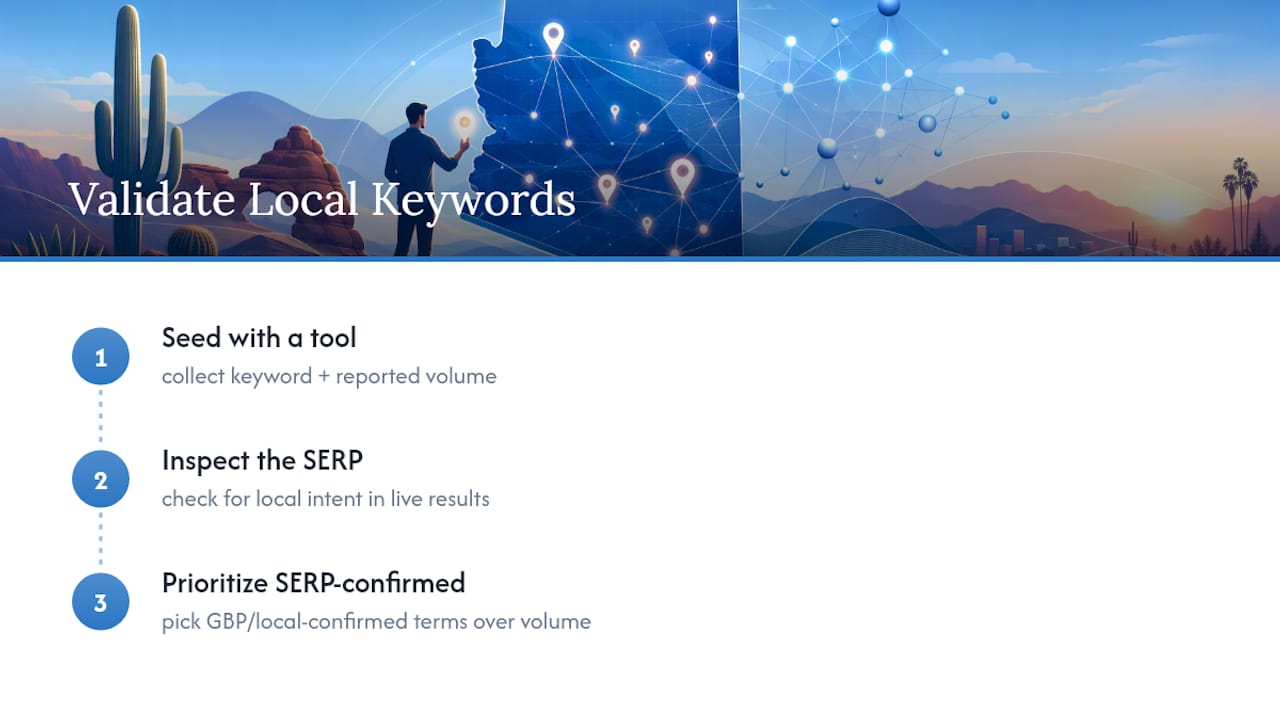
The bigger blind spot is small-town bias. Business owners in smaller Arizona communities see “0 search volume” and assume nobody’s looking, then abandon a page that would have brought in steady, low-competition business. Volume data undercounts thin markets constantly. If you have a real location or service area somewhere, that beats a national number every time.
Prioritize verification over volume, and prioritize your Google Business Profile over another blog post. Most small businesses have more unclaimed opportunity sitting in an underoptimized GBP listing than in any keyword they have not targeted yet.
— Brett
Get a Local Keyword Audit Built for Your Arizona Business
Webtechs is the practical alternative to piecing this together yourself with a stack of free tools and guesswork. A local keyword audit from our team delivers a finished keyword-to-page map, a Google Business Profile optimization checklist built around your actual services, and a tracking setup so you know within weeks whether it’s working, not months.

This fits single-location small businesses and service-area providers across Scottsdale, Phoenix, and Tempe who need a plan that reflects how their real customers search, not a templated report. You can see how this plays out in practice in our portfolio of local client work, including case studies with measurable ranking gains. If you’re ready to see where your business currently stands, request a local keyword audit and get a clear roadmap instead of another spreadsheet of untested guesses.
Sources
A few resources worth bookmarking as you build out your own process:
- Local SEO Keyword Research: 5 Steps + Free Template
- Local SEO keyword research: A step-by-step guide
- Local SEO: The Complete Guide
- How to Find and Use Local Keywords for Better SEO
FAQ
Is SEO Dead Now With AI Overviews and Chatbots?
No. AI Overviews and chat-based search still pull from indexed, well-structured local content, so pairing specific service and location phrasing with strong local signals actually improves your odds of being cited.
How Much Should I Pay for Local SEO Services?
Costs vary widely based on how competitive your market and service are, and local SEO services are typically structured as ongoing monthly services rather than one-time fees, since rankings require continued monitoring and adjustment.
Can I Do Local Keyword Research Myself?
Yes, especially for a single service and location using free tools like Google Autocomplete, Keyword Planner, and your own Google Business Profile reviews. The process gets more time-consuming with multiple locations or services, which is when many owners bring in outside help.
What Are Some Local Companies in Arizona Doing Local SEO Well?
Small businesses across Scottsdale, Phoenix, and Tempe that combine verified local keywords with a fully optimized Google Business Profile and consistent NAP information tend to see stronger Local Pack visibility than those relying on website content alone.
How Do I Handle Local Keywords for a Multi-Location Business?
Build a separate, uniquely written page for each location rather than one generic page with swapped city names, and map distinct keyword sets to each based on that specific area’s search behavior and competition.