
Claim These 8 Local Citations First for Arizona Businesses
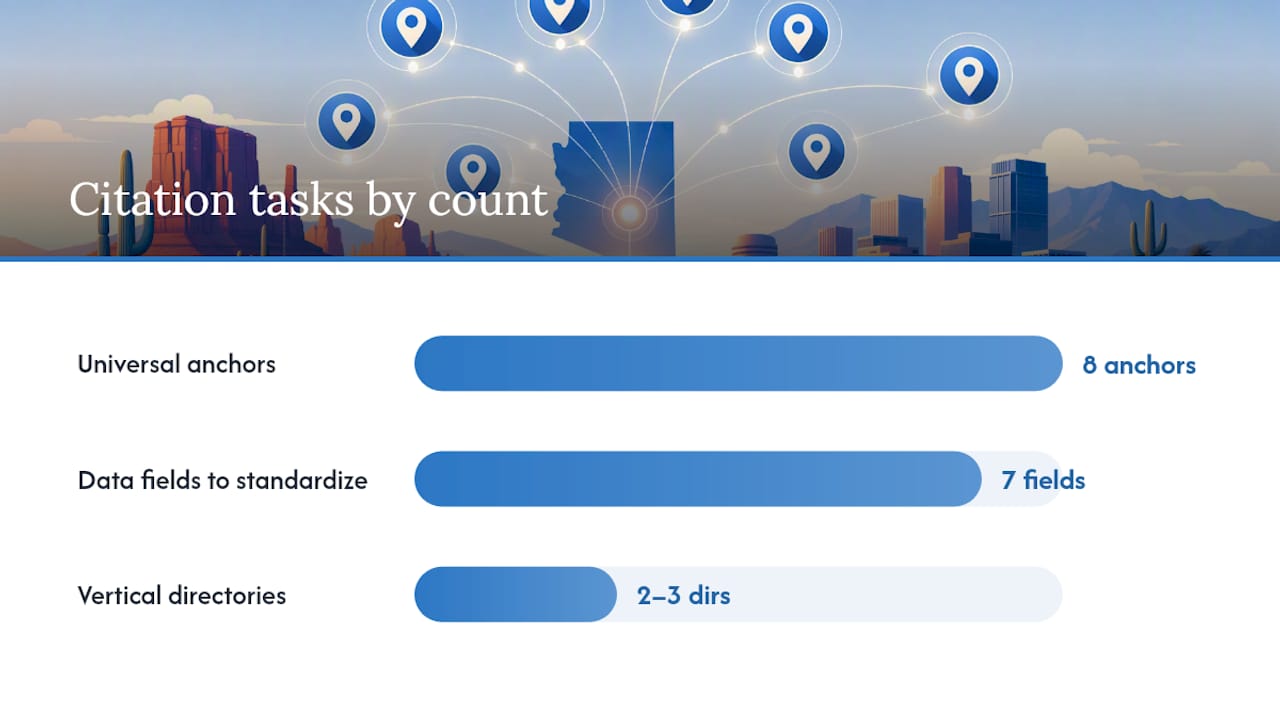
Claim Google Business Profile, Apple Business Connect, Bing Places, Facebook, Yelp, Foursquare, OpenStreetMap, and the Better Business Bureau before anything else, because these anchors feed the data pipelines that maps, voice assistants, and AI search tools pull from constantly. Get your name, address, and phone number identical across these sites, as this covers the foundational citations. Everything else on your local citations list, including Arizona-specific directories and industry-specific sites, builds on top of that base.
TL;DR:
- Claim and verify the Google Business Profile, Apple Business Connect, Bing Places, and Facebook listings first, as they directly influence search and map visibility.
- Prioritize industry-specific directories such as Yelp for restaurants and service providers, and vertical sites like Healthgrades or Houzz, which are more relevant for customer conversions.
- Incorporate Arizona-specific sources like regional chambers and state boards to boost local relevance and authority within the smaller data ecosystem.
- Maintain consistent NAP (name, address, phone number) data across all listings and continuously monitor for duplicates or outdated information every quarter.
- Consider professional citation audits for multiple locations or complex profiles to prevent data fragmentation and ensure ongoing accuracy in local search results.
Table of Contents
- The Universal Citation Sites Every Arizona Business Needs
- Industry-Specific Directories Worth Your Time
- Arizona-Specific Sources Every Local Business Should Check
- Your Step-by-Step Citation Workflow
- Managing Citations at Scale Without Losing Your Mind
- How Citation Work Fits Into a Scottsdale SEO Plan
- Why Citations Are Infrastructure, Not a Checklist You Finish
- Consider professional assistance to avoid sorting through dozens of directories. A full local citation audit can identify duplicates, mismatched NAP fields, and missing profiles across universal, vertical, and local listings, then claim and verify the ones that matter for your industry.
- Sources
- FAQ
The Universal Citation Sites Every Arizona Business Needs
These eight listings aren’t optional. They’re the backbone that data aggregators, GPS apps, and increasingly AI assistants like ChatGPT and Google’s AI Overviews scrape to answer “near me” searches. Getting these right first saves you from fixing bad data everywhere else later.
Google Business Profile is the one that matters most for showing up in Google Maps and the local pack. Claim it at business.google.com, verify using the available methods, and fill out every field: hours, categories, service area, photos, and attributes. A profile with only a name and address is incomplete.
Apple Business Connect is Apple’s answer to GBP and it powers Apple Maps, Siri results, and Apple’s search features. Scottsdale and Phoenix residents running iPhones (a huge share of the local market) will find you here or not find you at all. Claim it at businessconnect.apple.com using your Apple ID.
Bing Places still matters more than people assume. Microsoft’s search engine powers a meaningful slice of desktop searches, and Bing data also feeds some AI tools. Setup mirrors Google’s process almost exactly and can be completed quickly if your GBP listing is already built.
Facebook business pages function as a citation and a discovery tool. Customers check Facebook for hours, reviews, and photos before they check your website. Make sure your “About” section carries the exact same NAP data as everywhere else.
Yelp carries outsized weight for restaurants, home services, and retail. Even businesses that get no leads from Yelp directly benefit because Yelp’s data feeds other citation aggregators and its structured business data gets pulled by search engines.
Foursquare feels dated to consumers, but its API quietly powers location data behind the scenes for apps like Uber, Snapchat, and other services you’d never associate with a “directory.” Claiming it takes a short time and benefits you in many places behind the scenes that you might not directly see.
OpenStreetMap is the open-source map data source behind countless apps and services, including some GPS units and delivery platforms. It works differently from the others: you or a local mapping contributor edits your business directly onto the map. It’s less about “claiming a profile” and more about making sure your pin and details are accurate.
Better Business Bureau listings function as both a citation and a trust signal, particularly for service businesses where customers research reputation before calling. The Better Business Bureau accepts free basic listings and offers paid accreditation, and either level puts your NAP data on a domain search engines treat as highly authoritative.
Here’s the order I’d tackle these in if you’re starting from zero:
- Google Business Profile
- Bing Places
- Apple Business Connect
- Yelp
- Foursquare
- Better Business Bureau
- OpenStreetMap
Pro Tip: Keep a simple spreadsheet with your exact NAP formatting (suite number style, phone format, business name with or without “LLC”) before you touch a directory. Copy and paste from that sheet every time to maintain consistency and avoid confusing aggregators.
Claiming and verifying these accurately increases the odds that search engines and AI tools display correct business information instead of pulling stale or duplicate data from somewhere else.
Industry-Specific Directories Worth Your Time
Universal listings get you found. Vertical directories get you found by people already shopping in your category, which tends to convert better. Moz’s research on local ranking factors makes a point worth repeating: vertical relevance is more important than sheer volume. A landscaping company with a few relevant, well-filled vertical listings typically outranks competitors with many generic directories irrelevant to their category.
Here’s how the major verticals break down:
- Healthcare and medical practices: WebMD’s provider directory, Healthgrades, and Vitals carry real weight because patients specifically search these sites before booking.
- Legal services: Justia is close to mandatory for attorneys. Avvo and FindLaw round out the set for firms that want broader coverage.
- Home services and contractors: Houzz dominates for remodelers, designers, and contractors, especially anyone doing higher-ticket residential work. Angi and HomeAdvisor matter too, though lead quality varies by market.
- Real estate: Zillow, Realtor.com, and Trulia function as both citation sources and lead generators for agents and brokerages.
- Hospitality and restaurants: TripAdvisor, OpenTable, and Yelp (already on your universal list) carry the most weight, with TripAdvisor mattering more for anyone pulling tourist traffic, which matters plenty in a state that sees heavy winter visitor volume.
- Automotive services: RepairPal and CarGurus matter for repair shops and dealers respectively.
- Professional services (accountants, consultants): Clutch and industry association directories tend to outperform generic business listings.
A combined U.S. citation source list backs up this pattern: the strongest local citation strategies blend a handful of global anchors with a short, deliberately chosen set of American vertical directories rather than spreading thin across everything available.
If you’re not sure where to start, ask a different question than “which directories exist.” Ask “where do my actual customers go to compare options before they call me.” A Scottsdale med spa’s customers check Healthgrades and Google reviews. A Tempe HVAC company’s customers check Angi and Nextdoor referrals. Pick the two or three verticals that match your customer’s actual research habits, get those profiles complete, and skip the rest.
Arizona-Specific Sources Every Local Business Should Check
State and municipal directories don’t get the attention universal listings do, but they matter for two reasons: they’re often free, and they carry the kind of hyper-local relevance that generic national directories can’t replicate. BrightLocal’s state-by-state citation research confirms this pattern holds across markets: state-level and regional aggregators supply an important portion of the local data ecosystem that national directories do not cover.
For Arizona businesses, start with these categories:
- Better Business Bureau serving the Pacific Southwest — Arizona businesses fall under a regional BBB chapter, and that regional listing carries more local relevance than a generic national profile alone.
Finding these sources takes some searching. Try queries like “[your city] business directory,” “[your industry] Arizona association,” and “[your city] chamber of commerce members” to surface options a generic citation checklist would never mention.
Pro Tip: Call your local chamber directly and ask whether their directory listing is included with membership or requires a separate opt-in. Some chambers bury the directory feature behind a setting members never activate, which means paying dues without getting the citation.
Your Step-by-Step Citation Workflow
Building a full local citations list from scratch feels overwhelming until you break it into a sequence. Here’s the order that actually works, based on what moves the needle first.
- Audit what already exists. Search your business name plus city across Google, and check existing profiles on the universal sites listed above. You’re looking for duplicates, outdated addresses, old phone numbers, and any listing you didn’t create yourself (these show up more often than owners expect, especially after a move or rebrand).
- Standardize your NAP data in one document. Write out your exact business name, address format, and phone number the way you want it to appear everywhere, then treat that document as gospel. Academic citation guides recommend exactly this kind of documented, consistent formatting for a reason: consistency is what makes a source trustworthy, whether it’s a research paper or a business listing.
- Fix or remove duplicates before adding anything new. Adding fresh listings on top of conflicting old ones just multiplies the confusion.
- Claim and verify the eight universal anchors in the order covered earlier.
- Layer in two to three vertical directories relevant to your industry.
- Add Arizona-specific sources, starting with your local chamber and any required licensing directories.
- Set a recurring reminder to re-check every listing quarterly, since data drifts even after you’ve done everything right the first time.
The data fields worth standardizing before you touch a single directory:
- Business name exactly as it appears on your tax documents (with or without “LLC”)
- Complete street address, including suite number formatting
- Phone number in one consistent format
- Website URL (use your canonical version, with or without “www”)
- Business hours, including holiday exceptions if you track them
- Primary and secondary business categories
- A short business description you’ll reuse across profiles
Pro Tip: Keep your website’s own structured data markup in sync with your citation data too. The LocalBusiness schema on your site should list the exact same name, address, and phone number as your Google Business Profile, since mismatched on-site and off-site data sends a confusing signal to search engines.
If you want a broader view of how citation work fits into a full local SEO plan rather than standing alone, our small business SEO checklist walks through the surrounding pieces, including reviews, on-site content, and link building.
Managing Citations at Scale Without Losing Your Mind
Citation work doesn’t end once you’ve claimed your listings. Semrush’s listing management research makes the case plainly: NAP data gets scraped and redistributed constantly across the web, which means listings you didn’t touch can still change without your knowledge. A data aggregator picks up an old address, a directory auto-generates a duplicate profile, or a well-meaning customer edits your Google listing incorrectly. None of that requires action from you, but all of it requires monitoring from you.
Run a light audit at least quarterly, checking for NAP mismatches, duplicate listings, and missing attributes like updated hours or new service categories. Regular checks catch problems before they impact rankings.
Your toolkit here splits into three tiers:
- Free manual checks: Search your business name plus city in Google, scan your GBP dashboard for suggested edits, and periodically Google “[your business name]” plus “[your address]” to spot rogue duplicates.
- Listing management platforms: Services that push updates across dozens of directories simultaneously save real time once you have more than a handful of locations or listings to track. Our guide to local SEO tools breaks down the options worth considering.
- AI-specific citation audits: As AI search tools increasingly pull business data for conversational answers, tools built specifically for AI discoverability, like BabyLoveGrowth’s citation audit, check whether your listings are structured in a way models can actually parse and cite correctly.
There’s no fixed number of listings you need to hit. Moz’s guidance is direct about this: quality and relevance beat volume every time, and chasing hundreds of low-authority directories wastes time that’s better spent perfecting the dozen that actually matter. If your business runs multiple locations, or you’ve simply run out of hours in the week to check listings quarterly, that’s the point where a managed service starts paying for itself instead of costing you.
How Citation Work Fits Into a Scottsdale SEO Plan
Citations rarely move the needle alone. They work as one piece of a coordinated local SEO effort, and this approach has been applied for Scottsdale-area clients since 1997: pairing citation cleanup with broader on-site and off-site work that determines whether a business shows up when a nearby customer searches.
A clean, consistent citation footprint gives every other local SEO effort, from Google Business Profile optimization to content and review strategy, something solid to build on. When the foundational data is wrong, everything stacked on top of it inherits that error.
Local SEO engagements that handle citation work alongside broader optimization often include:
- Auditing existing NAP data across universal and vertical directories to catch inconsistencies before they spread further
- Coordinating internal linking and on-site structured data so citation signals and website signals match
- Claiming and verifying the core universal anchors, then layering in relevant vertical and Arizona-specific sources
- Ongoing monthly monitoring to catch new duplicates or scraped errors before they affect rankings
Businesses that combine a clean citation footprint with the rest of a local SEO plan tend to see gains in both visibility and direct customer engagement, though results vary by industry, competition, and starting condition. If your current listings are a mess and you don’t have the bandwidth to sort through dozens of directories one at a time, that’s exactly the kind of work worth requesting a managed audit for.
Why Citations Are Infrastructure, Not a Checklist You Finish
Most guides treat citations like a project with an end date: build the list, claim the sites, move on. That framing is wrong, and it’s why so many Arizona small businesses end up with outdated listings two years after “finishing” their citation work. Treat it instead like plumbing. Nobody thinks about plumbing until something backs up, and by then the damage is already visible to everyone walking through the door.
Arizona’s data ecosystem deserves particular attention because it’s smaller and more fragmented than a major metro’s. A handful of chamber directories, city resources, and regional aggregators carry outsized weight here compared to a market like Los Angeles or Chicago, where national directories drown out local ones. That’s an advantage if you claim these sources early, and a blind spot if you ignore them entirely.
DIY works fine for a single-location business with the patience to check listings quarterly. Once you’re managing multiple locations, multiple verticals, or you simply keep discovering duplicate listings you never created, that’s the signal to hand the monitoring to someone whose job is to catch it.
— Brett
Consider professional assistance to avoid sorting through dozens of directories. A full local citation audit can identify duplicates, mismatched NAP fields, and missing profiles across universal, vertical, and local listings, then claim and verify the ones that matter for your industry.

Deliverables typically include a documented list of what was fixed, claimed, and what is being monitored going forward, integrated into broader local SEO and web design efforts for small and mid-sized businesses in the region. If your citation footprint is scattered across old addresses and duplicate profiles, or you’ve simply never had the time to check, take a look at our portfolio of local SEO and web design work and request a citation audit as your next step.
Sources
For anyone who wants to verify these recommendations or dig deeper, a few sources cover the ground well: BrightLocal publishes regularly updated state and national citation lists with domain-authority context, Semrush breaks down listing management mechanics in detail, Moz covers the ranking-factor research behind quality-over-quantity guidance, schema.org documents the LocalBusiness structured data standard, and the BBB remains a straightforward authority signal worth claiming directly. Running your own periodic audit against these sources beats trusting any list, including this one, as permanently accurate.
FAQ
What Is a Local Citation, Exactly?
A local citation is any online mention of your business name, address, and phone number, typically on directories, maps, and platforms like Google Business Profile, Yelp, or the Better Business Bureau. Search engines and AI tools cross-reference these mentions to verify your business is real and located where you claim.
How Many Citations Does My Business Actually Need?
There’s no fixed number to hit. Moz’s ranking factor research recommends focusing on a small set of consistent, high-quality listings on sites your customers actually use rather than chasing volume across low-authority directories.
Which Citation Sites Should Arizona Businesses Claim First?
Start with Google Business Profile, Apple Business Connect, Bing Places, Facebook, Yelp, Foursquare, OpenStreetMap, and the Better Business Bureau, then add two or three vertical directories and a chamber of commerce listing in Phoenix, Scottsdale, or Tempe.
How Often Should I Audit My Citations?
Run regular checks, since NAP data gets scraped and redistributed constantly and can change without your knowledge, per Semrush’s listing management guidance.
Can I Build My Citations List Myself, or Should I Hire Someone?
A single-location business with time to check listings quarterly can handle this manually. Businesses managing multiple locations, several verticals, or recurring duplicate listings usually benefit from a managed audit, which is the kind of work Webtechs provides for Scottsdale-area clients.