

Website Copy Audit: A Step-by-Step Guide for 2026
A website copy audit is a structured read of the words on your site, done to find what is unclear, what is missing and what is quietly costing you leads. You can run a useful one in an afternoon with a spreadsheet, a stopwatch and a few honest strangers. This guide gives you the method, the checklist and the rules for deciding what to rewrite first.
TL;DR
- A copy audit judges whether each page makes a clear offer to a specific reader and asks for a next step. It is not a grammar check.
- Start with the 5-second test on your homepage, then score every important page on the same few criteria.
- Fix the pages closest to revenue first: homepage, top service pages and paid landing pages.
- Automated tools can flag long sentences, jargon and vague claims. They cannot tell you whether a real visitor feels the page helped.
- Rewrite, then wait weeks, not days, before judging the result.
Table of Contents
- What a website copy audit actually covers
- Before you start: set up the audit
- The 5-second test
- The page-by-page checklist
- Auditing the homepage
- What about service pages and landing pages?
- Don’t forget page experience and accessibility
- Score, rank and decide what to fix
- Can software or ChatGPT do the audit for you?
- Perspective: why most copy audits find the same three problems
- When to bring in help
- After the rewrite: measure and be patient
- FAQ
- Sources
What a website copy audit actually covers
Most people confuse a copy audit with a content audit. They overlap, but they answer different questions.
A content audit is an inventory. You list every URL, note its traffic, age and owner, and decide whether to keep, update, merge or remove it. The American Marketing Association’s audit template is a spreadsheet built for this, and Yale’s guide to content audits walks through the same inventory approach for large sites.
A copy audit goes deeper into the words on the pages that matter. According to one copy-audit tool’s published criteria, a thorough review looks at headline clarity and specificity, benefit-led versus feature-heavy framing, the strength of calls to action, voice consistency and how well the page handles objections. That list is a good spine for a manual audit too.
In practice you do both, in order. The content audit tells you which pages exist. The copy audit tells you which of them are worth the effort of improving.
Before you start: set up the audit
Spend twenty minutes on setup. It saves hours later.
- Pick the pages. For a small business site, list the homepage, every main service page, the about page, the contact page and any page you send paid traffic to. Ten to fifteen pages is plenty for a first pass.
- Pull one number per page. Use Google Analytics and Search Console to note visits, and, if you track it, how many visitors call, fill a form or buy. A page with traffic and no action is a copy problem. A page with no traffic is usually a different problem.
- Write down the reader. One sentence per page: who lands here, what they searched for and what they want to do next. If you cannot write that sentence, the page probably cannot either.
- Build the sheet. Columns: URL, reader, main promise, criteria scores, top fix, effort, priority.
If the site is old, fix the technical foundation in parallel. Our technical SEO audit guide covers crawl, indexing and speed checks that sit alongside this work.
The 5-second test
Run this first, because it is the fastest way to find out whether you have a copy problem at all.
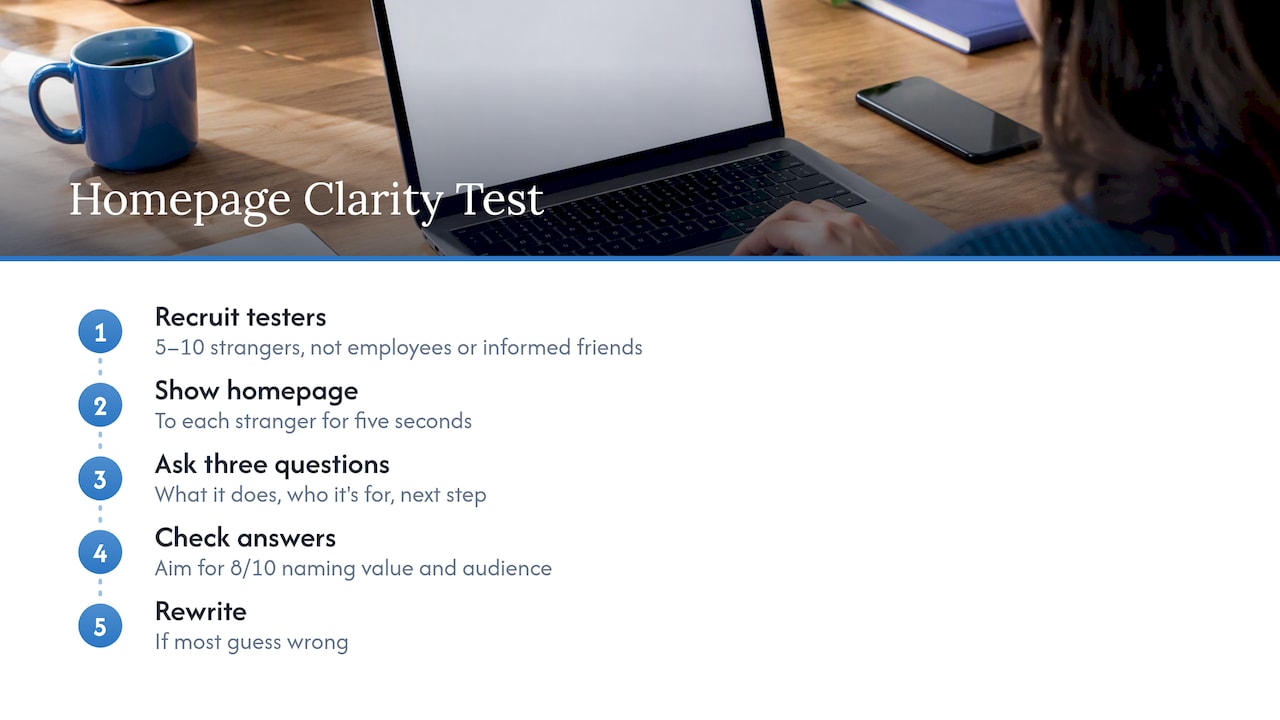
Show your homepage to someone who has never seen it, for five seconds. Then hide it and ask three questions: What does this company do? Who is it for? What would you do next?
The 5-second test appears in published copy-audit criteria as a standard check on whether a visitor can grasp the offer almost immediately. Copywriting teacher Joanna Wiebe of Copyhackers is cited in one analyzer’s guidance as recommending that around 8 out of 10 strangers should be able to name the value and the audience within seconds. Treat that as a useful target rather than a law of nature.
Use people who are not your employees, friends who know your business or your mother. Five to ten strangers is enough to see a pattern. If most of them guess wrong, you have just found your first rewrite.
Why owners fail their own test
The usual cause is the curse of knowledge. You know your trade so well that you write for yourself. Words such as “solutions,” “full-service” and “quality” feel meaningful to you and tell a stranger nothing. The fix is almost always the same: replace the category word with the specific thing you do, for whom, and where.
The page-by-page checklist
Score each page from 1 to 3 on each line: 1 means a clear problem, 2 means acceptable, 3 means strong. Be harsh. A score you cannot defend with a quote from the page is a guess.
Headline and opening
- Does the headline say what you offer, or only gesture at a feeling?
- Does the first paragraph confirm the reader is in the right place (service, location, type of customer)?
- Could a competitor paste your headline onto their site unchanged? If yes, it is too generic.
Specifics and proof
- Are there concrete numbers: years in business, turnaround times, counts of projects, named results?
- Are claims backed by something a reader can check, such as a testimonial with a name, a case study or a portfolio?
- Is jargon explained or removed?
Automated tools commonly flag the same weaknesses. One tool’s criteria mention sentences averaging more than 24 words, a lack of concrete numbers and dense jargon. You do not need software to check this. Read the page aloud. Wherever you run out of breath, split the sentence.
Benefits over features
A feature says what you have. A benefit says what the reader gets. “Mobile-friendly design” is a feature. “Customers can book from their phone in the parking lot” is a benefit. Mark each paragraph F or B. If a page is mostly F, rewrite it.
Objections and trust
- What would make a hesitant buyer leave? Price, timing, risk, switching hassle?
- Does the page answer that near the point where the doubt arises, not in a footer?
- Is there a guarantee, a process description or an FAQ that lowers the perceived risk?
Calls to action
- Is there one clear primary action per page?
- Does the button say what happens? Action-oriented labels beat passive ones like “Submit,” which is the example the audit criteria above use.
- Is the action repeated after the reader has been persuaded, not only at the top?
Voice and consistency
- Do the homepage, service pages and about page sound like the same company?
- Do you switch between “we” and the third person, or between formal and casual?
- Do the same services have the same names everywhere?
Search fit
- Does the page use the words customers type, in the title, the headline and the body, without stuffing?
- Does it answer the question behind the search, or only mention the topic?
Google’s own guidance frames the goal as a satisfying experience for the visitor. Content that does not meet a visitor’s expectations is expected to perform worse. That is a good tiebreaker for every copy decision: would the reader leave feeling they got what they came for?
Auditing the homepage
The homepage deserves its own pass because it serves the widest mix of visitors. If you are wondering how to write a homepage from scratch, or how to judge the one you have, check these elements in order.
| Element | What good looks like | Common failure |
|---|---|---|
| Headline | Names the service, the customer and ideally the place | A slogan that could belong to any business |
| Subheadline | One or two sentences on how you help and what makes you different | Repeats the headline in longer words |
| Primary call to action | One button with a specific label, visible without scrolling | Three competing buttons, or “Learn more” |
| Proof | Named testimonials, years in business, results, a link to your portfolio | Unattributed praise, or none |
| Service overview | Short blocks that each link to a service page | A wall of text, or a list of buzzwords |
| Objection handling | Process, timeline, guarantee or FAQ | Silence |
| Closing action | A repeat of the main call to action plus contact details | A footer with only legal links |
These are the same principles covered, with a design lens, in our guide to homepage design best practices for Arizona small businesses. For a look at what strong copy looks like on the page, see these website copywriting examples.
A quick structure for rewriting
If the homepage fails, a simple Problem, Agitation, Solution outline is a reliable starting point, and it is the framework Copyhackers-inspired guidance recommends for testing a value proposition. Name the problem your customer has in their words. Say what it costs them if it stays. Then show how you solve it and what to do next. Keep each step to a few sentences.
What about service pages and landing pages?
Service pages usually carry the most commercial intent. Someone searching for a specific service is closer to buying than someone reading your homepage. Audit them with the same checklist, then add three questions:
- Does the page name the service and the location in the way customers search?
- Does it say what is included, how it works and how long it takes?
- Does it end with a specific next step?
We cover this in depth in our piece on service page copywriting that converts.
Paid landing pages are stricter still. The reader arrived on a specific ad promise, so the headline must match it, and there should be few exits. If you spend on search ads, audit those pages before you raise the budget. Our PPC landing pages playbook shows what to look for.
Don’t forget page experience and accessibility
Good words on a slow or hard-to-use page still lose readers. Google publishes target thresholds for Core Web Vitals, which measure loading, interactivity and visual stability. Google also says that page experience is one of many signals and that site owners should not focus on only one or two aspects. A good score does not guarantee high rankings.
For your audit, that means two cheap checks per page: does it load quickly on a phone, and can everyone read it? Low-contrast text, vague link labels such as “click here” and missing image descriptions are copy problems and accessibility problems at once. Our web accessibility checklist covers the WCAG and ADA steps.
Score, rank and decide what to fix
An audit that ends with a long list of problems gets shelved. End with a ranked list instead.
- Total the scores for each page.
- Multiply by value. Give each page a weight of 1 to 3 based on how close it sits to revenue. The homepage, top service pages and paid landing pages get a 3.
- Estimate effort as small (edit a headline), medium (rewrite a section) or large (rebuild the page).
- Sort by low score, high value and small effort. Those are your first moves.
A typical result: the homepage headline and call to action, two service page openings and the contact page. That is a week of focused work, not a rebrand.
If the audit turns up pages with no traffic, no purpose and thin content, do not rewrite them by reflex. Decide whether to merge, redirect or remove them, and do it carefully. Our guide to content pruning decisions explains how to do that without hurting the rest of the site. For a broader view of where to focus after an audit, see our notes on prioritizing conversion rate fixes.
Can software or ChatGPT do the audit for you?
Partly. Tools are good at the mechanical layer: sentence length, readability, missing numbers, vague words, inconsistent terms. They are fast, and they give you a first list to react to.
They are weak at the human layer: whether your offer is believable, whether your price positioning fits your market, whether the page matches what your customers actually say on the phone. Google’s guidance points the same way, with the satisfying experience of the reader as the aim, and the helpful content guidance warns against writing for scores instead of people. Use tools for the first pass, then let strangers and your own sales conversations settle the questions that matter.
Perspective: why most copy audits find the same three problems
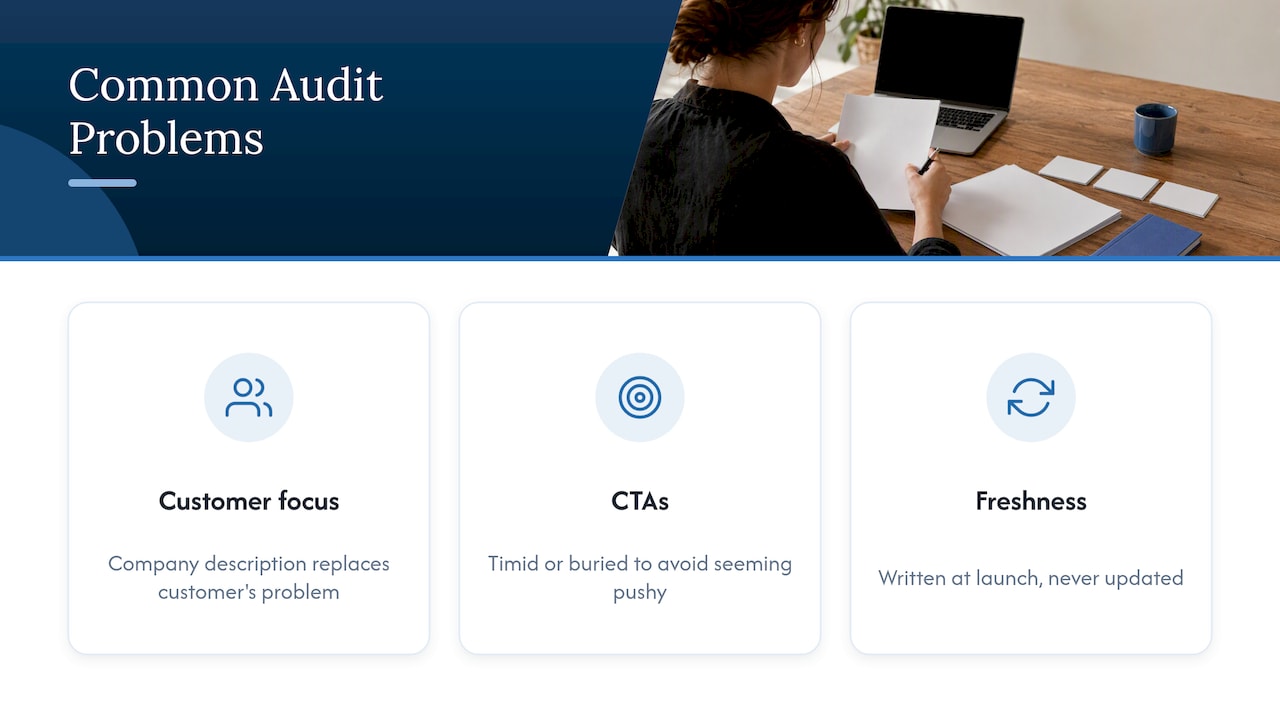
We have been building and marketing small business websites since 1997, and the pattern is stubborn. Nearly every audit lands on the same three things.
First, the site describes the company instead of the customer’s problem. “We are a family-owned provider of quality solutions” says nothing a reader can use. Second, the calls to action are timid or buried, because the owner does not want to seem pushy. Third, the pages were written once, at launch, and never touched again, while the business moved on.
The fix is rarely clever writing. It is plain specifics: what you do, for whom, how it works and what to do next, written the way you would explain it across a table. We also push owners to keep the copy and the search plan together. A beautiful page nobody finds and a well-ranked page nobody understands fail in the same way.
One more thing: do not audit once and forget. Put it on the calendar, once or twice a year, and after any change to your services or pricing.
— Brett
When to bring in help
You can do this audit yourself. Bring in help when the findings outgrow your time: many pages need rewriting, the site needs a redesign to support new copy, or the copy needs to be tied to an SEO plan.
We handle that under one roof. Our SEO content writing services cover rewriting pages so they read well to customers and match how people search. If the audit shows the layout is the bigger problem, our website design and re-design work is the next stop. You can also see our portfolio first. If you want a human opinion on your pages before you commit to anything, contact us through our site.
If you are unsure whether you need writing or something broader, our comparison of copywriting and content writing clears up the difference, and improving your website’s content outlines the broader approach.
After the rewrite: measure and be patient
Change one set of pages at a time so you can tell what worked. Record the before numbers, then compare actions per visit, not just traffic.
Search results lag. Google’s SEO starter guide notes that some changes take effect in hours while others can take several months, and it suggests waiting a few weeks before judging whether your work helped. Conversions from existing visitors, on the other hand, can move faster, so watch calls and form submissions too.
FAQ
What should a website copy audit include?
At minimum: headline clarity, a specific offer, benefits over features, proof, objection handling, call-to-action strength, voice consistency and search fit. Add a quick check of page speed and readability on a phone. Score each page the same way so you can compare them.
How long does a website copy audit take?
For a small business site with ten to fifteen key pages, plan an afternoon for the scoring and a few days to collect stranger feedback. The rewrite is the longer part, and it depends on how many pages score poorly.
How often should I audit my website copy?
Once or twice a year is a sensible rhythm for most small businesses. Do an extra pass after you change services, pricing or target customers, and before you start paid advertising to a page.
Can ChatGPT or a tool audit my website copy?
They can flag long sentences, jargon, vague claims and weak button labels quickly. They cannot judge whether your offer is credible or whether real visitors feel the page helped. Use them for a first draft of findings, then test with real people.
What is the difference between a copy audit and an SEO audit?
A copy audit judges whether the words persuade and inform a reader. An SEO audit checks technical health, indexing, links and keyword targeting. They work best together, since good copy on an unindexed page and a crawlable page with confusing copy both lose customers.
Sources
- Website Copy Audit Tool for Landing Pages
- Website Copy Analyzer
- AMA Website and SEO Content Audit Template
- How to Conduct a Content Audit, YaleSites
- Understanding Core Web Vitals and Google search results
- Understanding Google Page Experience
- Google’s August 2022 helpful content update
- SEO Starter Guide: The Basics