

Entity SEO: How to Make Google Understand Your Business

Entity SEO is the practice of making it unmistakable to search engines who you are, what you offer and how those things connect, instead of only repeating keywords on a page. For a small business, that means a clear business identity, consistent details across the web, structured data on your site, and one clear page for each topic. This guide shows you what that looks like in practice, including how duplicate and thin content get in the way.
TL;DR
- An entity is a distinct, identifiable thing: your business, you as an owner, a service, a city. Search engines map how these connect, and your site should make those connections obvious.
- Start with the basics: the same business name, address and phone number everywhere, plus Organization or LocalBusiness schema on your home page.
- Duplicate content rarely triggers a penalty. The real cost is split signals, so pick one canonical page per topic.
- Thin pages that say little weaken your coverage. Merge them or build them out with real substance.
- Link related service, person and location pages to each other so the whole site reads as one coherent picture.
Table of Contents
- What an entity is, in plain terms
- Entity SEO vs. keyword SEO
- The signals that define your business as an entity
- Duplicate content and entity SEO
- Thin content: the other side of the problem
- A practical entity SEO checklist for a local business
- Entity SEO and AI search
- Our perspective
- When to bring in help
- FAQ
- Sources
What an entity is, in plain terms
An entity is a uniquely identifiable thing: a person, a company, a product, a place or a concept. Search Engine Land’s guide to entity-first optimization describes entities as the named people, products and concepts that make up Google’s Knowledge Graph, and says Google now understands meaning through them and the relationships between them.
Think about the word “Phoenix.” It could be a city, a mythical bird, a basketball team or a software product. A keyword alone cannot tell which you mean. An entity-aware search engine uses the surrounding context to decide. That is called disambiguation, and it is the heart of entity SEO.
The same thing happens to your business. If your name is shared with another company in another state, or your services are described in vague terms, a search engine has to guess. Entity SEO removes the guessing.
Entity SEO vs. keyword SEO
The two are not rivals. HubSpot’s explainer puts it well: keyword SEO targets the words people type, while entity SEO targets the concepts behind those words.
| Keyword-focused approach | Entity-focused approach | |
|---|---|---|
| Starting point | A phrase people search | A real thing the phrase refers to |
| Page goal | Match the phrase | Make the topic unambiguous and complete |
| Typical tactic | Repeat variations of the phrase | Define the topic, cover related subtopics, link them |
| Business identity | Often an afterthought | Core signal: name, address, profiles, schema |
| Risk | Near-duplicate pages for each variation | Fewer, stronger pages |
You still research keywords. You just stop treating each variation as its own page.
The signals that define your business as an entity
Consistent identifiers
Your business name, logo, address, phone number and social profiles should read the same everywhere: your site, Google Business Profile, directories, social accounts and press mentions. Search Engine Land’s entity SEO guide is built around this idea, because consistent mentions help search engines avoid attributing your business to something else.
A quick audit takes an afternoon. List every place your business appears and check for differences such as “LLC” in one place and not another, an old suite number, or a retired phone line. Fix what you control and request edits on what you do not.
Structured data
Structured data is a standard format for giving search engines explicit clues about a page. Google’s documentation on how structured data works explains that you add it so Google can better understand a page’s content, and that it can make a page eligible for richer search appearances. It does not guarantee those appearances.
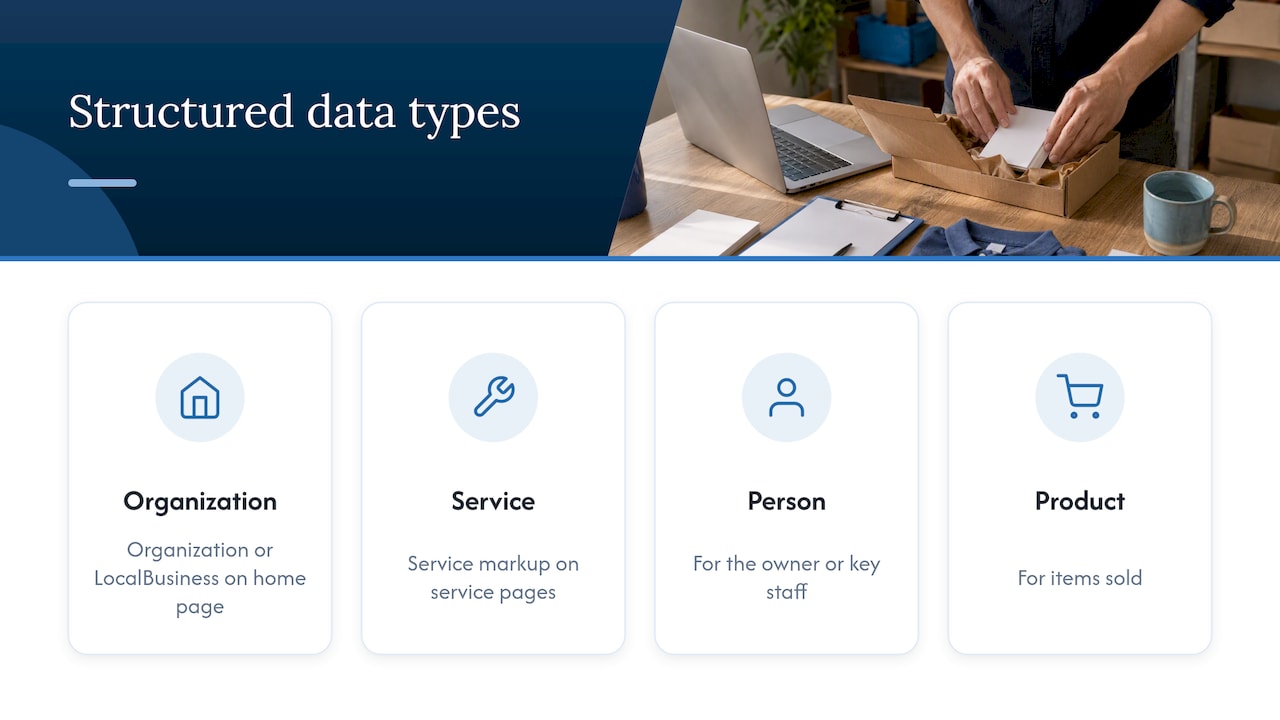
For most small businesses, the types that matter are Organization or LocalBusiness on the home page, Service on service pages, Person for the owner or key staff, and Product if you sell items. Google’s Organization markup documentation notes that adding it to your home page can help Google understand your organization’s details and disambiguate it from others.
The property worth knowing is sameAs. It lists the URLs of your official profiles, so you are saying plainly that your website and those profiles describe the same business. Google’s Organization documentation covers the supported properties, and it is the place to check before you ship anything.
If you run a local service business, we wrote a short walkthrough of one homepage change that fixes local business schema.
A connected site
A single page is not an entity. Your site as a whole describes one. Search Engine Land’s entity-first content guide stresses connecting related content so the relationships are visible. In practice:
- Your main service page links to its sub-services, and each of those links back.
- Location pages link to the services offered there.
- An about or team page names the people behind the business and links to what they do.
- Blog posts link to the service page they support, using descriptive anchor text.
We have seen how much structure matters. Our write-up on internal linking that produced a 1,620% lift and our site architecture case for Arizona small businesses show the approach in detail.
Duplicate content and entity SEO
Duplicate content means substantial blocks of content that match, or nearly match, other content on the same site or on others. Google’s own long-standing explanation of duplicate content notes that most of the time it is unintentional rather than malicious.
That matters because many owners fear a penalty. Search Engine Land’s complete guide to duplicate content says large amounts of it can hurt rankings, but the practical issue is usually less dramatic: when several URLs say the same thing, search engines have to pick one, and your signals get split across them.
This is an entity problem at heart. If three pages all claim to be “the” page about your water heater repair service, Google has to guess which one represents it.
Where duplicates come from on small business sites
- The same page reachable at www and non-www, or with and without a trailing slash.
- Tracking parameters creating new URLs for the same page.
- Near-identical city pages where only the city name changes.
- Service pages that overlap, such as “AC repair,” “air conditioning repair” and “AC repair services” each with their own page.
- Product or service descriptions copied from a manufacturer or another site.
- Printer-friendly or staging versions left indexable.
How to fix duplicate content
- Inventory your URLs. Crawl your site or review the pages report in Google Search Console to find clusters of similar pages.
- Decide the one page for each topic. This is your canonical page.
- Merge where pages overlap. Fold the useful content into the stronger page and redirect the weaker URL to it. Google’s guide to specifying a canonical URL lists redirects and
rel="canonical"annotations as strong signals, and sitemap inclusion as a weaker one. - Annotate what must stay. Where two URLs have to exist, such as a parameter version, point
rel="canonical"at the preferred one. - Keep your sitemap and internal links clean. Link to the canonical version, not the duplicate.
- Rewrite copied text. If your descriptions match a supplier’s, write your own.
City pages deserve special care. If you serve several areas, each page needs something real: local projects, service details that differ, local reviews, or staff who work there. Our multi-location SEO playbook covers how to scale this without producing clones.
Thin content: the other side of the problem
Thin content is a page that says too little to help anyone: a 100-word service blurb, a placeholder city page, a post that restates the headline. There is no magic word count. The test is whether the page fully answers what a visitor came for.
For entity SEO, thin pages hurt in two ways. They fail to establish what you know about a topic, and they often duplicate each other because there is only so much to say in a few sentences.
A practical way to handle them:
- Keep and expand pages that target a real need: add specifics such as process, pricing factors, examples, photos, and answers to common questions.
- Merge pages that cover near-identical topics into one thorough page.
- Remove or redirect pages that serve no purpose.
If you want a plan for building depth on a schedule, our SEO content strategy for Phoenix businesses lays out a practical sequence.
A practical entity SEO checklist for a local business
- Write a one-sentence description of who you are and what you do. Use it consistently on your home page, Google Business Profile and social bios.
- Standardize your name, address and phone number across every listing.
- Add Organization or LocalBusiness schema to your home page, with
sameAslinks to your official profiles. - Give each core service its own page, with Service schema where it fits.
- Add a real about page and bios for the people behind the business.
- Link service pages, location pages and supporting articles to each other with descriptive anchors.
- Resolve duplicate URLs with redirects and canonical tags.
- Expand or merge thin pages.
- Mention your business alongside the topics you want to be known for: reviews, local press, industry associations, community sponsorships.
- Revisit every quarter. Names change, profiles go stale, and pages accumulate.
Entity SEO and AI search
AI-powered answers need to decide which sources and businesses to name. A business with a clear identity, consistent details and well-organized content is easier for any system to describe correctly. We cannot promise any particular outcome from AI search, and nobody honestly can. What we can say is that the groundwork for entity SEO is the same groundwork that makes your site clear to people and machines alike. Our practical guide to AI search optimization goes deeper, and our five-step AI content and SEO workflow shows how we keep AI-assisted writing accurate and original.
Our perspective
We have been building websites and running SEO for small and mid-sized businesses since 1997, and the pattern we see most is not a lack of effort. It is a lack of clarity. A plumber has four near-identical pages for the same service, a different phone number on each directory, and no schema at all. Nobody did anything wrong on purpose. The site just grew without a plan.
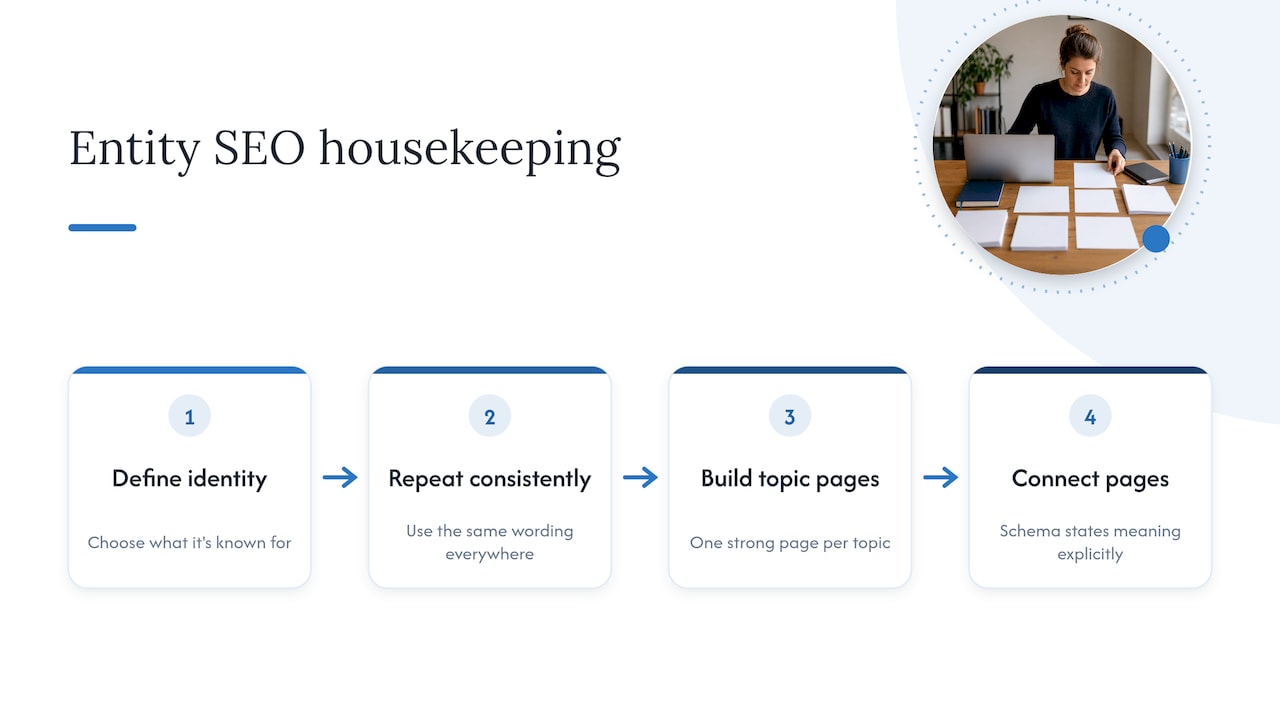
Our view is that entity SEO is mostly disciplined housekeeping with a clear point of view. Decide what your business is and what it is known for. Say it the same way everywhere. Give each topic one strong page. Connect the pages. Everything else, including schema, is a way of stating that more explicitly.
We also think owners should be skeptical of anyone who sells entity SEO as a secret trick. There is no shortcut, and no markup guarantees a ranking. The work is steady and unglamorous, and it compounds. When we restructure a site so that its pages support each other, the results tend to show it, as in our garage door repair case study.
When to bring in help
You can do the identity audit and basic schema yourself. Help is worth it when you have hundreds of URLs to untangle, several locations, a site rebuild on the horizon, or no one with time to maintain it all. Our SEO and local SEO services cover on-site and off-site optimization, Google Maps marketing and more, and we can handle the content side through our SEO content writing services. If you would like a straight conversation about where your site stands, get in touch with us.
FAQ
What is an example of an entity in SEO?
Your business is the simplest example. It has a name, an address, a type, services and related people and profiles. Other entities include you as the owner, a service such as water heater repair, and a city like Scottsdale. Search engines work out how they relate, and your site helps by stating those relations clearly.
Does duplicate content cause a Google penalty?
Usually not in the sense most people fear. Google’s own guidance says duplication is mostly unintentional. The practical cost is that signals get split across similar URLs and Google may choose a version you did not prefer. Redirects and canonical tags fix most cases.
Is entity SEO different from keyword research?
It builds on it. You still learn what people search, but you organize pages around the topic and the thing behind the phrase, not around every wording variation. That typically means fewer, deeper pages.
Do I need schema markup to do entity SEO?
It is not strictly required, but it is one of the clearest ways to state facts about your business. Google says structured data helps it understand a page, though it does not guarantee rich results. Pair it with consistent details and good content.
How do I know if I have thin content?
Read each page and ask whether a visitor with that question would leave satisfied. Pages with a few generic sentences, copied descriptions or only a swapped city name are the usual suspects. Combine or expand them.
Sources
- Entity SEO: The definitive guide (Search Engine Land)
- Entity-first SEO: How to align content with Google’s Knowledge Graph (Search Engine Land)
- Duplicate content and SEO: The complete guide (Search Engine Land)
- Entity-based SEO: An explainer (HubSpot)
- Intro to how structured data markup works (Google Search Central)
- Organization structured data (Google Search Central)
- How to specify a canonical URL (Google Search Central)
- Deftly dealing with duplicate content (Google Search Central Blog)