

Pillar Page vs Landing Page: Which One Does Your Business Need?
A pillar page and a landing page do different jobs. A pillar page is a deep, open educational resource built to win organic search traffic on a broad topic. A landing page is a focused page built to get one action from one visitor, usually after a click on an ad, an email or a search result. Most small businesses need both, and the mistakes start when one page is asked to do the other’s job.
This guide explains the difference in plain terms, shows where each page fits, and gives you a way to decide what to build first.
TL;DR
- Pillar page: a comprehensive guide to a broad topic that anchors a cluster of related pages and attracts search traffic over time.
- Landing page: a single-purpose page with one call to action, built to turn a specific visitor into a lead or a sale.
- Never gate a pillar page. Search engines need to read it. Landing pages, by contrast, are often gated on purpose.
- Paid ads go to landing pages, not to your homepage or a pillar. The match between ad and page affects what you pay per click.
- Build them as a pair: the pillar earns trust and traffic, the landing page captures the result.
Table of Contents
- What a pillar page is
- What a landing page is
- Pillar page vs landing page: the differences that matter
- Why they get confused
- When you need a pillar page
- When you need a landing page
- The money question: landing pages and ad costs
- Our perspective: treat them as a pair
- How to make them work together
- A worked example
- Common mistakes to avoid
- Where we can help
- FAQ
- Sources
What a pillar page is
A pillar page is a comprehensive resource on a broad subject. HubSpot describes it as the foundation of a topic, supported by related content that links back to it. The pillar covers the big subject at a high level, and the surrounding pages each answer a narrower question in detail.
That structure is called a topic cluster: one central pillar, many cluster pages, and internal links running both ways. The supporting pages link up to the pillar, and the pillar links out to each of them. That linking pattern is what separates a pillar from a long blog post. Length alone does not make a pillar. Architecture does.
A pillar page typically:
- Targets a broad, high-interest keyword, such as “commercial roofing” rather than “how to patch a flat roof leak.”
- Answers the whole topic in one place, with a table of contents so readers can jump around.
- Links out to deeper cluster pages for every subtopic.
- Stays open to everyone, with no form in front of it.
- Has a soft call to action, if any, because the reader is learning, not buying.
If you want the full mechanics of building the cluster around it, our guide to topic clusters for Scottsdale small businesses walks through the setup.
What a landing page is
Google’s own glossary defines a landing page as the page where people end up after clicking your ad. In marketing more broadly, the term covers any standalone page built for a campaign: a quote request, a free consultation booking, a download, a webinar signup.
The defining trait is focus. A good landing page has:
- One goal and one primary call to action.
- Little or no navigation, so visitors are not tempted to wander.
- A headline that repeats the promise that brought the visitor there.
- Proof close to the action: reviews, results, logos, guarantees.
- A short form, or a phone number and button, depending on how your customers prefer to buy.
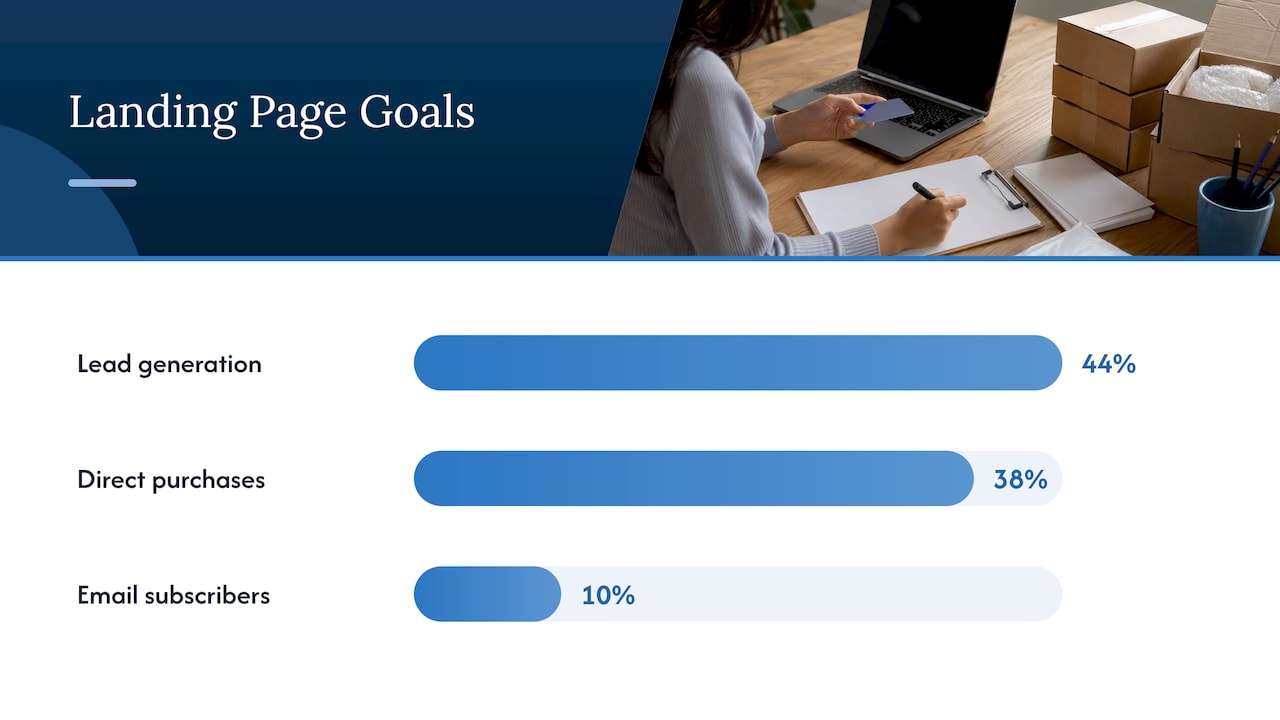
In a 2024 HubSpot survey of 101 marketing and advertising professionals, the main goals for landing pages were lead generation (44%), direct purchases (38%) and email subscribers (10%). The sample is small, so treat it as a snapshot, but it shows what these pages are for: getting a visitor to do something measurable.
Pillar page vs landing page: the differences that matter
| Pillar page | Landing page | |
|---|---|---|
| Main goal | Rank and educate | Convert one action |
| Visitor mindset | “I want to understand this” | “I am ready to act” |
| Typical traffic source | Organic search | Paid ads, email, social, sometimes search |
| Keyword scope | Broad topic | Specific offer or intent |
| Length | Long, often thousands of words | Short to medium, as long as the offer needs |
| Navigation | Full site menu, many internal links | Minimal, one path forward |
| Forms | None in front of the content | Common, often the whole point |
| Payoff timeline | Months, compounding | Immediate, measurable |
| Success metric | Rankings, organic sessions, links earned | Conversion rate, cost per lead |
The rows that cause the most trouble in practice are forms and navigation. A pillar page should not be locked behind a form, because that stops search engines from crawling the full content and defeats the reason you built it. A landing page with a full site menu and twelve links, on the other hand, gives visitors twelve reasons not to finish the form.
Why they get confused
The confusion is understandable. A pillar page can be styled like a landing page, with a hero banner and a bold button, and some practitioners treat it as one. The SEO side of the page is the same either way: it exists to match what a searcher wants to learn. A landing page, even a beautiful one, rarely has the depth to rank for a broad term.
The real test is intent. Someone searching “what is local SEO” wants to learn. Someone who clicks an ad for “local SEO company in Scottsdale” wants to compare providers and get in touch. Our search intent playbook covers how to read those signals on the results page. When you send the second person to the first kind of page, they read a bit and leave. When you send the first person to a sales page, they leave faster.
When you need a pillar page
Build a pillar page when:
- You sell something people research before buying. Roofing, legal help, dental implants, accounting, home remodeling and marketing services all fit. Buyers read first, then call.
- You already have, or plan, several related articles. A pillar without cluster pages is just a long article. The cluster is what signals topical depth.
- You want traffic that does not stop when the ad budget does. A pillar page keeps working month after month once it ranks, as long as you keep it current.
- You are competing in a crowded market. Owning the best answer to a broad question gives you a presence at the top of the funnel that competitors who only run ads do not have.
Plan your supporting content first. Our SEO content strategy for Phoenix-area businesses shows how to decide which topics deserve a pillar and which only need a single article.
When you need a landing page
Build a landing page when:
- You are paying for clicks. Every Google Ads campaign needs a destination that matches its ad groups.
- You have a specific offer. A free site audit, a seasonal discount, a booking for a specific service, an event.
- You send email or social campaigns. The click should go to a page dedicated to that message, not to a general page.
- You want to test. Landing pages are small enough to change a headline or button and measure the result in days, rather than waiting on search rankings.
For design specifics, see our guide to landing page design for Arizona businesses and the PPC landing page playbook.
The money question: landing pages and ad costs
This is where choosing the wrong page costs you real dollars. Google Ads treats landing page experience as part of Quality Score, the 1 to 10 diagnostic that helps determine how competitive your ads are and what you pay. Google describes Quality Score as a measure of how your ad quality compares with other advertisers, reported at the keyword level.
Google’s guidance on optimizing ads and landing pages says people who click an ad expect a page that is relevant to what they saw. If they do not find it right away, they are likely to leave. In practice that means:
- The page headline should echo the ad headline and the keyword.
- The call to action on the page should match the call to action in the ad.
- The page should load quickly on a phone, because most local searches happen there.
The costly mistake we see most is sending ad clicks to a homepage. A homepage has to serve every visitor, so it serves none of them well. A pillar page is no better as an ad destination. It is built to inform, and its length and many exits dilute the action you are paying for. If you suspect that is happening in your account, start with our Quality Score checklist.
Our perspective: treat them as a pair
We have built websites and run search marketing for small and mid-sized businesses since 1997. Over that time, the pattern has been steady: the businesses that get the most from their site do not choose between education and conversion. They decide which job each page has, and they link the pages so a visitor can move from one to the other.
Here is how we think about it with clients in Scottsdale and across Arizona:
- The pillar is your reputation page. It should be the page you would be comfortable having a stranger find first. If it reads like a brochure, it will not earn links, and it will not rank.
- The landing page is your closing page. It should be so clear that a visitor who has never heard of you knows within seconds what you offer, who it is for and what to do next.
- The bridge between them is a single, honest link. A pillar about home remodeling can end with a section on kitchen remodels, and that section points to a landing page for a free kitchen estimate. No pop-ups, no pressure. If the reader is ready, the path is there.
- Measure them differently. Judging a pillar by form fills, or a landing page by organic traffic, leads to bad decisions. Pillars are judged on rankings, qualified organic visits and assisted conversions. Landing pages are judged on conversion rate and cost per lead.
One more point from experience: most small businesses start with landing pages because ads give faster feedback, then add pillars when they want to stop renting traffic. That order is fine. What matters is that you eventually build both.
— Brett
How to make them work together
A simple flow works for most service businesses.
Step 1: Pick the broad topic and the offer
Choose the topic your best customers research before they call you, and the single offer you want to sell. For a plumber, the topic might be water heater replacement and the offer a same-day estimate.
Step 2: Build the pillar
Write the definitive guide to the topic: types, costs, timelines, mistakes, how to choose a provider. Keep it open, give it a table of contents, and plan cluster pages for each subtopic, such as tankless vs tank, permit rules and signs of failure.
Step 3: Publish the cluster and link it up
Every supporting page links to the pillar, and the pillar links to each of them. That two-way structure is what topic cluster guidance describes as signaling topical authority to search engines.
Step 4: Build the landing page
Create a page for the offer with one goal, one form or button, proof and a headline that mirrors your ad copy. If you will use video, think about what shows the offer best. Short, authentic-feeling clips are one option, and tools for UGC-style video for landing pages can help teams produce them without a studio. HubSpot’s survey notes that multimedia elements like video, images and social icons can help conversion when used well.
Step 5: Connect the two
Place contextual links from the pillar and the most relevant cluster pages to the landing page, at points where the reader would naturally want to act. Keep the landing page itself free of distractions.
Step 6: Send paid traffic to the landing page only
Point each ad group to the landing page that matches it. If you run several services, you need several landing pages, not one generic one.
Step 7: Review quarterly
Check which cluster pages bring organic visitors who then click through, which landing pages convert, and where the drop-offs are. Update the pillar when facts change, since an outdated pillar loses trust and rankings.
A worked example
Imagine a Scottsdale HVAC company.
- Pillar: “The Complete Guide to Air Conditioning in the Arizona Desert,” covering system types, sizing, maintenance schedules, energy use, repair vs replace, and how to choose a contractor.
- Cluster pages: “Signs your AC is failing in summer,” “How often to service your system,” “Heat pump vs central AC,” “What a replacement quote should include.”
- Landing pages: one for “AC repair, same-day appointments” tied to a search ad group, another for “free replacement estimate” tied to a different group.
A homeowner whose air conditioner dies in July clicks the repair ad and lands on the repair page, with a phone number at the top and a booking button. A homeowner researching an upgrade in March finds the pillar through organic search, reads three cluster pages, and eventually clicks through to the estimate page. Same business, two paths, each with the right page.
Common mistakes to avoid
- Gating the pillar. You lose crawlability and the trust that comes from giving the answer freely.
- Sending ad traffic to the pillar or homepage. You pay more per click and convert fewer visitors.
- Writing one page to do both. The result is long enough to confuse a buyer and thin enough to lose to real guides.
- Skipping the cluster. A pillar with no supporting pages is one long post.
- Using the same keyword on both. Give the pillar the broad term and the landing page the specific commercial one, so your own pages do not compete.
- Never updating. Pillars decay. Landing pages stale out as offers change.
Where we can help
We design landing pages and full websites, write the long-form content that pillars need, and manage the search and PPC campaigns that feed both. If you want one team to plan the cluster, build the pages and connect them to your ads, start with our SEO services for Scottsdale businesses, our custom website design or our SEO content writing. We do not publish prices for these services, so the quickest way to get a number is to tell us what you need through our site and we will scope it with you, without pressure.
FAQ
Is a pillar page a landing page?
Not in the marketing sense. A pillar page is built to educate and attract organic traffic, while a landing page is built to convert one action. Some people style pillars like landing pages, and that is fine for design, but the purpose, navigation and form usage still differ.
Can I use a pillar page for Google Ads?
It is rarely a good idea. Google evaluates landing page experience as part of Quality Score, and a broad educational page seldom mirrors a specific ad’s promise. A dedicated landing page usually costs less per click and converts better.
Which should I build first?
If you are running paid ads or need leads quickly, build the landing page first. If you are investing in long-term organic visibility, start with the pillar and its cluster. Many small businesses do the landing page now and the pillar over the next few months.
How long should each page be?
A pillar page is usually long because it must cover the whole topic, but it should be as long as the subject needs and no longer. A landing page should be as short as it can be while still answering the visitor’s questions about the offer, with proof and one clear action.
Should a pillar page have a call to action?
Yes, a gentle one. Link to the relevant landing page or contact page at natural points, but do not gate the content or interrupt reading with pop-ups. The reader came to learn, so earn the click first.
Sources
- Topics, pillar pages, and subtopic keywords (HubSpot Knowledge Base)
- Topic clusters: The next evolution of SEO (HubSpot)
- 13 Landing Page Types to Test and Pick for a Campaign (HubSpot)
- Landing page glossary entry (Google Ads Help)
- Evaluate the performance of your landing pages (Google Ads Help)
- About Quality Score for Search campaigns (Google Ads Help)
- Optimize your ads and landing pages (Google Ads Help)