
Small business owner setting up Google Ads
Written by webtechs

Google Ads for Small Businesses: Budget and Strategy Guide

Small business owner setting up Google Ads

Yes, Google Ads is worth it for most small local businesses — but only when you target the right campaign type and set a realistic budget from day one. Starter daily budgets typically run a modest amount, with many small businesses increasing their monthly spend as they learn what converts. If you have clear search demand for your service and can track phone calls or form fills, start with a Search campaign at a reasonable daily budget. If you’re short on time or not sure where to begin, Webtechs handles Google Ads setup and management for local businesses across Arizona.


Table of Contents

Is Google Ads the right fit for your small business?

Google Ads works best when people are already searching for what you sell. A plumber, locksmith, dental office, or roofing contractor tend to win because their customers have immediate needs and are ready to call. The ad shows up at exactly the right moment.

Locksmith planning Google Ads strategy with colleague

It’s a worse fit when search demand is thin or the math doesn’t work. If your average sale is modest and click costs are relatively high, you need a very high close rate just to break even. Niche B2B products, brand-new service categories, or businesses with razor-thin margins often find that the cost per acquisition outpaces what a customer is worth.

Run this quick diagnostic before you spend a dollar:

  • Does your core service have steady Google search volume? (Check Google Keyword Planner for monthly searches.)
  • Can you capture leads by phone or online booking — and track them?
  • Is your customer lifetime value (CLV) meaningfully higher than your target cost per acquisition (CPA)?
  • Do you have a dedicated landing page, or at least a service page that loads fast on mobile?
  • Can you commit to at least 30–60 days of consistent spend to let the campaign learn?

A simple CLV-to-CPA check: If your average customer spends significantly over their lifetime and your close rate on phone leads is reasonable, your maximum profitable CPA is the product of these factors. If your industry’s average CPC is moderate and your conversion rate is favorable, your CPA can be within a profitable range. If those numbers flip, fix the margin or the conversion rate before you run ads.


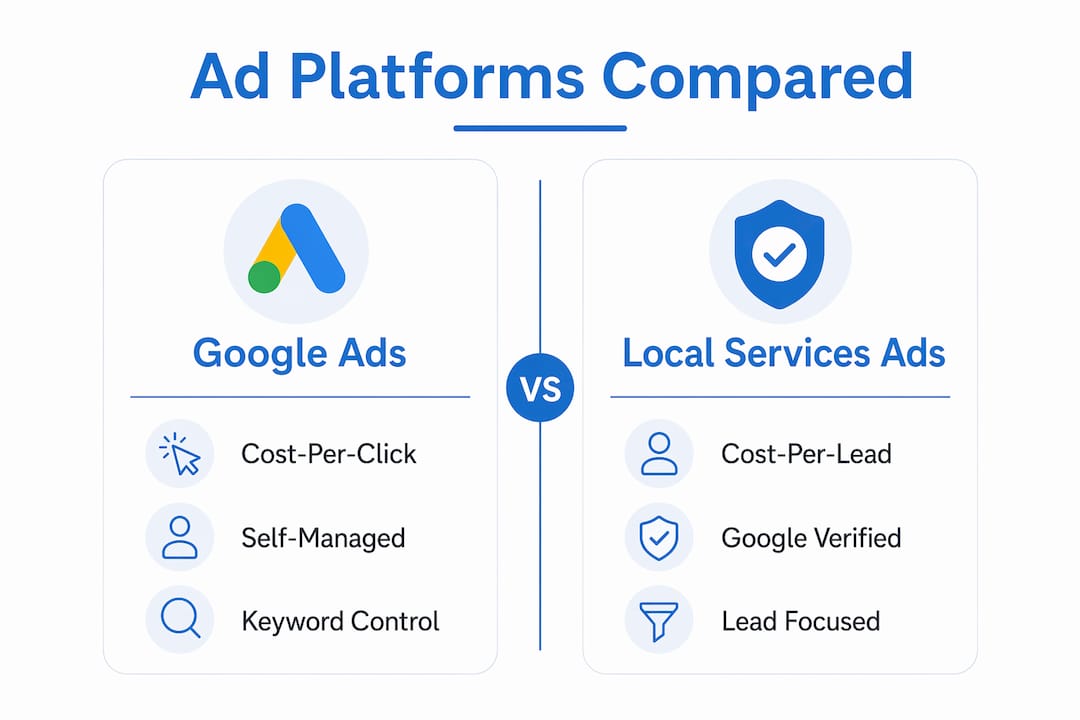
These are two different products with different pricing structures, different verification requirements, and different use cases. Confusing them is one of the most common mistakes local service businesses make.
Infographic comparing Google Ads and Local Services Ads

Google Ads (Search, Display, Performance Max) runs on a cost-per-click model. You write the ads, choose the keywords, set the bids, and pay every time someone clicks — whether or not they call you. Setup is more involved, but you control targeting, ad copy, and budget at a granular level.

Local Services Ads (LSAs) run on a cost-per-lead model. Google charges you only when a verified lead contacts you through the ad. LSAs require a background check and license verification, and they display a “Google Guaranteed” or “Google Screened” badge. They’re available for specific categories: home services (HVAC, plumbing, electrical, roofing, locksmiths), legal, financial, and a growing list of others.

Dimension Google Ads (Search) Local Services Ads
Best for Any local business with search demand Home services, legal, financial — verified categories
Pricing shape Cost per click ($2–$50+ depending on industry) Cost per lead (varies by category and market)
Setup complexity Moderate — keywords, bids, ad copy, extensions Low — profile, verification, budget cap
Time to launch 1–3 days 1–2 weeks (verification required)
Conversion measurement Online and offline (call tracking, form fills) Lead count via LSA dashboard
Google Guaranteed badge No Yes

When to use LSAs alone: You’re a plumber, electrician, or locksmith in a competitive Arizona market, you want the Google Guaranteed badge to build trust fast, and you’d rather pay per lead than per click.

When to use Search alone: Your category isn’t LSA-eligible, you sell higher-ticket services, or you need granular control over keywords and ad messaging.

When to run both: You qualify for LSAs and want maximum coverage. A common split for monthly budgets balances spending between LSAs (for lead volume) and Search campaigns (for keyword control and remarketing).

Recommended mixes by business profile:

  • Home services business, $1,000/month: 50% LSAs, 50% Search — LSAs capture urgent calls, Search captures comparison shoppers.
  • Law firm or financial advisor, $2,500/month: 30% LSAs, 70% Search — higher-ticket services benefit from detailed ad copy and landing pages.
  • Retail or restaurant, $800/month: 100% Search or Performance Max — LSAs don’t apply; focus on local intent keywords and Google Maps integration.

What Google Ads actually costs for a small business

There’s no minimum spend — you can start with a small daily budget — but in competitive industries, very low spending can limit data for optimization. That’s the practical floor: spend enough to get at least 50–100 clicks per month, or you won’t have enough signal to optimize.

Sample CPC ranges by industry (U.S. market):

Industry Estimated CPC Range Competition Level
Locksmith / Emergency services $8–$20 High
HVAC / Plumbing $10–$30 High
Legal / Attorney $30–$50+ Very high
Landscaping / Lawn care $3–$8 Medium
Dental / Medical $5–$20 Medium-high
Retail / E-commerce (local) $1–$5 Low-medium

Budget-to-lead estimates at common daily spend levels:

  • $10/day ($300/month): At a $5 CPC, you get roughly 60 clicks/month. If 10% convert to a lead, that’s 6 leads. Useful for testing, not for scaling.
  • $20/day ($600/month): Around 120 clicks at $5 CPC, 12 leads. A reasonable starting point for low-competition local services.
  • $50/day ($1,500/month): 300 clicks, 30 leads — enough volume to feed Smart Bidding and start optimizing.
  • $250/day ($7,500/month): For competitive categories like legal or HVAC, this is where you start seeing consistent lead flow and meaningful ROAS data.

For a practical $500 budget allocation, putting roughly half toward Google Ads Search and the remainder toward other channels (social, email, local SEO) is a reasonable starting split for a new advertiser.

Agency pricing models you’ll encounter:

  • Flat setup fee: $300–$1,500 one-time to build the account, campaigns, and tracking.
  • Monthly retainer: $500–$2,000/month for ongoing management, reporting, and optimization.
  • Percentage of ad spend: Typically 10–20% of monthly ad spend, with a minimum floor.
  • Hybrid: Setup fee plus a lower monthly retainer, common with smaller agencies.

One thing to plan for: the first 30–60 days are the learning period. Google’s algorithms need conversion data before Smart Bidding can optimize effectively, so early CPAs will often run higher than your steady-state target.


Which Google Ads campaign types should you start with?

Not all campaign types are built for the same goal, and running the wrong one with a small budget is a fast way to waste money. Here’s how to match campaign type to your situation.

Close-up hands preparing Google Ads campaign on laptop

Campaign Type Best For When to Add It Setup Complexity
Search Phone calls, form fills, local intent Day 1 — always start here Moderate
Local Services Ads Verified lead categories (home services, legal) Day 1 if eligible Low
Performance Max Leads + awareness across all Google surfaces After 30+ conversions/month Moderate-high
Display / Remarketing Re-engaging past site visitors After Search is profitable Low-moderate
Shopping Product-based retail When you have a product feed Moderate
Video (YouTube) Brand awareness, local reach After core campaigns are stable Moderate

For most small businesses, Search is the only campaign type you need in the first 90 days. It targets people who are actively searching for your service, which means the intent is already there — you’re not creating demand, you’re capturing it.

Starter allocation for a $1,500/month advertiser:

  • Search campaigns: $1,200/month (80%) — core lead generation
  • Display/Remarketing: $300/month (20%) — re-engage visitors who didn’t convert

Add Performance Max only after you’ve hit consistent conversion volume. Performance Max works best when conversion tracking is set up and the account is generating at least 30 conversions per month. Without that data, the automation has nothing to learn from.

Pro Tip: 62% of advertisers using Smart Bidding pair it with broad match keywords. For small budgets, start with exact and phrase match to control spend, then test broad match once you have conversion data and a solid negative keyword list.


How to launch your first Google Ads campaign: a step-by-step checklist

Follow these steps in order. Skipping conversion tracking is the single most common mistake — without it, you’re flying blind.

  1. Create your Google Ads account at ads.google.com. Link your Google Business Profile and Google Analytics from the start. Google recommends connecting Analytics and Tag Manager early so the AI can learn from your data signals faster.
  2. Set your primary conversion goal before you build any campaign. Choose one: phone calls, form submissions, or online bookings. Don’t try to track everything at once.
  3. Install conversion tracking. For calls, use Google’s call-tracking number or a third-party call-tracking provider. For forms, add the Google tag to your thank-you page. Google’s own guidance stresses that conversion tracking must be live before you launch.
  4. Research your keywords. Use Google Keyword Planner to find terms with real monthly search volume. For a local service business in Arizona, include city and neighborhood modifiers (“Phoenix HVAC repair,” “Scottsdale emergency plumber”). Check Webtechs’s keyword research tools guide for a deeper walkthrough.
  5. Build your negative keyword list. Add negatives before launch, not after you’ve wasted spend. Common negatives for local service businesses: “DIY,” “how to,” “free,” “jobs,” “career,” “reviews,” “YouTube.”
  6. Write 3–5 responsive search ad headlines and 2 descriptions per ad group. Examples for a local plumber:
    • Headline: “Scottsdale Plumber — Same Day” | “Licensed & Insured Since 2005” | “Free Estimates — Call Now”
    • Description: “Emergency plumbing repairs across the Phoenix metro. No overtime fees. Call for a free quote today.”
  7. Add ad extensions: call extensions (your phone number), location extensions (linked to your Business Profile), sitelinks (service pages), and callout extensions (“Licensed,” “24/7 Available,” “No Hidden Fees”).
  8. Set your daily budget and bidding strategy. Start with Maximize Clicks or Manual CPC while you gather data. Switch to Target CPA once you have 30+ conversions.
  9. Check your landing page. It should match the ad’s promise, load in under 3 seconds, and have one clear call to action above the fold. A slow or generic homepage kills conversion rates. Webtechs’s website hosting guide covers the technical basics.
  10. Launch and monitor daily for the first two weeks. Check search terms reports every few days and add new negatives as irrelevant queries appear.

Timeline expectations: Plan for 30–60 days before you have enough data to make confident optimization decisions. Early results will be noisy. Don’t pause campaigns after a slow week — that resets the learning period.


How to measure whether your Google Ads are working

The metrics that matter for a small local service business are simple: conversions, cost per conversion, and return on ad spend (ROAS). Everything else is secondary.

The four metrics to watch:

  • Conversions: The number of tracked actions (calls, form fills, bookings) your ads generated. This is the only number that connects to revenue.
  • Cost per conversion (CPA): Total spend divided by conversions. Compare this to your CLV-to-CPA threshold from the diagnostic above.
  • ROAS: Revenue generated divided by ad spend. A ROAS of 3 means you earned $3 for every $1 spent. For service businesses, calculate this using average job value times conversion count.
  • Click-through rate (CTR): A low CTR (under 3–5% for Search) usually means your ad copy isn’t resonating or your keywords are too broad.

Offline conversions matter more than most small businesses realize. If your customers call and book over the phone, that conversion never shows up in Google Ads unless you import it. Set up a call-tracking provider, then use Google’s offline conversion import to feed those phone bookings back into the platform. This materially improves Smart Bidding’s ability to optimize toward real revenue, not just clicks.

A simple ROAS example: You spend $1,500/month and generate 25 booked jobs at an average value of $300 each. Revenue = $7,500. ROAS = 5.0. That’s a healthy return. If ROAS drops below 2.0 for two consecutive months, investigate: check search terms for irrelevant traffic, review landing page conversion rate, and audit your negative keyword list before cutting budget.

Optimization cadence for small businesses:

  • Weekly: Review search terms, add negatives, check for budget pacing issues.
  • Monthly: Review CPA trends, adjust bids or budget, test new ad copy.
  • Quarterly: Reassess campaign structure, keyword strategy, and whether to add new campaign types.

DIY vs. hiring an agency: how to decide and what to ask

The honest answer: DIY works if you have 5–10 hours per month to dedicate to it and you’re willing to learn. Most small business owners don’t — and the cost of mismanaged campaigns often exceeds what an agency would charge.

DIY pros and cons:

  • Pro: No management fee; full control; you learn the platform.
  • Con: Steep learning curve; easy to waste budget on broad keywords or wrong bidding strategies; no time for ongoing optimization.

Agency pros and cons:

  • Pro: Faster setup, professional tracking, ongoing optimization without your time.
  • Con: Management fees add to your total cost; quality varies widely; you need to vet carefully.

Common agency pricing (U.S. local market):

  • Setup fee: $500–$1,500
  • Monthly management: $500–$2,000 (or 10–20% of ad spend, whichever is higher)
  • Performance-based: Some agencies add a bonus fee tied to lead volume or CPA targets

Questions to ask before you hire any agency:

  • How do you set up conversion tracking, and will I own the account?
  • What does your monthly reporting look like, and how often do we meet?
  • Do you manage my specific industry, and can you share relevant case examples?
  • What’s your process for negative keywords and search term audits?
  • How do you handle the learning period, and what’s your 90-day plan?

Red flags to walk away from:

  • They promise a specific number of leads or guaranteed rankings.
  • They won’t give you access to your own Google Ads account.
  • Reporting is vague — clicks and impressions only, no conversion data.
  • No mention of conversion tracking setup in the onboarding process.
  • They push Performance Max immediately without asking about your conversion volume.

Pro Tip: Always insist that the Google Ads account is created under YOUR Google account, not the agency’s. If you part ways, you keep the account history, conversion data, and campaign structure — which has real value.


What Webtechs’s client results show about realistic outcomes

Webtechs has worked with local service businesses and small companies across Arizona since 1997, and the results from their SEO case studies illustrate what focused digital marketing can do for businesses in competitive categories.

Client outcome examples:

  • A garage door repair company saw a 1,620% increase in organic performance after a targeted SEO and digital marketing engagement — a category where Google Ads and local search work in tandem.
  • A garden nursery achieved a 353% increase, demonstrating that even lower-urgency local businesses can see significant gains with the right targeting and content strategy.

These are SEO-focused case results, not Google Ads-only outcomes. In practice, paid and organic search reinforce each other: a well-ranked business page improves Quality Score, which lowers CPC in Google Ads. Businesses that invest in both channels typically see better returns from each.

A note on variability: Results depend on industry competition, geographic market, budget, landing page quality, and how well conversion tracking is configured. Arizona markets like Phoenix and Scottsdale are competitive for home services and legal categories, which means CPCs run higher than national averages in those verticals.


Key Takeaways

Google Ads is a profitable customer-acquisition channel for most small local businesses when you start with Search campaigns, track conversions from day one, and budget $10–50/day to generate enough data to optimize.

Point Details
Start with Search campaigns Search targets active buyers; it’s the right first campaign for any local service business.
Budget $10–50/day to start Most small businesses spend $500–3,000/month; start low, scale once you see what converts.
Track conversions before launch Set up call tracking and form-fill tracking before your first campaign goes live.
Allow 30–60 days to learn Early CPAs run high; don’t pause campaigns during the learning period.
Webtechs handles it for you Webtechs manages Google Ads setup, tracking, and monthly optimization for Arizona small businesses.

Why Search-first, conservative budgets, and measurement are the right approach

The conventional wisdom in paid search circles is to go big early — load up the budget, run Performance Max, let Google’s AI figure it out. For a Fortune 500 brand with a large conversion history, that’s reasonable advice. For a small business in Scottsdale or Tempe spending $1,000/month, it’s a recipe for burning through budget with nothing to show for it.

The approach that actually works for local service businesses is less exciting but far more reliable: start with a tightly controlled Search campaign, target your highest-intent keywords, and spend the first two months building conversion data rather than chasing volume. Once you know your real CPA and which keywords are driving booked jobs, you can expand.

The pitfalls I see most often aren’t about strategy — they’re about execution. Poor landing pages that don’t match the ad’s promise. No conversion tracking, so the campaign optimizes toward clicks instead of calls. Targeting that’s too broad, pulling in searchers from three states away. And agencies that report on impressions and clicks while the client has no idea whether a single dollar turned into a customer.

The fix is straightforward: own your account, track your conversions, and measure against revenue — not vanity metrics. If your agency can’t show you cost per booked job, find one that can.


Webtechs can run your Google Ads campaigns from day one

Running profitable Google Ads for a small business takes more than clicking “launch.” You need conversion tracking configured correctly, a landing page that actually converts, negative keywords that protect your budget, and someone reviewing search terms every week. Most business owners have the expertise to run their business, not to manage a paid search account on top of it.
Webtechs

Webtechs has been helping small and mid-sized businesses across Arizona get real results from digital marketing since 1997. The team handles Google Ads campaign setup, call-tracking integration, landing-page design, and monthly optimization, so you’re not guessing at what’s working. You can see the kind of work Webtechs delivers in their client portfolio, and if your site needs a stronger landing page before you spend a dollar on ads, their web design services cover that too. Contact Webtechs to get a straight assessment of what Google Ads could realistically do for your business in Arizona.


Authoritative sources and where to read more

  • Google Ads official site — Sign-up credits, campaign type overviews, and Google’s own quick-start guidance for new advertisers.
  • How to set up your first Google Ads campaign — Google’s step-by-step walkthrough covering conversion goals, bidding, and campaign structure.
  • Atmos: Complete Guide to Google Ads for Small Businesses — Detailed budget ranges, CPC benchmarks, Performance Max prerequisites, and Smart Bidding best practices.
  • Backlinko: How to advertise with a $500 budget — Practical channel allocation examples for small businesses with limited ad budgets.
  • Webtechs garage door repair SEO case study — A 1,620% performance increase for a local home services client; illustrates what focused digital marketing delivers in a competitive category.
  • Webtechs garden nursery SEO case study — A 353% increase for a local retail business; useful context for smaller-budget advertisers.
  • Webtechs portfolio — Examples of web design and digital marketing work for small and mid-sized businesses across Arizona.

0
Woman auditing local business listings at desk
Written by webtechs

NAP Consistency: A Local SEO Guide for Small Businesses

Woman auditing local business listings at desk

What is NAP consistency and why does it matter?

NAP stands for Name, Address, and Phone Number. NAP consistency means those three details appear identically across every platform where your business shows up online: your website, Google Business Profile, Yelp, Facebook, local directories, and anywhere else.

Google uses this data to verify that your business is real and located where you say it is. When the information matches everywhere, Google gains confidence and rewards you with better placement in local search results. When it conflicts, Google hesitates, and your rankings can slip.

The stakes for consumers are just as real. Inconsistent or outdated NAP information frustrates 93% of consumers and causes 80% to lose trust in a business. That is not a rounding error. That is most of the people who find you online.

Key benefits of maintaining accurate, uniform listings:

  • Higher visibility in Google’s local 3-pack and Maps results
  • Stronger citation signals that reinforce your local authority
  • Reduced friction for customers trying to contact or visit you
  • Clearer brand identity across every platform
  • Better conversion rates from local search traffic

Table of Contents

Why even small NAP differences can hurt your local rankings

A missing suite number, a swapped abbreviation, a phone number formatted differently on two platforms. None of these feel like emergencies, but they add up.

Team reviewing NAP inconsistencies in business listings

Search engines are sophisticated enough to treat common formatting variants like “St.” and “Street” as equivalent, so pure formatting differences rarely cause serious damage. The real problem is core accuracy: a wrong phone number, an old address from a previous location, or a business name that appears under two slightly different versions. Those discrepancies signal unreliability.

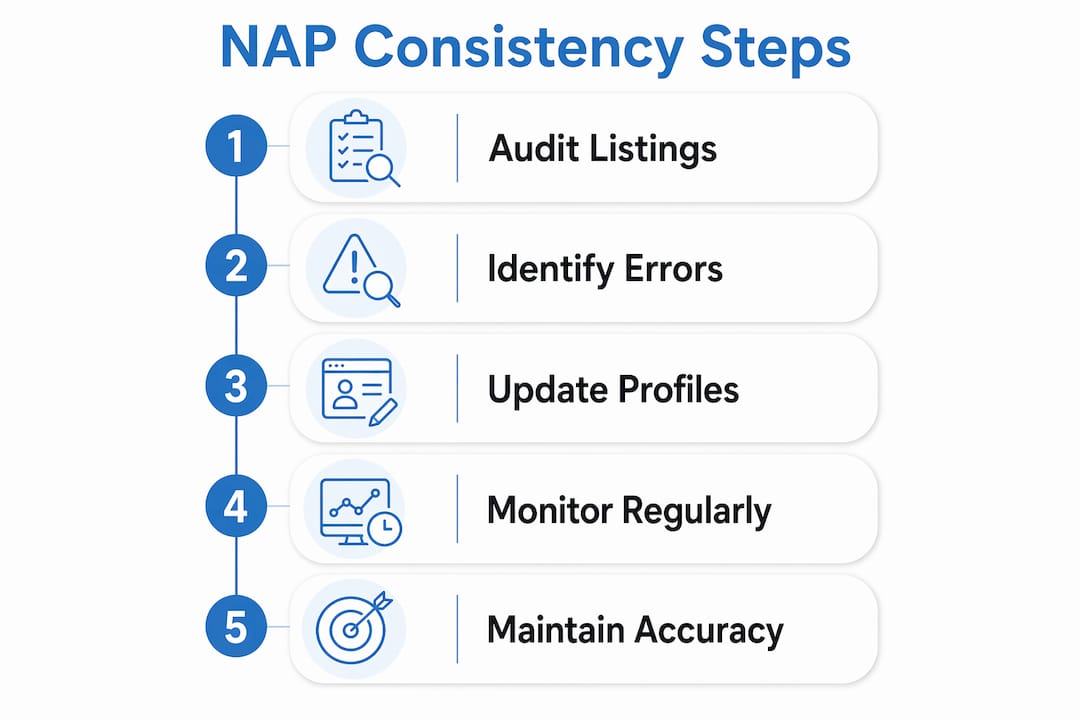
Infographic showing steps for maintaining NAP consistency in local SEO

Think of it from Google’s perspective. It is trying to match your listing against dozens of other data points across the web. If your address reads “Suite 200” on your website but “Ste. 200” on Yelp and nothing on your Google Business Profile, Google can still connect the dots. But if your phone number changed six months ago and half your listings still show the old one, that is a genuine conflict. Google may lower your local ranking because it cannot confidently confirm your identity.

The practical rule: sweat the substance, not the style. Standardize formatting for consistency’s sake, but treat wrong or outdated core details as urgent.

Man checking and fixing business information via smartphone

Where NAP inconsistencies come from in the first place

Most business owners do not create NAP problems on purpose. They accumulate over time through predictable channels:

  • Multiple listing platforms: Directories like Yelp, Yellow Pages, and Apple Maps often pull data from aggregators, not directly from you. Errors introduced at the aggregator level spread fast.
  • User-generated edits: On platforms like Google Maps, anyone can suggest an edit to your listing. Those suggestions sometimes go live without your approval.
  • Business changes: A move, a new phone number, or a rebrand creates a gap between your current reality and what dozens of old listings still say.
  • Dynamic Number Insertion (DNI): Call tracking tools swap your real phone number for a tracking number on your website. If implemented carelessly, DNI can create inconsistent phone data that search engine crawlers pick up.
  • Legacy data: Old citations from years ago do not disappear. A business that moved three years ago may still have its former address listed on a dozen directories nobody actively manages.

How to audit your NAP data across the web

A thorough audit takes some time, but the process is straightforward.

  1. Define your canonical NAP first. Before you check anything, decide what the correct version of your business name, address, and phone number actually is. Write it down exactly as it should appear everywhere.
  2. List every platform where your business appears. Start with Google Business Profile, Yelp, Facebook, Apple Maps, Bing Places, and the Better Business Bureau. Then expand to industry-specific directories and any local Scottsdale business listings.
  3. Check each listing manually. Compare the name, address, and phone number on each platform against your canonical version. Note every discrepancy, no matter how minor.
  4. Use automation tools to catch what you miss. Tools like BrightLocal and Moz Local can scan hundreds of directories simultaneously and flag inconsistencies. Manual audits are time-consuming; automation handles the volume, but you still need to verify the results yourself.
  5. Prioritize by platform authority. Google Business Profile, Yelp, and Facebook carry the most weight. Fix those first before working down to smaller directories.
  6. Document everything in a spreadsheet. Record the platform name, the current NAP as listed, what needs to change, and the status of each correction. This becomes your master audit log.

Pro Tip: Search Google for your business name plus your city and scan the first two pages of results. Anything that surfaces there, including old press mentions and aggregator listings, is worth adding to your audit log.

How to choose your canonical NAP

Your canonical NAP is the single official version of your business details that every listing should match. Getting this right before you start fixing anything saves you from creating new inconsistencies.

  • Use your legal business name as registered, not a shortened nickname or a marketing tagline. If your registered name is “Scottsdale Plumbing Solutions LLC,” that is your baseline, though you may reasonably drop the “LLC” for consumer-facing listings as long as you do it consistently.
  • Match your address to USPS formatting. The United States Postal Service standardizes address formats; using their version reduces ambiguity across platforms.
  • Pick one phone number and stick with it. A local number generally outperforms an 800 number for local SEO purposes. If you use call tracking, configure DNI so tracking numbers display only to human visitors while crawlers see your real number.
  • Confirm internally before publishing. If you have a team, a marketing vendor, or an agency like Webtechs managing your listings, everyone needs to work from the same document. One person updating listings with a slightly different address format undoes the work.
  • Treat your Google Business Profile as the anchor. Whatever formatting Google accepts and displays for your address should be your standard everywhere else.

How to fix inconsistent listings once you find them

Fixing NAP errors is less glamorous than finding them, but it is where the SEO gains actually happen.

  1. Start with Google Business Profile. Log in, verify your details, and correct anything that does not match your canonical NAP. This is the single most impactful listing you control.
  2. Claim unclaimed listings. Many directories allow businesses to claim their profile and edit it directly. Claim every major platform before attempting corrections.
  3. Submit corrections directly where possible. For platforms that accept direct edits, update them manually. For aggregators like Data Axle or Neustar Localeze, correcting the data at the source pushes updates downstream to dozens of directories at once.
  4. Use listing management tools for scale. Services like BrightLocal or Moz Local can push corrections across hundreds of directories simultaneously. This is especially useful for businesses with many existing citations.
  5. Find and resolve duplicate listings. Duplicates confuse both search engines and customers. Merge or remove them rather than leaving two competing versions of your business live.
  6. Schedule a follow-up check. Set a calendar reminder for 30 days after your corrections to verify that changes went live and no new errors appeared.

Pro Tip: After any business change, update your Google Business Profile and your website within 24 hours. Then work through your top ten directory listings within the same week. Waiting months lets bad data spread to aggregators.

How to display NAP on your website for maximum SEO impact

Your website is the one platform you fully control, which makes it the most reliable anchor for your NAP data.

  • Place your NAP in the footer of every page. Search engines crawl your footer on every page load, reinforcing your location signal consistently across your entire site.
  • Include a dedicated contact page with your full canonical NAP, an embedded Google Map, and your business hours.
  • Use schema.org LocalBusiness markup. Structured data helps search engines confirm your NAP and improves local SEO visibility. Adding this markup to your homepage and contact page is one of the highest-leverage technical steps you can take.
  • Never display conflicting addresses or phone numbers on the same site. If you have multiple locations, each location needs its own dedicated page with its own NAP, not a single page listing all of them together.
  • Match your website NAP exactly to your Google Business Profile. Even minor formatting differences between these two sources can create a signal conflict.

For Scottsdale businesses especially, where local competition in industries like real estate, healthcare, and home services is intense, getting this right on your own site is a meaningful edge. Webtechs builds local SEO foundations directly into every site it develops, including proper schema markup and footer NAP placement.

Expert advice on keeping your NAP accurate over time

NAP management is not a project you complete once. It is an ongoing process, and the businesses that treat it that way consistently outperform those that do not.

Run a full audit every 3–6 months, and immediately after any business change: a move, a new phone number, a rebrand, or even a change in business hours. Aggregators re-pull data on their own schedules, so errors can reappear even after you fix them.

For call tracking, configure DNI correctly so tracking numbers are visible only to human visitors. Search engine crawlers should always see your real, canonical phone number. Well-implemented DNI preserves your NAP consistency while still giving you the conversion data you need.

Webtechs has worked with Scottsdale businesses across industries, from hair salons to garden nurseries, and the pattern is consistent: businesses that maintain clean, uniform citations see measurable improvements in local pack rankings and inbound calls. The work is not complicated, but it requires discipline and a system.

Key Takeaways

NAP consistency is the single most controllable factor in local SEO, and fixing it costs far less than losing customers to a competitor whose listings are simply more accurate.

Point Details
Define your canonical NAP first Choose one exact version of your name, address, and phone number before touching any listings.
Audit every platform systematically Check Google Business Profile, major directories, and social profiles, then document every discrepancy.
Fix high-authority listings first Correct Google Business Profile, Yelp, and Facebook before working down to smaller directories.
Use schema markup on your website LocalBusiness structured data helps search engines confirm your NAP and strengthens local visibility.
Audit every 3–6 months Business changes and aggregator re-pulls can reintroduce errors; regular checks prevent backsliding.

Article generated by BabyLoveGrowth

0
Marketing manager reviewing PPC pricing reports
Written by webtechs

PPC Management Pricing in 2026: Real Costs for SMBs

Marketing manager reviewing PPC pricing reports

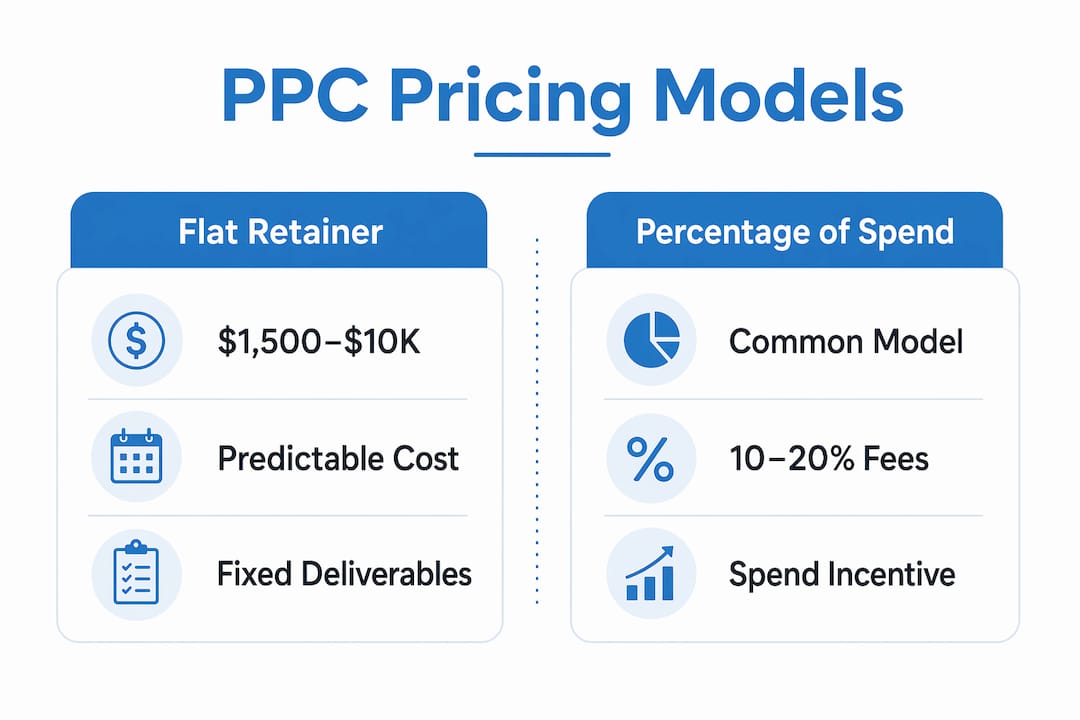
Most small and mid-sized businesses in Arizona and across the U.S. spend a moderate amount per month all-in on PPC, which means management fees plus actual ad spend combined. Management fees alone typically range from 10% to 20% of ad spend, or as a flat monthly retainer usually between $1,500 and $10,000 depending on the account size and complexity. This portion of your total PPC spend can vary, but these are the most common benchmarks for agency management. So if you plan to put a moderate monthly amount into Google Ads, budget an additional amount for management on top of that.

The three pricing models you will see in almost every agency quote:

  • Flat monthly retainer: A fixed fee regardless of how much you spend on ads, typically within a moderate range per month for agencies.
  • Percentage of ad spend: The agency takes a portion of your monthly ad budget as their fee.
  • Hybrid: A base retainer plus a smaller percentage, common for accounts with larger monthly spend.

Hourly and performance-based models exist too, but most SMBs end up on one of the three above. The model matters as much as the number, and the next section explains exactly why.


Table of Contents

What PPC management pricing models actually cost you

Understanding the model behind a quote tells you more than the dollar figure alone. Each structure creates different incentives, and some of those incentives work against you.

Close-up of hand annotating PPC pricing chart

Pricing Model Typical Cost Range Best For Watch Out For
Flat monthly retainer $1,500–$10,000 per month Predictable budgets, defined scope “Set and forget” management with no deliverable guarantees
Percentage of ad spend 10%–20% of spend Scaling accounts, larger budgets Agency earns more when you spend more — misaligned incentive
Hourly Varies by freelancer and agency Project work, audits, short engagements Hard to predict monthly cost; attention varies by client load
Performance-based Varies Clear conversion goals, high risk tolerance Complex to track; can favor quantity over lead quality
Hybrid (base + %) Flat fee plus portion of spend Mid-size accounts wanting stability + growth incentive Requires clear contract language on triggers for percentage

Infographic comparing PPC pricing models

Flat retainer: predictable but potentially passive

You pay the same amount every month whether the account is thriving or struggling. That predictability is genuinely useful for budgeting. The risk is that a flat fee without defined deliverables can drift toward minimal attention over time.

Ask any agency quoting you a flat fee to specify exactly what you get each month: how many campaigns, how often bids are reviewed, what reporting looks like, and whether creative testing is included.

Percentage of ad spend: the most common model, with a catch

Percentage-of-spend models can create a conflict of interest because agencies earn more as you spend more. That does not make the model bad, but it does mean you need to ask whether the percentage applies to ad spend only, whether there is a monthly floor, and whether creative or tools are billed separately. At $10,000 in monthly ad spend, a 15% fee is $1,500. At $50,000, that same rate is $7,500. The work involved does not scale at the same rate the fee does.

Hourly: fine for audits, awkward for ongoing management

Freelancers commonly charge $50–$200 per hour, with monthly retainers ranging from $500 to $3,000 or more, depending on experience and account scope. Agency hourly rates for U.S.-based firms typically average $100–$149 per hour. For ongoing campaign management, hourly billing makes monthly cost hard to predict. It works well for one-time audits or account cleanups, less so for the week-to-week optimization a live campaign needs.


Real price ranges and sample budgets by business size

The numbers below reflect typical all-in costs. Ad spend and management fees are always separate line items.

Management fee ranges by ad-spend band

Monthly Ad Spend Typical Management Fee Notes
Lower ad spends (<$2,500) $500–$1,000+/mo Management fees tend to be a larger proportion of spend at lower levels
Mid-range ad spends ($2,500–$10,000) $1,500–$3,000/mo or ~10–20% of spend Percentage model often used; boutique agencies common
Higher ad spends ($10,000–$50,000) $3,000–$7,500+/mo or hybrid model Hybrid models common; dedicated account manager typical
Very high ad spends (>$50,000) $7,500+/mo or custom pricing Enterprise tiers; multi-platform, ABM, advanced attribution

Sample scenarios

Local service business (plumber, HVAC, landscaper in Arizona): A moderate monthly spend in Google Ads plus a typical management fee equals an all-in budget that can be a lean but workable starting point for a single-market, single-platform campaign. Add a one-time setup fee within a common range and your first month budget will be higher.

E-commerce testing budget: A moderate ad spend across Google Shopping and Meta, managed at a typical percentage of spend, results in a total budget combining ad spend and management fees. If the agency also handles creative production, add a moderate budget per asset for display or social ads.

Growth-stage SMB: A moderate to higher monthly ad spend on Google Search and Performance Max, managed at a hybrid rate with a base fee plus a percentage of spend, results in a management fee and total budget that generally fits within typical ranges seen for small-to-mid businesses, though some growth-stage accounts spend more.

Setup and onboarding fees

Setup fees are billed once, typically at the start of a new engagement. The standard range is $500–$2,500 for a new account build, keyword research, campaign structure, and conversion tracking setup. Some agencies waive the setup fee for longer contract commitments. Either way, your first-month budget will be higher than every month after it.


What does a PPC management fee actually pay for?

A management fee covers the work of running your campaigns, not the cost of the ads themselves. Here is what a solid retainer typically includes:

  • Account and campaign setup: Keyword research, campaign structure, ad group organization, match-type strategy
  • Bid and budget management: Daily or weekly bid adjustments, budget pacing, dayparting
  • Ad copy and creative testing: Writing and rotating text ads, testing headlines and descriptions
  • Conversion tracking: Setting up and verifying goal completions in Google Ads and Google Analytics 4
  • Reporting: Monthly or bi-weekly performance reports covering clicks, cost per click, conversions, and cost per acquisition (CPA)
  • Ongoing optimization: Negative keyword additions, Quality Score improvements, audience refinements

What is usually not included in a standard management fee: landing-page design or development, video ad production, custom display creative, third-party attribution tools, and CRM integration work. Hidden costs like landing pages ($1,000–$10,000 per page), creative assets ($200–$10,000+ per asset), and third-party tools ($120–$1,000+/month) can add significantly to your total spend if you do not clarify scope upfront.

The two metrics that matter most in any report: Return on ad spend (ROAS) and cost per acquisition (CPA). If an agency’s reporting leads with impressions and click-through rates but never mentions what a lead or sale actually cost you, that is a problem worth addressing before you sign anything.

Pro Tip: Always plan for the all-in cost — management fee plus ad spend — and demand reporting that ties both to business outcomes like leads, sales, and customer acquisition cost, not just traffic metrics.


What drives PPC management costs higher?

Not all campaigns cost the same to manage. These are the factors that push a quote up, and knowing them helps you understand whether a higher price is justified.

  • Number of platforms: Google Ads alone is one scope. Add Meta, Microsoft Ads, Amazon, or LinkedIn and the management workload roughly doubles per platform added.
  • Campaign complexity: A single search campaign targeting one city is straightforward. Multi-location targeting, multiple product lines, and granular audience segmentation each add hours.
  • Creative and asset production: Video ads, display banners, and iterative creative testing require either in-house design resources or additional fees. This is one of the most commonly underquoted cost categories.
  • Tracking and attribution setup: CRM integrations, multi-touch attribution models, and offline conversion tracking (connecting a phone call or in-store visit back to a click) require technical setup time that is often billed separately.
  • Industry keyword competition: A personal injury law firm in Phoenix competes in one of the most expensive keyword markets in the country. Higher CPCs mean more active bid management, which means more management hours.
  • Account history and cleanup: Inheriting a poorly structured account with years of bad data, irrelevant keywords, and broken tracking takes time to fix. Many agencies charge a higher setup fee or a one-time audit fee when taking over existing accounts.
  • SLA and dedicated hours: Some clients need same-day response times or a named account manager. That level of access costs more and is usually only available at higher retainer tiers.

Pro Tip: When comparing quotes, ask each agency to break down what percentage of their fee covers strategy versus execution. A quote heavy on execution with no strategic layer is a sign the account will be managed reactively rather than proactively.


How to budget total PPC spend and set realistic timelines

The management fee is only part of the equation. Getting the total budget right from the start prevents the most common mistake SMBs make: underfunding ad spend while paying for management, then blaming the agency when there is not enough data to optimize.

Team discussing PPC budgeting in meeting room

For Google Search campaigns, most boutique agencies set minimum ad-spend thresholds of $2,500–$5,000 per month. Below that level, the campaign rarely generates enough clicks and conversions to make meaningful optimization decisions. LinkedIn Ads requires a minimum daily budget of $10 per campaign, but realistically needs $3,000–$5,000 per month to generate usable B2B data.

A practical rule for Arizona SMBs starting out: plan for at least $3,000–$5,000 in total monthly spend (ad spend plus management) for a single-platform, single-market campaign. That gives you enough data to make real decisions within 60–90 days.

On timelines, allow at least 90 days before drawing conclusions about long-term performance. The first 30 days are largely about learning: the algorithm needs data, and your team needs to see which keywords and ads actually convert. Days 31–60 are for optimization based on early signals. By day 90, you should have enough conversion data to make confident decisions about scaling, pausing, or restructuring.

About one in five marketers spend between $1,000 and $3,000 per month on external PPC support. For most SMBs, that range covers a single-platform campaign with basic reporting — but not multi-channel management or advanced attribution.

The $20/day rule is a useful sanity check for Google Search: $20 per day equals roughly $600 per month in ad spend. That is enough to test a handful of keywords in a low-competition local market, but not enough to generate statistically reliable conversion data in most industries. Double it to $40/day ($1,200/month) as a more realistic floor for meaningful testing.


How to evaluate PPC quotes and spot red flags

Getting three quotes is a start. Knowing what to ask and what to watch for is what separates a good hire from an expensive mistake.

Questions to ask every agency or freelancer

  1. What is included in the monthly fee, and what is billed separately?
  2. Who specifically will manage the account — a senior strategist or a junior coordinator?
  3. How often will bids and budgets be reviewed (daily, weekly)?
  4. What does the reporting cadence look like, and which metrics are in the report?
  5. Is creative production (ad copy, display banners, video) included or extra?
  6. Does the management fee cover conversion tracking setup and ongoing maintenance?
  7. What platforms are included, and what does adding a second platform cost?
  8. What is the minimum contract term, and what are the exit terms?

Red flags in a PPC quote

  • Management fee includes ad spend: The fee and the ad budget must always be separate. Any quote that bundles them makes it impossible to know what you are actually paying for management.
  • Percentage model with no floor: If the agency charges 15% of spend with no minimum, they have little incentive to actively manage a small account. Ask for a stated monthly minimum.
  • Vague deliverables: “We’ll manage your campaigns” is not a deliverable. A real scope includes specific outputs: number of campaigns, reporting frequency, creative testing cadence, and hours or tasks per month.
  • No conversion tracking discussion: If an agency does not ask about your conversion goals in the first conversation, they are not thinking about your business outcomes.
  • Lock-in with no performance clause: A 12-month contract with no performance benchmarks or exit clause for underperformance shifts all the risk to you.

Negotiation levers worth using

  • Ask for a 30–60 day trial period before committing to a 6–12 month contract.
  • Request a setup fee waiver in exchange for a longer initial commitment.
  • Define a minimum hours-per-month commitment in writing, especially for flat retainers.
  • Ask for a named account manager and a stated response-time SLA.

Comparing agency quotes against freelancer rates ($50–$200/hour, or $500–$3,000/month on retainer) is worth doing, but factor in the full picture. Freelancers often manage many accounts simultaneously; the effective attention your account gets depends on their total client load. Ask any freelancer for an estimated hours-per-month commitment and a deliverables list before comparing their rate to an agency’s.


Sample packages and how Webtechs structures PPC pricing

Transparent package examples help you benchmark any quote you receive. The table below shows three tiers that reflect how a well-structured PPC engagement scales with business size and goals.

Package Pricing Model Monthly Management Fee Ad Spend Range Included Deliverables Setup Fee Best For
Starter Flat retainer $1,500–$2,000 $2,500–$5,000 1 platform, campaign build, keyword research, monthly report, basic conversion tracking $500–$1,000 Local service businesses, single-market campaigns
Growth Hybrid (flat + %) $2,000–$3,000 $5,000–$15,000 2 platforms, A/B ad testing, bi-weekly reporting, CPA tracking, audience optimization $1,000–$2,000 E-commerce, multi-location SMBs, lead-gen businesses
Scale Percentage of spend $3,000–$7,500+ $15,000–$50,000 Multi-platform, dedicated account manager, weekly reporting, creative testing, attribution setup $1,500–$2,500 Growth-stage companies, competitive verticals

Webtechs structures its PPC packages around a simple principle: the management fee should be tied to defined deliverables, not just account access. For SMBs in Arizona, that means every engagement starts with a clear scope document specifying platforms, reporting cadence, and what optimization work happens each month.

Webtechs’s approach to PPC aligns with the outcomes that matter to local businesses: leads, calls, and sales, not impressions. The agency’s client results across Arizona service businesses demonstrate what happens when spend is tied directly to measurable business outcomes rather than vanity metrics. For SMBs that also need a landing page built or optimized before running ads, Webtechs handles that work in-house, which removes the coordination cost and the markup that comes from outsourcing creative to a third party.


Key Takeaways

PPC management pricing for most U.S. SMBs runs $2,000–$15,000 per month all-in, with management fees representing 10–20% of total spend, or a flat fee typically between $1,500 and $10,000/month — and a 90-day evaluation window is needed before drawing performance conclusions.

Point Details
All-in monthly range Most SMBs spend $2,000–$15,000/month total (ad spend + management fee combined).
Management fee benchmark Budget 10–20% of total PPC spend for management; under $2,500 ad spend, fees of $500–$1,000+/mo are common.
90-day evaluation window Allow at least three months before judging long-term performance; the first 30 days are data collection.
Red flags to avoid Bundled fee + ad spend, no defined deliverables, percentage model with no floor.
Webtechs for Arizona SMBs Webtechs offers defined-scope PPC retainers for small and mid-sized businesses with transparent deliverables and outcome-focused reporting.

What fair PPC pricing actually looks like from the inside

The percentage-of-spend model gets a bad reputation, and some of it is earned. But it is not inherently unfair. It makes sense when an agency is actively scaling your account, because the additional management work at $30,000 in monthly spend genuinely exceeds what is needed at $5,000. The problem is when agencies use a percentage model on small accounts where the math produces a fee that is wildly disproportionate to the actual hours worked.

For most SMBs spending under $10,000 per month on ads, a flat retainer with defined deliverables is the fairer structure. It gives you predictability and forces the agency to specify what they are actually doing. Above $10,000, a hybrid model starts to make more sense because the management complexity does scale with spend.

The minimum contract question is one where I think the industry often gets it wrong. Six-month minimums are standard, and they are not unreasonable given that 90 days of data is the minimum needed to evaluate performance. But a 12-month contract with no performance benchmarks written in is a red flag. Any agency confident in their work should be willing to define what success looks like at 90 days and give you an exit path if those benchmarks are not met.

For SMBs in Arizona, the reporting cadence matters as much as the contract length. Monthly reporting is the minimum. Bi-weekly is better. If an agency is only touching base once a month, they are not actively managing your account; they are monitoring it.

Webtechs recommends a minimum three-month engagement for any new PPC account, with bi-weekly reporting and a defined scope document before the first dollar is spent. If you want a custom, transparent quote that separates media from management, reach out to Webtechs directly.


Webtechs PPC management for Arizona small businesses

Running paid search without a clear scope and transparent pricing is how ad budgets disappear without results. Webtechs offers PPC campaign management built specifically for small and mid-sized businesses in Arizona, with defined deliverables, bi-weekly reporting, and fees that are always quoted separately from your ad spend.

Webtechs

Every Webtechs PPC engagement starts with a scope document: which platforms, which campaigns, what optimization work happens each month, and what metrics define success. No vague retainers, no bundled fees. For businesses that also need landing pages built or improved before running ads, Webtechs handles web design in-house, which means your campaign and your landing page are built to work together from day one.

See the Webtechs portfolio to review past results, or contact the team for a free PPC audit and a quote that breaks down management fees and ad spend clearly. The audit takes about 30 minutes and gives you a concrete starting budget before you commit to anything.


Benchmarks, calculators, and sources to verify PPC pricing

The figures in this article come from a combination of industry pricing studies and agency benchmark data. Here are the primary sources worth bookmarking if you want to run your own estimates or verify ranges before a vendor conversation.

  • AdBot PPC Cost Guide: Covers management fee ranges by ad-spend band, setup fee norms, and the minimum-spend dynamics that affect small accounts. Good for benchmarking flat retainer and percentage-model quotes.
  • Pitchsite PPC Pricing Guide + Calculator: Includes a fee estimator tied to ad spend and campaign complexity. Useful for running a quick sanity check on a quote before a vendor call.
  • Clutch PPC Pricing Guide: Aggregated data from verified agency reviews. Hourly rates, project cost ranges, and location-based pricing benchmarks for U.S. agencies.
  • TripleDart B2B PPC Cost Breakdown: Detailed breakdown of B2B-specific management costs, platform-by-platform CPC benchmarks, and in-house versus agency cost comparisons.
  • Groas Google Ads Freelancer Cost Guide: Freelancer hourly and retainer ranges, plus a framework for evaluating freelancer attention and deliverables against agency alternatives.

For local Arizona businesses comparing PPC costs against local SEO budgets, the Webtechs local SEO cost guide covers how paid and organic search budgets interact and where the trade-offs make sense for different business types.

This article provides general pricing information for educational purposes. Actual costs vary by account, market, and provider. Consult directly with a qualified PPC specialist to get figures specific to your business situation.

0
Woman optimizing Google Business Profile on laptop
Written by webtechs

Google Business Profile Optimization: Scottsdale 2026 Guide

Woman optimizing Google Business Profile on laptop

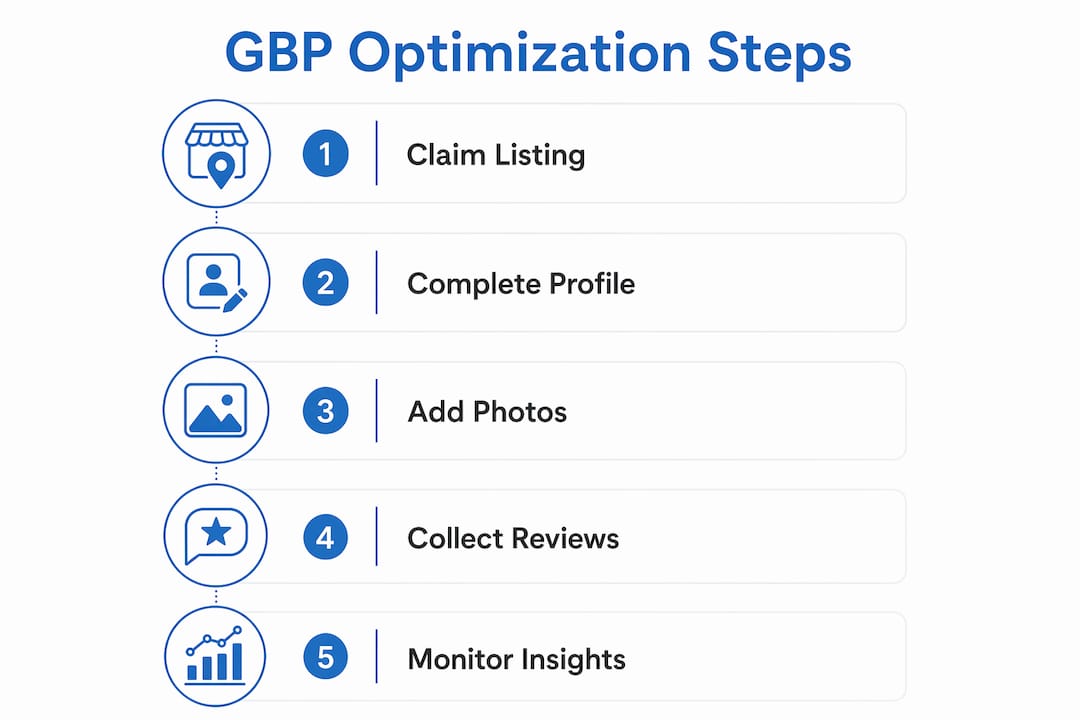
Claim your profile, fix your NAP, choose the right primary category, and add at least five quality photos. Do those four things today and you will outperform most of your local competitors before you spend a dollar on paid help. If you would rather hand it off, Webtechs has been doing exactly this for Scottsdale small businesses since 1997. Google’s own documentation confirms that local rankings turn on three factors: relevance, distance, and prominence. Distance is fixed. Relevance and prominence are yours to control.

Start here, in this order:

  • Claim and verify your listing at business.google.com
  • Correct NAP and primary category so Google knows exactly what you do
  • Add photos, services, and a business description to signal an active, complete profile

Pro Tip: Businesses with photos receive significantly more direction requests and website clicks than those without. Upload at least five real photos before you do anything else.


Table of Contents

Which Scottsdale providers are worth hiring for Google Business Profile optimization?

The table below covers seven local and regional providers. Pricing models are described as shapes, not exact figures, because most agencies quote after a discovery call.

Infographic showing five key steps for GBP optimization

Provider Primary service Pricing model Core deliverables Specialization Trust signals
Webtechs Full-service local SEO + GBP management Monthly retainer or project Profile claim, NAP, photos, citations, posts, reporting Small/mid-sized businesses, Scottsdale Operating since 1997; documented case studies
Scale Up Marketing AI-driven local SEO systems Monthly retainer GBP optimization, AI Smart Websites, local SEO Tech-forward SMBs AI tooling, local SEO systems
Coded Formula SEO, web design, PPC Transparent upfront pricing Web design, SEO, consulting Local and national campaigns Upfront pricing published
BusinessSEO.io Done-for-you local SEO packages Monthly subscription GBP setup, ongoing management, coaching Local service businesses Affordable entry-level packages
LeadUp Solutions Reputation and review management Monthly retainer Google review management, lead-gen web design Review-heavy industries Review management focus
Vinio Marketing Broad digital marketing bundle Monthly retainer SEO, paid ads, reputation management, web design Businesses wanting one vendor Multi-service bundle
Google Business Profile Professionals GBP setup and optimization Project or retainer Profile claim, category setup, photo upload GBP-only specialists Specialist positioning

Quick picks:

  • Best for transparent pricing: Coded Formula publishes rates upfront, which cuts the back-and-forth on proposals.
  • Best for AI-driven local SEO: Scale Up Marketing integrates AI Smart Websites with GBP systems, a fit for owners who want technology doing more of the heavy lifting.
  • Best for monthly review management: LeadUp Solutions centers its entire model on Google review management and lead-gen design, useful when your reputation is the bottleneck.

Before you sign anything, run these quick checks:

  • Google rating and total review count (look for consistency over time, not a single burst)
  • Published case studies or before/after snapshots
  • Transparent pricing or at least a clear package description
  • Google Partner badge or equivalent certification
  • Sample reports on request

Pro Tip: Sample deliverables are the single most reliable trust signal. Any agency that will not show you an example report before you sign is hiding something.


Marketing team consulting on local SEO deliverables

How do you choose the right GBP optimizer and what should it cost?

What to ask on the first call

Ask every candidate these five questions before you commit:

  1. Who owns the profile after the engagement ends? (It must stay yours.)
  2. Can you show me a sample monthly report?
  3. How exactly do you request reviews from clients? (Automated bulk emails violate Google policy.)
  4. What is your citation cleanup process?
  5. What are the cancellation terms?

Red flags that should end the conversation

Keyword stuffing a business name, such as “Joe’s Plumbing Scottsdale Best Plumber AZ,” is a common policy violation that can get a profile suspended. Walk away from any vendor who suggests it. The same goes for promises of instant top-3 rankings, offers to generate fake reviews, or refusal to share sample reports.

What does GBP optimization actually cost?

Service tier Typical scope Realistic timeline to results
One-time setup Claim, NAP, category, photos, services, description 1–2 weeks for quick wins
Entry monthly management Posts, review responses, monthly reporting
Full monthly management Above + citation cleanup, Q&A, advanced posting

For Scottsdale-specific pricing context, Webtechs publishes local SEO cost guidance that breaks down what each tier typically includes.

Can a Google Business Profile actually generate $100–$200 per day?

Yes, but the math has to work. Revenue from Maps traffic comes down to three variables: how many local search impressions your profile earns, what percentage of those convert to calls or visits, and what your average job or transaction is worth. A plumber with a $350 average ticket needs fewer than one new call per day to hit $200. A coffee shop needs far more foot traffic to reach the same number. The profile itself does not generate revenue. It generates visibility. Visibility generates leads. Leads close at whatever rate your sales process allows. Optimize the profile first, then track calls and direction requests in your GBP dashboard to measure actual lead volume.


Webtechs handles your GBP so you can run your business

Webtechs

Webtechs is the local alternative to a generic national SEO agency for Scottsdale small businesses. The difference is specificity: every engagement starts with a full profile audit, not a templated checklist. A typical Webtechs GBP engagement covers profile claim and verification, NAP correction, primary and secondary category selection, photo upload and optimization, services and description copy, weekly posting, review response management, and monthly reporting with ranking snapshots.

The results speak for themselves. A garage door repair client saw a 1,620% increase in search visibility. A garden nursery grew organic traffic by 353%. Both started with the same foundation: a fully optimized local profile backed by on-site SEO. Webtechs works on a monthly retainer for ongoing management or a one-time project fee for setup and handoff. No long-term lock-in required. See the full client portfolio and reach out for a free profile audit.


Key Takeaways

A fully optimized Google Business Profile is the highest-return local marketing activity available to Scottsdale small businesses, and most profiles are using less than half their potential.

Point Details
Claim and complete first Fix NAP, primary category, photos, and services before any other tactic.
Reviews drive prominence Review volume and recency are the strongest ranking variable you can control.
Avoid policy risks Keyword-stuffed business names and fake reviews can get a profile suspended.
Realistic cost tiers One-time setup, entry monthly management, and full monthly management each deliver different timelines to results.
Webtechs as local partner Webtechs offers Scottsdale businesses full GBP management with documented case studies and no mandatory long-term contract.
0
Marketer reviewing call tracking reports at desk
Written by webtechs

Call Tracking for Ads: A 2025 Guide for Marketers

Marketer reviewing call tracking reports at desk

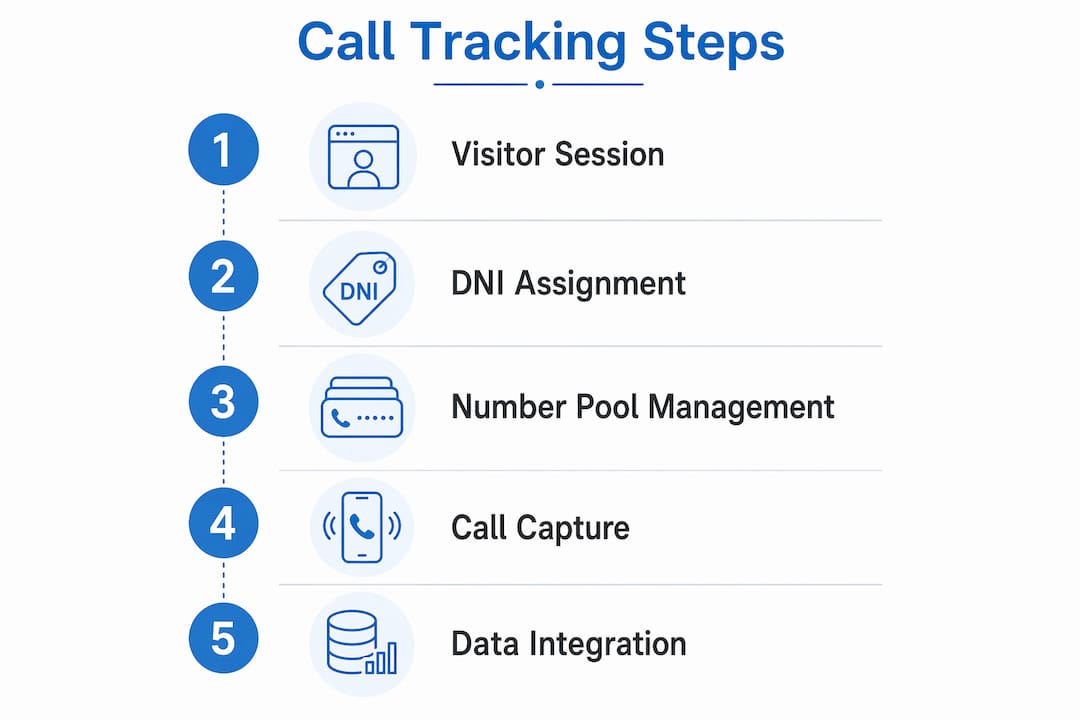
Call tracking for ads is the practice of attributing inbound phone calls directly to the specific campaigns, keywords, or channels that generated them. The core mechanism is dynamic number insertion (DNI), a JavaScript-based technique that swaps the phone number displayed on your website based on how a visitor arrived. Someone clicking a Google Ads campaign sees one number; someone from a Facebook post sees another. Both route to the same business, but each carries a distinct attribution trail.

Without this, phone calls are a black hole in your analytics. You know the call happened. You have no idea which ad paid for it.

Key capabilities call tracking delivers:

  • Attribution at the session level: DNI ties each call to the exact source, campaign, and keyword, not just the page.
  • Conversion counting: Set a minimum call duration (say, 90 seconds) and count only those as conversions.
  • Bid strategy input: Feed call conversion data directly into Google’s automated bidding to optimize for calls, not just clicks.
  • AI-driven lead scoring: Platforms like Invoca analyze call content and sentiment, not just duration, to score lead quality.
  • CRM integration: Push call data into HubSpot, Salesforce, or similar tools to enrich contact records automatically.

Table of Contents

How does call tracking for ads work with Google Ads?

The DNI mechanism

DNI assigns a tracking number at the visitor session level, not the page view. That distinction matters. If a visitor clicks your Google Ad, browses three pages, then calls, the attribution stays pinned to the original ad source throughout the session. Without session-level tracking, multi-page journeys break the attribution chain.

Infographic illustrating call tracking process steps

One technical detail most guides skip: number pool sizing. If two visitors arrive simultaneously and your pool only has one tracking number, both calls get logged to the same number, corrupting your data. Your pool needs to cover your maximum expected concurrent visitors, not just your average.

Script placement matters too. Place your DNI script in the HTML head tag rather than the body or footer. A script loaded late causes the default number to flash visibly before being replaced, which degrades both user experience and data quality.

Setting up call tracking in Google Ads

  1. Enable Call Reporting at the account level under Account Settings. This tells Google to assign forwarding numbers to your ads.
  2. Install the Google tag on every page of your site. Use Google Tag Manager if you want to avoid touching code directly.
  3. Add the phone snippet to pages displaying your business number. This is the code that triggers the number swap when a visitor arrives from a Google Ad.
  4. Configure a call conversion action in your Conversions settings. Set the minimum call duration that counts as a conversion for your business.
  5. Enable call recording (US and Canada only). Google AI analyzes call recordings to evaluate lead quality beyond simple duration, which sharpens automated bidding decisions.
  6. Verify forwarding numbers are live by running a test click from your ad and confirming the swapped number appears.

Eligibility and privacy notes: Google forwarding numbers are available in the United States and a range of other countries. Caller ID still works for routed calls. Google Ads charges only when a user clicks the forwarding number shown in the ad, not when someone manually dials it. If you prefer to show your own business number or use a third-party platform, you can disable Call Reporting in account settings without losing ad functionality.

Troubleshooting checklist:

  • Number flicker on load: move the script higher in the <head>.
  • Attribution gaps: check that the Google tag fires on all pages, not just the homepage.
  • Pool collisions: increase your number pool if concurrent traffic spikes during campaigns.
  • Conversion undercounting: confirm your minimum call duration threshold is realistic for your sales cycle.

What are the real benefits of call tracking in ad campaigns?

Phone calls convert at a higher rate than digital form submissions for most service businesses. Tracking them closes the attribution gap between your online ad spend and the offline conversations that actually close deals, giving you a complete picture of ROI rather than a partial one.

The practical gains stack up quickly:

  • Accurate attribution: Know which campaign, ad group, and keyword drove each call. Stop funding ad groups that generate clicks but no conversations.
  • Smarter bidding: Google’s automated bidding strategies improve when fed call conversion data alongside form and purchase conversions.
  • AI-powered lead scoring: AI call scoring systems analyze conversation content and sentiment, flagging high-intent callers in real time rather than waiting for a sales rep to manually qualify them.
  • CRM enrichment: Every call can auto-create or update a contact record, tag the marketing source, and trigger a follow-up task.
  • Multi-channel clarity: Third-party platforms extend attribution beyond Google Ads to cover Facebook, email, direct mail, and organic search in a single dashboard.

Common challenges: Many teams underestimate the setup time for CRM integrations, or set call duration thresholds too low, counting short wrong-number calls as conversions. Start conservative on thresholds and adjust based on actual sales data.

Pro Tip: Set up custom AI outcome fields in your call tracking platform to detect specific phrases like “schedule an appointment” or “what’s your price?” These signals are far more predictive of deal quality than call duration alone, and they feed directly into bid optimization.

Which Arizona providers offer call tracking for your ad campaigns?

The providers below serve the Arizona market with varying degrees of specialization. Some are full-service digital agencies; others focus on specific niches like AI-driven local lead generation or data analytics.

Provider Services Offered Specializations Local Presence Pricing & Contracts Rating
GPS and Track GPS and tracking systems, supplier services GPS/tracking hardware and solutions Scottsdale area Not publicly listed 4.8★ (105 reviews)
Cyber Controller AI Local Dominance, Google Maps marketing, AI Lead-to-Job automation, Generative SEO Local service businesses, Phoenix metro lead generation Phoenix metro Month-to-month after 90-day initial period 5★ (28 reviews)
WebTechs.Net Full-service SEO, PPC management, web design, local SEO, Google Maps marketing Contractors and local businesses, affordable SEO Scottsdale, AZ Project-based and monthly retainers 4.8★ (19 reviews)
Ads With Excellence Advertising services Professional ad services, local reputation Glendale, AZ Not publicly listed 5★ (6 reviews)
Az Mobile Ads Mobile and digital advertising Mobile advertising, Phoenix-area campaigns Phoenix, AZ Not publicly listed 3★ (8 reviews)
eDataTalk Data analytics, conversion tracking support Marketing analytics, call tracking insights Phoenix, AZ Not publicly listed 5★ (2 reviews)

Cyber Controller is the strongest fit for local service businesses in the Phoenix metro that want AI-driven lead generation without a long-term contract commitment. Its Lead-to-Job automation and Google Maps focus are genuinely differentiated, not just marketing language.

Webtechs suits contractors and small-to-mid-sized businesses that need call tracking integrated into a broader Scottsdale SEO and PPC strategy. The agency has managed PPC campaigns and local SEO since 1997, and its client testimonials document measurable traffic and lead growth.

GPS and Track operates as a supplier of GPS and tracking hardware in the Scottsdale area. It serves businesses needing physical tracking systems rather than ad attribution software.

eDataTalk is worth considering when you need analytics support to interpret call tracking data alongside other conversion metrics. It is a thin-profile provider with limited public detail, but its local Phoenix presence and analytics focus make it a reasonable complement to a primary tracking platform.

Ads With Excellence and Az Mobile Ads are local advertising services. Neither publishes detailed service breakdowns publicly, so treat them as options to evaluate directly for fit.

How do you choose the right call tracking service?

The decision comes down to what you actually need to measure and how much of the setup you want to own.

Questions to ask before committing to a provider:

  • Does the platform support DNI for every channel you run ads on, including paid search, social, and display?
  • How does it integrate with your CRM? Native connector or API only?
  • What is the pricing model: monthly subscription, per-call, or per-minute? Pricing structures vary significantly and affect cost predictability at different call volumes.
  • Is the contract month-to-month or annual? What are the exit terms?
  • Does it offer AI call scoring and transcription, or just duration-based reporting?
  • Can it handle multi-channel attribution across both online and offline sources?

Match the platform to your campaign complexity. A single-location business running Google Ads can start with Google’s native call reporting at no additional cost. Once you need cross-channel attribution, CRM sync, or AI lead scoring, third-party platforms like CallRail, CallTrackingMetrics, or Invoca earn their subscription fees.

Budget matters too. Start with your highest-spend channel, prove the attribution model works, then expand tracking to secondary channels. Trying to instrument everything at once usually means instrumenting nothing well.

Professionals discussing call tracking services in office

Why tracking missed calls and call duration changes your ROI picture

Duration and outcome data are where call tracking shifts from a reporting tool to a revenue tool. A 12-second call is almost certainly a wrong number or a hang-up. A 4-minute call from someone who found you through a specific ad group is a qualified lead. Treating both as “calls” in your conversion data produces a misleading cost-per-lead figure.

Hands holding phone showing call durations

Missed calls deserve equal attention. If a campaign drives 40 calls on a Tuesday afternoon and your team misses 15 of them, that is not a tracking problem. That is a staffing and response-time problem that your call data just surfaced. Many platforms flag missed calls in real time and can trigger automated follow-up sequences via SMS or email.

Voicemail tracking adds another layer. A caller who leaves a voicemail is expressing higher intent than one who hangs up immediately. Segmenting voicemails by source lets you identify which campaigns attract callers willing to wait, a signal that often correlates with purchase intent.

The practical move: build separate conversion actions in Google Ads for calls over 2 minutes, missed calls, and voicemails. Weight them differently in your bidding strategy. That granularity is what separates a campaign optimized on real revenue signals from one optimized on raw call volume.

Webtechs brings SEO and PPC together for Arizona businesses

If the providers compared above feel like a lot to evaluate on top of running your actual campaigns, Webtechs offers a different path. Rather than purchasing a standalone call tracking subscription and managing it yourself, you get professional web design and full PPC campaign management from a Scottsdale agency that has been doing this since 1997.

Webtechs

Webtechs handles the setup, the tracking integration, and the ongoing optimization, so your team focuses on closing the calls rather than debugging tag fires. For contractors, local service businesses, and small-to-mid-sized companies across Arizona, that managed approach often costs less in total than a DIY stack of tools plus the time to run them. Check the website design price list to see current service tiers, or review the client portfolio to see what results look like in practice.

Key Takeaways

Call tracking for ads works when DNI, proper number pool sizing, and conversion thresholds are configured correctly from the start.

Point Details
DNI is session-level, not page-level Tracking numbers follow the visitor across pages, preserving attribution through multi-page journeys.
Number pool sizing prevents data corruption Your pool must cover maximum concurrent visitors, not average traffic, to avoid reuse collisions.
Script placement affects data quality Place the DNI script in the HTML <head> to prevent number flicker and protect tracking accuracy.
Segment by call type for real ROI Track missed calls, voicemails, and call duration separately to build conversion actions that reflect actual revenue signals.
Webtechs manages the full stack For Arizona businesses wanting PPC, SEO, and tracking handled together, Webtechs offers managed campaigns without the DIY overhead.

Article generated by BabyLoveGrowth

0
Written by webtechs

What Is A Good Domain Rating?

What Is A Good Domain Rating

Domain Rating is a third-party metric that eveluates a particular domain’s ability to rank highly on Google. It is undoubtedly one of the most important measurements a marketer will use to document SEO performance. What is a good domain rating, though, and how can it impact your ability to outrank your competitors?

What Does Domain Rating Mean?

Domain Rating (DR) is a measurement that was created by Ahrefs, an SEO evaluation platform that tracks website rankings, as well as backlinks. Domain Authority, which is quite similar to Domain Rating, is another great way to track SEO performance.

It’s no secret that Domain Rating is strongly correlated to a website’s ability to rank well on Google.

How Does Domain Rating Work?

Domain Rating is a proprietary algorithm responsible for measuring a website’s overall link popularity. It will take into account the quality of the domains linking to your website by measuring the amount and quality of the domains linking to each of them.

Next, it will rank-order the websites, distributing them into 100 percentiles. For example, a website with a Domain Rating of 90 linking to your website is much more beneficial than receiving a link from a website with a Domain Rating of 10.

Today, there are only a couple websites with a DR above 95, including Google, Facebook, and Amazon. On the other hand, there are millions of websites that feature a DR of 10 and under. Needless to say, increasing your DR will be a methodical, long-term project.

What Is Considered A Good Domain Rating?

Let’s take a quick look at DR and what this measurement ultimately allows a website to do on in terms of ranking on Google.

Domain Rating Google Rankings Impact
Under 5 Ability to rank top 3 for keywords in 0% of industries
5-20  Ability to rank top 3 across 12% of industries
20-35 Ability to rank top 3 across 27% of industries
35-50 Ability to rank top 3 across 39% of industries
50-75 Ability to rank top 3 across 73% of industries
75 and above Ability to rank top 3 across 95% of industries

What Else Determines Rankings On Google?

Search results will not be perfectly ordered based on DR. There are three other major ranking factors, all detailed below.

Industry Expertise

Industry or niche expertise is a measure of the website’s specialization in a specific topic. In most cases, a 30-page website on one topic would be considered a niche expert. Meanwhile, a 500-page website on the same topic may be considered a generalist.

Google will value what an expert has to say on a topic over a generalist.

Page Optimization

Technical factors, such as mobile-friendliness, speed, and safety, are also prerequisites to ranking. Technical issues that impact the user experience will cause rankings to plummet until the problems are fixed.

Engagement

Google will know when an audience is engaged on your website, measuring time on page and user behavior. “High engagement” is considered when a page attracts and keeps a user’s attention for more than one minute.

In this event, the user will also scroll down the page and interact with other elements of the site.

Conclusion

While DR is undoubtedly correlated with a website’s traffic, it’s not best to focus your entire efforts on increasing this metric.

Google ranks pages, not websites, meaning it’s best to always focus on creating high-quality content. When high-quality content is produced, you can acquire quality backlinks based directly off said content. Both DR and your search traffic will grow naturally over time as a byproduct of your focus on producing the best content possible.

Content Writing

Are You Looking For SEO Services?

For a Free SEO consultation in Scottsdale, Phoenix, Tempe, or Mesa, Arizona areas, contact WebTechs.Net today.

0
Written by webtechs

Cost Effective SEO: 7 Best Strategies

Cost Effective SEO Strategies

These days, impactful SEO does not have to come with a hefty cost. Let’s take a look at some of the best cost-effective SEO strategies below to help build your online brand into a long-term success!

What Are The Best Cost-Effective SEO Strategies?

Whether you are simply an individual with a blog or you’re starting a small business, the strategies outlined below can give you the online results you desire without a massive marketing budget. Check out 7 of the best cost-effective SEO strategies and how to properly implement them into your website.

1. Improve/Update Existing Content

One of the easiest cost-effective ways to improve your SEO is by improving and updating the content your site already has. It’s always a good start to update and optimize existing landing pages and blog posts to make them more search-engine friendly.

Improve your existing content to make it more relevant to your target audience. You can begin updating all the content on your site before attempting to create brand new content.

How to improve your existing content:

Identify any underperforming pages. Check for things like weak meta descriptions and outdated content.
Add more internal links. Increase your internal linking to encourage your audience to find more helpful information within your site.
Update old content. Update your site’s information and create more engaging content for your audience.

2. Optimize For Local SEO

If your business is targeting a specific geographic area, it’s wise to optimize for local SEO. This can result in a significant impact on your visibility without the need for a huge SEO budget.

Local SEO methods can help you outrank your competition. Target searches related to your area, and you could see a steady flow of traffic courtesy of nearby customers.

How to optimize for local SEO:

Claim and optimize your Google My Business profile. Make sure all your business details are accurate and up to date.
Use local keywords in your content. Local keywords should be placed in your site’s content, meta descriptions, and title tags to help search engines understand your services.
Ask for reviews. Always encourage satisfied customers to leave online reviews as you strive to build trust in your community.

3. Acquire Backlinks

Time and time again, backlinks remain one of the most important ranking factors for SEO. You may be able to purchase a bundle of high-quality links, but thankfully there is another way to build backlinks without spending money.

You can either acquire these valuable backlinks through quality content, or you can reach out to relevant websites to offer content in exchange for links.

How to build your backlinks:

Identify websites that relate to your industry. Reach out to these sites and offer to contribute content in exchange for links.
Create valuable original content. Useful content, such as how-to guides, can entice other sites to link to your site.

4. Utilize Social Media For Organic Traffic

Social signals, such as likes and shares, may not directly impact your rankings, but social media can certainly play a role in driving much wanted organic traffic to your site.

Sharing your original content on various social media platforms can help you engage with an audience. This can result in building brand awareness without ever paying for ads.

How to use social media to bring in traffic:

Share your content. Regularly post your content on social media platforms like Facebook, Twitter, Instagram, and LinkedIn for more online exposure.
Encourage your audience to share your content. This can increase both your visibility and traffic.
Be responsive. Always respond to comments and start conversations that is relevant to your audience.

5. Prioritize User Experience

The number one priority for Google is to provide users with the information they are searching for. If someone does a search and clicks on the first link to find the appropriate information, that helps build trust in Google and its overall rankings.

When a user clicks on a link and stays on the same website for a good amount of time, this signals to Google that the site is very helpful. While Google has never said outright that user time on a page is a ranking factor, it’s no secret keeping users on your site for as long as possible is a great thing.

A user that clicks on your post and finds helpful information is more likely to stick around and search throughout your site. Longer blog posts tend to rank the highest nowadays, with the average first-page result post on Google totaling almost 2,000 words long each.

When an audience reads a blog post that they enjoy, they’re more likely to share it, which can drive your website’s traffic up.

When you get lots of traffic and repeat customers, this shows Google that people like your site and will ultimately raise your authority level within their algorithm. This is great from an SEO perspective, but it’s even better for the overall success of your website.

How to focus on user experience:

Ensure easy navigation. Make your website easy to use with simple buttons, menus, and calls-to-action.
Prioritize mobile users. Make sure your site is responsive and performs well for all device types.
Focus on organization. Your site’s layout should be clean and organized, making life easier for your audience.

6. Target Long-Tail Keywords

Most people that begin their SEO journey will target specific keywords related to their industry or business. For example, if you own an auto repair shop you might target terms like “auto repair” or “car ac repair”. While this is a wise idea, it might take you a long time to reach the top spot unless you own the largest auto shop in the country.

The SEO world is super competitive, but there is one technique new bloggers can approach for an advantage. The best bet for newer brands is to target longer, more specific keywords. These are keywords your target audience is searching for, directly related to your business offerings.

These are called long-tail keywords and they are a crucial tool for new bloggers to use. They are the ideal terms to target in a blog post. Instead of “auto repair”, you could create a post called, “what is the average labor rate for auto repair”.

While these keywords will not pull in as much traffic to your site as shorter keywords, you could still end up with a larger audience for one single long-tail blog than several others.

How to target long-tail keywords:

Find industry-related keywords. Identify and target long-tail keywords that have less competition.
Create content around these keywords. Your target audience has questions; it’s your job to provide in-depth solutions.

7. Optimize Technical SEO

You know on-page and off-page SEO, but what is technical SEO? Technical SEO is all about ensuring search engines have no problem crawling, indexing, and understanding your site.

It’s no secret good technical SEO can get quite complex, but thankfully there are several cost-effective ways to improve your site without a large budget.

How to optimize your site’s technical SEO:

Ensure quick load time. Optimize image sizes and eliminate unnecessary scripts.
Check if your site is mobile-friendly. You can use Google’s Mobile-Friendly Test to see how your site performs.
Simplify the URL structure. Short and descriptive URLs tend to rank higher in search results.

Conclusion

The cost-effective SEO strategies detailed above can ultimately help your site rank higher, attract traffic, and build a loyal audience without spending a fortune. Update your site, optimize for local SEO needs, use social media, and watch as you boost your presence online.

SEO is a long-term investment, and even a small budget that puts the right strategies in place, can yield meaningful results. For more tips, contact the experienced SEO experts at WebTechs today!

SEO Services

Are You Looking For Cost-Effective SEO Services?

For a Free SEO consultation in Scottsdale, Phoenix, Tempe, or Mesa, Arizona areas, contact WebTechs.Net today.

Written by webtechs

Does Blogging Help Seo?

Does Blogging Help Seo

Starting a blog is one of the easiest ways to directly increase your chances of ranking high in the search engines. Let’s take a look at some common reasons why a blog is so helpful for SEO.

How Does Blogging Help SEO?

Consistent blogging is great for SEO purposes, as it helps with multiple ranking factors. When you regularly post high-quality blogs on relevant topics, it can make a huge difference in your site’s overall performance.

Blogging helps you reach an audience and perform well in the search engines. Let’s look at a few reasons why blogging can boost your website.

1. Internal Linking Opportunities

A large portion of SEO depends on linking. Internal links are the easiest for any blog since you can create them yourself. Failing to include internal links in your blog posts is one of the easiest SEO mistakes a site can make.

While there will undoubtedly be many good opportunities for internal linking on your site’s main pages, the options will really grow once you start a blog. As you create more pages, you add more natural opportunities to link to some of your other pages.

Every time you do this, you can strategically use the anchor text to let Google know you are intentionally strengthening the page and/or keywords you are linking to.

2. Keeps Your Website Up To Date

This is one of the biggest reasons why people continue to blog today. As a user, when you click on a website that needs to update information, you may move on elsewhere with your search. You always want your website and its content to be up to date.

Google never wants to send users toward outdated information. Websites that are updated regularly signal to Google that the sites are alive, well, and offering the highest quality content. It will also give the search engine algorithms more reason to index your site as often as possible.

Unless business offerings or hours change frequently, you might not update your home page that often. For this reason alone, blogging can be the most practical tool for adding fresh, new content to your site on a regular basis.

3. Blogging Can Target SEO Optimized Keywords

Most people that begin their SEO journey will target specific keywords related to their industry or business. For example, if you own an auto repair shop you might target terms like “auto repair” or “car ac repair”. While this is a wise idea, it might take you a long time to reach the top spot unless you own the largest auto shop in the country.

The SEO world is super competitive, but there is one technique new bloggers can approach for an advantage. The best bet for newer brands is to target longer, more specific keywords. These are keywords your target audience is searching for, directly related to your business offerings.

These are called long-tail keywords and they are a crucial tool for new bloggers to use. They are the ideal terms to target in a blog post. Instead of “auto repair”, you could create a post called, “what is the average labor rate for auto repair”.

While these keywords will not pull in as much traffic to your site as shorter keywords, you could still end up with a larger audience for one single long-tail blog than several others.

Keywords

4. Blogging Can Improve Users Time On Page

The number one priority for Google is to provide users with the information they are searching for. If someone does a search and clicks on the first link to find the appropriate information, that helps build trust in Google and its overall rankings.

When a user clicks on a link and stays on the same website for a good amount of time, this signals to Google that the site is very helpful. While Google has never said outright that user time on a page is a ranking factor, it’s no secret keeping users on your site for as long as possible is a great thing.

A user that clicks on your post and finds helpful information is more likely to stick around and search throughout your site. Longer blog posts tend to rank the highest nowadays, with the average first-page result post on Google totaling almost 2,000 words long each.

5. Builds A Connection With Your Audience

While this is not a direct ranking factor, it is absolutely something that contributes greatly to linking factors. When an audience reads a blog post that they enjoy, they’re more likely to share it, which can drive your website’s traffic up.

When you get lots of traffic and repeat customers, this shows Google that people like your site and will ultimately raise your authority level within their algorithm. This is great from an SEO perspective, but it’s even better for the overall success of your website.

People in your target audience will visit your site, connect with its content, and hopefully become regular followers of your blog.

Conclusion

Earning backlinks is one of the hardest parts of SEO. When you start to acquire backlinks, Google will recognize your site as trustworthy and authoritative. Backlinks are a crucial part of building your blog and site. A regularly-updated blog provides more opportunity to acquire these backlinks.

Blogging is a great way to keep your website fresh, build an audience, and find success in the SEO world. Once your blog really gets going, you’ll start to see some desirable backlinks coming your way.

Are You Looking For SEO Content Writing Services?

For a Free SEO consultation in Scottsdale, Phoenix, Tempe, or Mesa, Arizona areas, contact WebTechs.Net today.

0
Written by webtechs

SEO For Dummies: 5 Things You Need To Know

SEO For Dummies

Are you trying to improve your presence online, but aren’t sure how you can benefit from SEO? In this SEO For Dummies guide, we provide you with five things everyone must know when building a site and an audience.

1. What Is SEO?

SEO stands for search engine optimization, which is a technique used to match your information (webpages, services, etc) with what the world is searching for online. There is a science to the first result of any Google search. Whichever webpage holds that coveted number one spot has properly satisfied all of Google’s SEO requirements for relevant and up-to-date information.

SEO is all about answering the questions of the general public without using paid advertisements. With proper SEO, you can optimize one piece of content to generate leads and sales for years to come. The power is in your hands with SEO, unlike advertising services. PPC (pay-per-click advertising) only delivers results for you as long as you keep paying the steep prices to run these ads on Google. SEO has never been a secret; it has a long and proven track record of successful results.

2. SEO Terms

Here are a few key SEO terms and phrases that everyone needs to know:

SERP

SERP stands for Search Engine Results Page. This is the page you will encounter after looking for terms on a search engine. A SERP will display both paid advertisements and organic results.

Domain Authority

Think of domain authority as simply an extension of link equity. A website’s domain authority is measured by the link equity off all pages contained within the site. A domain authority (DA) directly relates to its ability to rank in a search engine.

Domain Ranking

Domain ranking (DR) is similar to domain authority, but it is a measured a bit differently. DR is used to rank websites, overall. The ranking will be based on a website’s portfolio of backlinks on a scale of 0-100. Both the domain ranking and authority are used to determine the overall quality of a site.

Short-Tail And Long-Tail Keywords

Short-tail keywords tend to be more generic and popular terms that have a high search volume. Using these terms can help garner more traffic for your site. An example of a short-tail keyword would be something such as “retirement age.” Long-tail keywords contain three or more words to identify a user’s intent. An example of this could be “full retirement age for social security.” These keywords will generally have a lower search volume than short-tail keywords.

Meta Description

Meta descriptions are the text you’ll find below the title tag on SERPs. These descriptions must clearly explain what your content is about. Make sure to include your main keyword(s) within the meta description. These will help users determine whether or not they are interested in your content.

3. Keyword Research

It is possible to do everything correctly and still rank for keywords that produce insufficient traffic. Thankfully, that’s where SEO tools like Ahrefs come into play. This tool, specifically, will help you find high-quality keywords to pull in traffic in a matter of minutes. Ahrefs will show you which keywords generate the most traffic and how difficult these terms may be to rank for. You can also get a glimpse of what your competitors currently rank for and how to overtake them.

So, how do you know which keywords are worth ranking for? Take a look at the cost-per-click (CPC) to help you decide. Next, check the search volume and level of difficulty. If your company is just starting out with a brand new online presence, try to use keywords with a ranking difficulty no higher than 30 (pictured below) . Once you’re ranking and can see how many searches the term gets, you’ll be able to estimate just how much money you can make off this content each month. Of course, make sure you attempt to rank for terms that are relevant to your business and/or services!

4. On-Page SEO Vs Off-Page SEO

On-page SEO entails everything featured on your site and other content. This mostly deals with the proper use of relevant keywords. Always aim for your target keyword(s) to be placed in:

  • Page URL
  • Page Title
  • At Least One Or More Headers
  • Body Of The Content (A Few Times)
  • Title And Alt Text Of One Image

Off-page SEO is related to social media and advertisements, but its main purpose is link building. Link building is simple: acquire links sent from other websites to your website. This can be the most important, yet difficult part of SEO all at once. Even if you target high-volume keywords and create great content, you won’t rank well without links sent your way. Try to think of links as approval ratings for your site. The more approval you receive, the higher you’ll rank. When other sites send you links, Google will recognize how valuable your content really is.

5. Should My Business Invest In SEO Services?

To put it simply, SEO is an all-around marketing tool. SEO is geared toward building the authority of your site and constantly spreading brand awareness to users and/or potential consumers. Understanding how to balance what works for Google, while also creating user-friendly content is vital today. SEO services will key in on a target audience in an effort to satisfy both the needs of your users and Google’s latest algorithms. Knowing how to reach an audience and produce results via Google are two important steps, but creating quality content that distinguishes itself is where the true challenge lies.

Right now, nearly every site produces content, but only a select few can actually capitalize on that. SEO professionals understand how to make the best of both worlds by using proven tools and methods to meet goals of local businesses. By creating a content strategy based on extensive keyword research, experienced SEO experts can help you build a stronger brand.

Secondly, you want any success you have to last for the long term. Your business is your livelihood, and it’s our duty to help your business grow, continually. Ranking number one on Google for any query will undoubtedly create consistent traffic to your site. To attain that goal, SEO experts will need to put in work; a lot of it. Combining  a focus on long-tail keywords, locally-relevant and engaging content takes a lot of time and experience. Together, though, we can perfect our SEO strategies and get your business recognized and respected for the long run.

Take a look at how much your online presence can grow with just a few months of SEO services:

SEO Growth

SEO Frequently Asked Questions

These are some of the most frequently asked questions regarding SEO:

What Is Local SEO?

Local SEO is exactly as it sounds. This is used to optimize your site for the promotion of brands/products to customers in your area by targeting specific geographic locations.

What Is Click-Through Rate?

Click-through rate shows the percentage of people who click on your ad compared to the total number of people who saw the ad. Marketing and SEO campaigns will commonly use this metric to measure success.

What Is A Bounce Rate?

This is the percentage of people who click on a website and leave immediately without interacting in any way. A high bounce rate indicates that a site does not have relevant content for users. A low bounce rate generally means users are pleased with the site’s content.

What Are The Best SEO Tools?

Google Analytics is an extremely popular free tool. This tool will display an analysis of your website’s visitors. Being able to view users and their patterns will help to improve your overall SEO.

If you plan on using WordPress for your website and/or blog, then Yoast SEO will be your new best friend. This common plugin can help you optimize your title tag, meta descriptions and analyze the SEO of your posts.

Google Search Console is another useful and free tool provided by Google. This tool will monitor your site’s whereabouts and rankings for a specific search result. Search Console comes in handy when you wish to troubleshoot mobile user’s issues, fix indexing problems, and submit sitemaps.

Grammarly is a must for anyone planning to produce a lot of written content. By highlighting grammar mistakes, this tool will improve user experience and help you grow as a content creator.

Ahrefs is known as the backlink authority checker. This tool offers valuable SEO information and serves as a guide on how to rank for google. Check out a screenshot below of Ahrefs’ keyword tool, which includes search volume and ranking difficulty:

Ahrefs

Free SEO Consultation In Scottsdale

For a Free SEO consultation in Scottsdale, Phoenix, Tempe, or Mesa, Arizona areas, contact WebTechs.Net today.

5
Written by webtechs

Affordable Search Engine Optimization In Scottsdale

Affordable Search Engine Optimization In Scottsdale

Small and large businesses in Scottsdale, Arizona continue to invest in Search Engine Optimization Services. Before choosing an SEO package, though, all companies should know exactly what an SEO service is, what it costs, and what it includes.

What Are SEO Services?

SEO services are offered by SEO companies/agencies to help your business flourish in search engine optimization. Successful SEO campaigns will increase your visibility on popular search engines like Google and Bing, among others. SEO companies will specifically focus their efforts on search results directly related to your products, services, or industry.

For example, if you own a car dealership in Scottsdale, SEO services will help you rank on Google for your desired goals. These companies will strategize to get you to the top of Google for searches like “auto sales scottsdale” or “hybrid cars for sale in scottsdale.” Since search engines like Google rely on upwards of 200 factors to determine rankings, years of SEO expertise are vital to launch a successful SEO campaign.

What Do Affordable SEO Services Include?

Local and affordable SEO packages should include all of the following:

  • SEO Audit
  • Custom Strategy
  • Competitor Evaluation
  • On-Page Optimization
  • Off-Page Optimization
  • Monthly SEO Reports

Any SEO service that you invest in should include an SEO audit as the first order of business. An SEO audit is an in-depth look at your current online strategy. SEO companies will generally evaluate your website even if there is no SEO strategy currently in place. Yes, there are free audit tools found online, but these tools will not provide the type of insight you can get from a team of SEO specialists. A successful SEO audit will determine the best possible strategies for your brand.

Designing and implementing a custom strategy is the biggest reason why so many companies opt for SEO services. When the strategy is created specifically for your brand, it can lead to increased exposure online, calls, orders and, of course, sales. Get the maximum return on investment (ROI) with a custom SEO strategy.

Competitor evaluation is a necessity in every industry. Discovering exactly what your competitors are doing online will help you build an SEO strategy that’s effective and efficient. Constantly monitoring competitor’s strengths and weakness will help an SEO company take advantage of openings or opportunities for rankings.

On-page optimization enhances your website’s features for search engines. Examples of on-page optimization include updating title tags, meta descriptions and H-tags for search results. This also includes executing any redirects and optimizing images featured within your site. Off-page optimization, meanwhile, maximizes factors outside the site to improve rankings. Off-page tasks include building your backlink profile and optimizing Google My Business profiles.

SEO services must be transparent with all customers. This is why you should only invest in an SEO company that will send monthly reports directly to you. These reports will detail and highlight the results of the SEO strategies.

A monthly SEO report should include the following:

  • Your Website’s Organic Traffic
  • Search-Result Rankings
  • Conversion Rate
  • And More!

SEO Services

Why Invest In SEO Services?

These are the two biggest reasons why so many businesses are choosing to pay for SEO services:

1. SEO Helps You Build Brand Awareness.

2. SEO Can Lead To Long-Term Success.

To put it simply, SEO is an all-around marketing tool. SEO is geared toward building the authority of your site and constantly spreading brand awareness to users and/or potential consumers. Understanding how to balance what works for Google, while also creating user-friendly content is vital today. SEO services will key in on a target audience in an effort to satisfy both the needs of your users and Google’s latest algorithms. Knowing how to reach an audience and produce results via Google are two important steps, but creating quality content that distinguishes itself is where the true challenge lies.

Right now, nearly every site produces content, but only a select few can actually capitalize on that. SEO professionals understand how to make the best of both worlds by using proven tools and methods to meet goals of local businesses. By creating a content strategy based on extensive keyword research, experienced SEO experts can help you build a stronger brand.

Secondly, you want any success you have to last for the long term. Your business is your livelihood, and it’s our duty to help your business grow, continually. Ranking number one on Google for any query will undoubtedly create consistent traffic to your site. To attain that goal, SEO experts will need to put in work; a lot of it. Combining  a focus on long-tail keywords, locally-relevant and engaging content takes a lot of time and experience. Together, though, we can perfect our SEO strategies and get your business recognized and respected for the long run.

Local SEO Company In Scottsdale

If you are searching for “scottsdale seo“, “scottsdale seo company“, or “seo scottsdale“, look no further than WebTechs. Net. For over 23 years, WebTechs has been providing safe, effective and affordable SEO services across the valley of the sun. WebTechs currently works with hundreds of clients across the valley, implementing top-notch SEO strategies for various industries.

Let our SEO experts optimize your website, leading to an increase in leads, sales, and traffic value. We understand the importance of your web presence when it comes to marketing locally. We offer everything from basic local SEO services, all the way up to advanced multi-page SEO services. These services may include site & content optimization, creating and maintaining your business presence on social networks, video marketing & optimization, & much more.

Take a look at one of our current SEO clients’ website below:

SEO Agency

Contact WebTechs.Net for a free SEO consultation right here!

How Much Does SEO Cost In Scottsdale?

Local SEO costs can vary based on the package purchased. For example, WebTechs.net in Scottsdale typically charges between $450$5,000 for a single brick-and-mortar location, per month. Of course, the value SEO can provide your business can make this an extremely cost-effective option, especially when compared to other marketing packages.

Here are some of the factors that can influence cost of SEO services:

1. Local Links: A potentially successful SEO campaign could pay as little as $500 per month for link development. Building a stable of reliable links sent back to your site is crucial for SEO development.

2. Citations: In order to list your business within the top 40 online directories, you may need up to 100 citations, depending on the industry. Finding your company in the top 40 is essential for local SEO strategies. Taking care of these citations can cost $50$150, per month.

3. Location(s): There are certainly benefits to having multiple business locations with only a single website. But, there are still continual costs for management of multi-location SEO campaigns. Companies should expect to budget $750$2,500 for each location, per month.

Scottsdale SEO Costs

Free SEO Consultation In Scottsdale

For a Free SEO consultation in Scottsdale, Phoenix, Tempe, or Mesa, Arizona areas, contact WebTechs.Net today.

1 2 3