

Small Business PPC in Scottsdale: Who to Hire and Why

If you own a small business in Scottsdale and you’re spending money on Google Ads without a dedicated landing page or working conversion tracking, hire a local PPC manager before you spend another dollar. Webtechs, a Scottsdale digital marketing agency operating since 1997, builds and manages small-business PPC accounts with local market knowledge you won’t get from a generic national provider or a rushed DIY setup. The evidence for going local is straightforward: local agencies understand Scottsdale’s seasonal demand swings, its competitive service categories like home trades and hospitality, and how to structure a Google Business Profile alongside paid search so the two channels reinforce each other.
Your next move is simple:
- Request a free PPC audit from Webtechs to see exactly where your current spend is leaking or where a new account should start.
- Ask for a short discovery call before committing to any monthly retainer.
Key Takeaways
Small business PPC in Scottsdale works best when you start with tight Search campaigns, install real conversion tracking, and hire a local manager who understands the market’s seasonal swings.
| Point | Details |
|---|---|
| Start with Search | Concentrate initial budget on one high-intent Search campaign before adding other types. |
| Track every conversion | Set up both web form and call tracking before launch, or you can’t optimize spend. |
| Match ads to landing pages | Dedicated landing pages that mirror ad copy convert far better than sending traffic to your homepage. |
| Wait on Performance Max | Add it only after Search is profitable and you have enough conversion history for Smart Bidding to work. |
| Hire local expertise | Webtechs has managed Scottsdale small-business PPC and SEO accounts since 1997, with transparent pricing and a free audit as the starting point. |
Table of Contents
- What Is Small Business PPC and How Does It Help You?
- Why Does PPC Work Differently for Scottsdale Businesses?
- Which PPC Campaign Types Should a Small Business Use?
- How Should a Small Business Set Up and Manage a PPC Campaign?
- What Budget and Results Should You Expect?
- How Do You Choose the Right PPC Provider in Scottsdale?
- Local Proof: What Webtechs Brings to a Scottsdale PPC Account
- What Should You Know About PPC Contracts Before Signing?
- Ready to Fix or Launch Your PPC Campaign?
- Sources
What Is Small Business PPC and How Does It Help You?
Pay-per-click, or PPC, is online advertising where you pay only when someone clicks your ad. It falls under the broader umbrella of search engine marketing (SEM), which also includes organic strategy. Businesses like it because it delivers targeted, measurable traffic instead of hoping an organic ranking eventually shows up.
- Turns on fast, unlike SEO, which can take months to gain traction.
- Lets you control exactly how much you spend daily.
- Reports precisely which keyword, ad, and click led to a phone call or form fill.
Pro Tip: If your Google Business Profile is thin or your organic rankings are already strong for your top keywords, put new budget into PPC to capture the searches you’re not winning organically.
Why Does PPC Work Differently for Scottsdale Businesses?
Scottsdale is not a generic market, and your account structure shouldn’t treat it like one. Location targeting lets you set campaigns to a specific city, a radius around your storefront, or a cluster of zip codes, and pairing that with a well built Google Business Profile strengthens both your map pack visibility and your paid results.
Demand here moves in cycles. Snowbird season drives spikes for hospitality, home services, and medical spas from roughly October through April, while summer slows for some categories and heats up for others like pool repair and HVAC. Competitive categories, especially home trades, med spas, and restaurants, require tighter targeting because cost per click runs higher.
- Expect a learning period before Google’s algorithm and your own optimizations produce stable results.
- Budget for that ramp period rather than judging performance in week two.
Which PPC Campaign Types Should a Small Business Use?
Not every campaign type deserves your budget on day one. Here’s how to sequence them:
- Search campaigns should be your first investment. They capture people actively typing “emergency plumber Scottsdale” or “best Scottsdale hair salon,” which is the highest intent traffic you can buy. Most small businesses see the best early results by concentrating budget here before branching out.
- Local campaigns, tied to your Google Business Profile, drive phone calls and store visits directly from Google Maps and local search results. Pair this with a Local Services Ads setup if you’re in a service category Google supports.
- Retargeting and display bring back visitors who almost converted, protecting the spend you already put into getting them to your site the first time.
- Performance Max looks appealing because it runs across every Google surface automatically, but it requires meaningful conversion history to optimize well. Add it after Search is profitable, not as your starting point.
How Should a Small Business Set Up and Manage a PPC Campaign?
Getting the structure right upfront prevents months of wasted spend later, and understanding lead nurturing explained can help you convert PPC leads more effectively. Here’s the sequence that matters:
- Build tight ad groups around closely related keywords rather than one giant catch-all group. This keeps your ad copy relevant to what people actually searched.
- Install conversion tracking for both web form submissions and phone calls before you launch anything. Without it, you have no way to know if your spend is producing customers.
- Send traffic to a dedicated landing page that matches your ad’s message word for word, not your homepage. Message match between ad and landing page is one of the biggest levers on conversion rate, and Webtechs’s own guide on improving website conversions covers this in more depth.
- Review your search terms report weekly and add negative keywords to block irrelevant clicks, then rotate in new ad variations monthly to test what copy actually pulls conversions.
Pro Tip: Ask whoever manages your account for direct login access to your Google Ads account, not just a monthly PDF. If you can’t log in and see your own data, you don’t actually control your campaign.
Good reporting shows cost per lead, which keywords converted, and what changed since last month, not just a spend total and a pat on the back.

What Budget and Results Should You Expect?
A safe starting budget for most Scottsdale small businesses runs a modest amount a month, concentrated on one service area rather than spread thin across many. Concentrating a modest budget on a single tight, high-intent campaign produces cleaner data faster than trying to cover everything at once.
Watch three numbers:
- Cost per lead — what you actually pay to generate one qualified contact.
- Conversion rate — the percentage of clicks that turn into a call or form fill.
- Return on ad spend (ROAS) — revenue generated against dollars spent.
Google Ads guidance for small businesses recommends setting your budget against your target cost per acquisition and your average customer value, not an arbitrary round number. Smart Bidding and automated strategies typically need sufficient conversion history before they optimize reliably. Until you hit that volume, manual bidding while you mine search-terms data works better than handing the wheel to an algorithm too early.
How Do You Choose the Right PPC Provider in Scottsdale?
Picking a provider is where most small businesses either win years of profitable growth or waste a year of ad spend on someone who never checks the account. Look for these criteria first:
- Documented local experience in your specific industry, not just generic “we run ads” claims.
- Working conversion tracking set up before your campaign launches, covering both calls and form fills.
- The ability to build and test dedicated landing pages, not just manage the ad account.
- Transparent, plain-language reporting you can read without a marketing degree.
- A clear pricing model, whether that’s flat fee, percentage of spend, or hybrid.
Before signing anything, ask these questions directly:
- Can I see a live example of results you’ve generated for a business like mine?
- Will I have direct access to my own ad account and reporting dashboard?
- How often do you test new ad copy and review search terms?
- What’s the minimum contract length, and what happens if I want to leave?
Red flags include agencies that won’t share account access, can’t produce a single relevant case study, or push you straight into Performance Max before you have any conversion history.
Local Proof: What Webtechs Brings to a Scottsdale PPC Account
Webtechs has operated in Scottsdale since 1997, working with local businesses across service industries, retail, and hospitality on both SEO and paid campaigns. That history matters because Scottsdale’s competitive categories, home trades, salons, medical practices, don’t respond to a one-size-fits-all national playbook.
- Full-service PPC management alongside web design, local SEO, and Google Business Profile optimization.
- Transparent PPC management pricing so you know the fee structure before you commit.
- Case study results documented across industries, including a roofing SEO case study and a hair salon SEO case study that show what sustained local optimization looks like over time.
A free PPC audit from Webtechs typically surfaces quick wins first, like missing conversion tracking or a mismatched landing page, then builds toward a prioritized roadmap for the next 90 days.
What Should You Know About PPC Contracts Before Signing?
Contract terms vary more between PPC agencies than most small business owners expect, and the fine print matters more than the pitch. Some agencies lock you into a 12-month agreement before you’ve seen a single month of results. Others run month-to-month, which puts more pressure on the agency to keep performing but gives you an easy exit if things aren’t working.
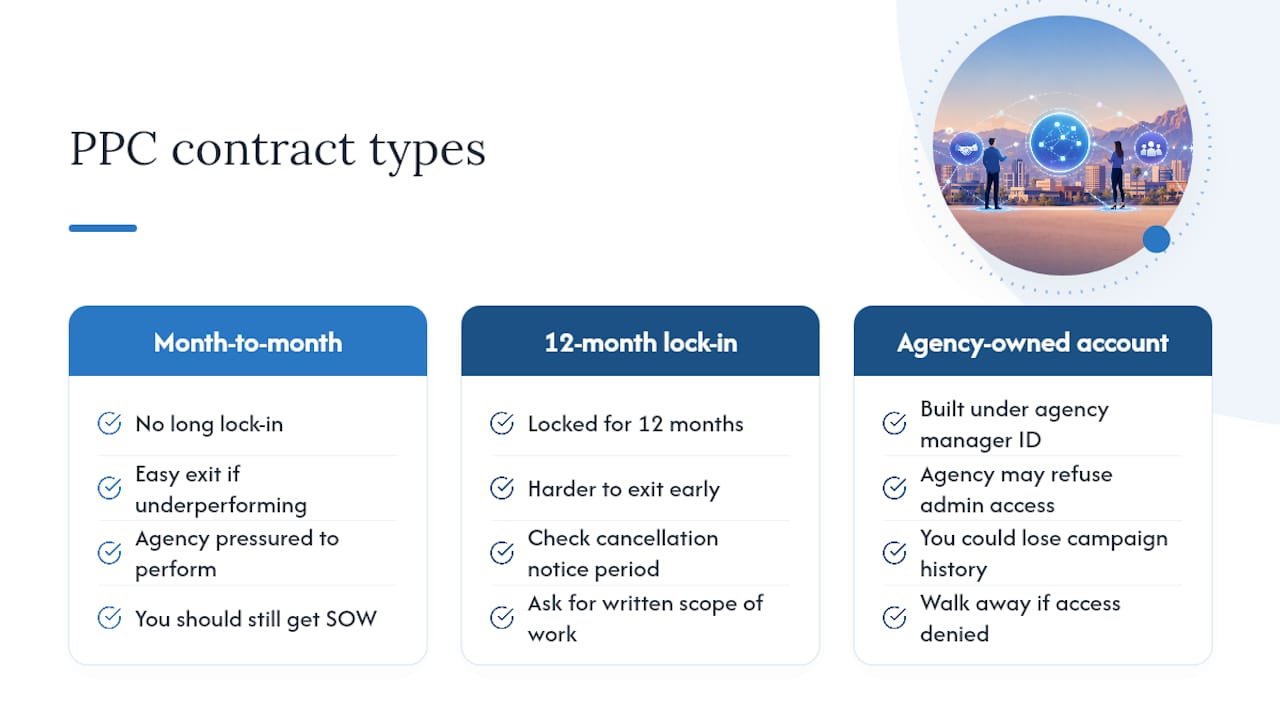
Read for a few specific terms. First, check the cancellation notice period, most reasonable agreements ask for 30 days written notice, not 90 or 120. Second, confirm who owns the account itself. Your Google Ads account, your conversion tracking setup, and your campaign history should belong to you, the business owner, not the agency. If an agency builds your account under their own manager ID and refuses to grant you admin access, walk away, because losing that agency later means losing your entire campaign history and optimization data.
Third, look at what’s actually included in the monthly fee versus what counts as a billable extra. Landing page builds, additional campaign types, and creative refreshes sometimes carry separate charges that aren’t obvious in the initial quote. Ask for a written scope of work, not just a verbal summary, so you know exactly what you’re paying for each month. A provider confident in their results won’t hesitate to put contract terms and deliverables in writing, and won’t need a long lock-in to keep your business.
DIY vs. Hiring an Agency: When Does Each Make Sense?
DIY makes sense if you’re testing a single keyword idea on a few hundred dollars a month, just to see if there’s demand before committing real budget. It gets riskier fast once you’re running multiple locations, tracking phone conversions alongside web leads, or trying to layer retargeting on top of Search.

That complexity is where a professional account manager consistently outperforms a business owner learning Google Ads on nights and weekends. If your funnel involves more than one conversion type or your customer value is high enough that a wasted month actually hurts, request an audit and let someone who does this daily take a look before you commit more budget.
Ready to Fix or Launch Your PPC Campaign?
If you’ve read this far, you probably already suspect your current PPC setup has gaps, whether that’s missing conversion tracking, ads pointing to your homepage instead of a dedicated landing page, or a budget spread too thin across campaign types. Webtechs runs PPC management alongside web design and SEO for Scottsdale small businesses, which means your landing pages, tracking, and ad copy all get built by the same team instead of stitched together from three different vendors.
Take a look at past client work in the Webtechs portfolio to see the kind of results local businesses have gotten, then check the PPC management pricing breakdown so you know the real cost before you talk to anyone. When you’re ready, request a free PPC audit and get a straight answer on whether your account is set up to make you money.
Sources
- About Performance Max campaigns — Google Ads Help
- What is pay-per-click (PPC)? — Salesforce blog
- The Complete Guide to Google Ads for Small Businesses in 2026 | Atmos
- Google Ads for Small Business: What Actually Works in 2026 | AdBot