

Topic Clusters for Scottsdale SMBs: One Pillar to Earn AI Citations
Topic clusters, a pillar page plus linked cluster pages, are the fastest way to turn scattered content into demonstrable topical authority that ranks and earns AI citations. We’ve found that Scottsdale businesses who consolidate thin, overlapping posts into a single hub-and-spoke structure see faster indexing and more consistent rankings. The immediate move: audit what you already have, then pick one conversion-relevant pillar topic to build around first.
TL;DR:
- Audit existing pages first, merging, redirecting, or retiring overlap; assign one primary intent to each URL to prevent keyword cannibalization.
- Publish the pillar before its spokes, then link each spoke back near the top using descriptive anchor text rather than generic labels.
- Map pages to awareness, comparison, and action questions, and open each section with a direct answer that AI systems can extract.
- Track rankings, organic clicks, engagement, assisted conversions, and AI citations monthly; wait three to six months for indexing and visibility before judging results.
- Review the pillar quarterly, add spokes only for distinct emerging questions, and merge thin pages instead of expanding the cluster for volume alone.
Table of Contents
- What topic clusters are and why they matter for SEO and AI search
- Step-by-step build plan to create a topic cluster that earns AI citations
- How to measure success: KPIs, AEO citations, reporting, and timelines
- Examples of successful topic cluster implementations in various industries
- Tools and software recommendations for building and managing topic clusters
- How to coordinate topic clusters with content calendars and SEO campaigns
- Role of user intent and search journey in shaping topic clusters
- Strategies for updating and expanding topic clusters over time
- What Scottsdale businesses get wrong about topic clusters
- How we build topic clusters for Scottsdale businesses
- FAQ
- Sources
What topic clusters are and why they matter for SEO and AI search
A topic cluster works on a simple division of labor. One pillar page owns the broad, high-volume head term and gives a complete overview. A set of cluster pages, sometimes called spokes, each target a narrower long-tail question or subtopic, linking back to the pillar and to each other. This hub-and-spoke pattern keeps every page focused on a single primary intent, which prevents the keyword cannibalization that happens when three different blog posts quietly compete for the same search term.
Google’s own guidance frames this as writing content primarily for people and using contextual, descriptive anchor text so crawlers can reliably trace the relationships between pages. When a site structures content this way, internal link equity flows cleanly from spokes into the pillar, and the pillar in turn signals topical depth across the cluster.
That structure matters even more for AI search. Search Engine Land’s reporting on topic clusters notes that answer engines break a query into sub-questions and pull short passages to answer each one, a process often called query fan-out. A cluster of focused, well-linked pages gives an AI system more precise passages to retrieve than a single sprawling article ever could.
- Pillar pages own the broad head term; cluster pages own the long-tail variations.
- One primary target per URL avoids pages competing against each other in search results.
- Clean internal linking passes authority and clarifies topical relationships for both crawlers and AI retrieval systems.
Step-by-step build plan to create a topic cluster that earns AI citations
Building a cluster is a sequence, not a single project. Skipping the audit step is the most common reason clusters underperform.
- Audit existing content. Pull a full inventory of your published pages, flag anything that overlaps in topic or target keyword, and decide what gets merged, redirected, or retired before you add anything new.
- Discover the right topics. Use semantic clustering around your core subject, study query fan-out patterns for your main keyword, and scout emerging questions your customers are already asking in reviews, calls, or support tickets.
- Map cluster pages by tier. Assign a Tier 1 pillar and Tier 2 supporting pages, giving each URL one clear primary intent so no two pages chase the same search.
- Write for extractability. Open each section with the direct answer, then support it. Chunk content into self-contained subsections, and use tables or numbered lists where a process or comparison is involved, since Search Engine Land notes that AI systems reward passages that fully answer a sub-question in their opening sentences.
- Set the linking rules and publish. Link from the pillar to each spoke in the introduction, link from every spoke back to the pillar near the top of the page, and use descriptive anchor text rather than “click here” on every internal link.
For Scottsdale businesses working through this for the first time, the mapping step is where most plans fall apart: a landscaping company, for example, might publish five posts that all target slightly different phrasings of “landscaping Scottsdale” instead of assigning one page to that term and sending the others after distinct subtopics like irrigation permits or drought-tolerant plant selection. Our SEO content strategy guide for Phoenix businesses walks through that kind of local topic mapping in more detail.
Anchor text deserves its own attention. Google Search Central recommends standard HTML anchors with contextual, descriptive text so crawlers follow links reliably, and a well-built pillar typically carries far more internal links than a standard post because it serves as the connective tissue for the entire cluster. We cover the specific linking patterns that moved the needle for one Scottsdale client in our internal linking strategy breakdown.
Pro Tip: Draft your pillar page’s outline before writing a single cluster page, then carve each H2 you can’t fully cover into its own spoke article.
How to measure success: KPIs, AEO citations, reporting, and timelines
A cluster earns its keep when you can show movement across both ranking data and AI visibility, not just a handful of vanity metrics.
- Rankings: track average position for the pillar’s head term and for each cluster page’s long-tail target separately.
- Traffic and engagement: watch organic clicks, pages per session, and how often visitors navigate from a cluster page into the pillar or another spoke.
- Conversions: segment cluster URLs in Google Search Console and analytics so you can measure assisted conversions tied to the cluster rather than lumping them into site-wide totals.
- AEO visibility: check whether your cluster pages appear in AI Overviews or get cited by third-party AI tools answering questions in your topic area.
HubSpot’s analysis of topic clusters recommends exactly this combination, rankings, traffic, engagement, and conversions, as the core framework for proving a cluster’s value, alongside tracking AEO citations across AI platforms. Give a new cluster three to six months before judging it: that’s roughly the window needed for a pillar and its spokes to get fully indexed, cross-linked, and picked up in both ranking systems and AI retrieval. Report monthly, but expect the real inflection point to show up closer to month four or five.
Examples of successful topic cluster implementations in various industries
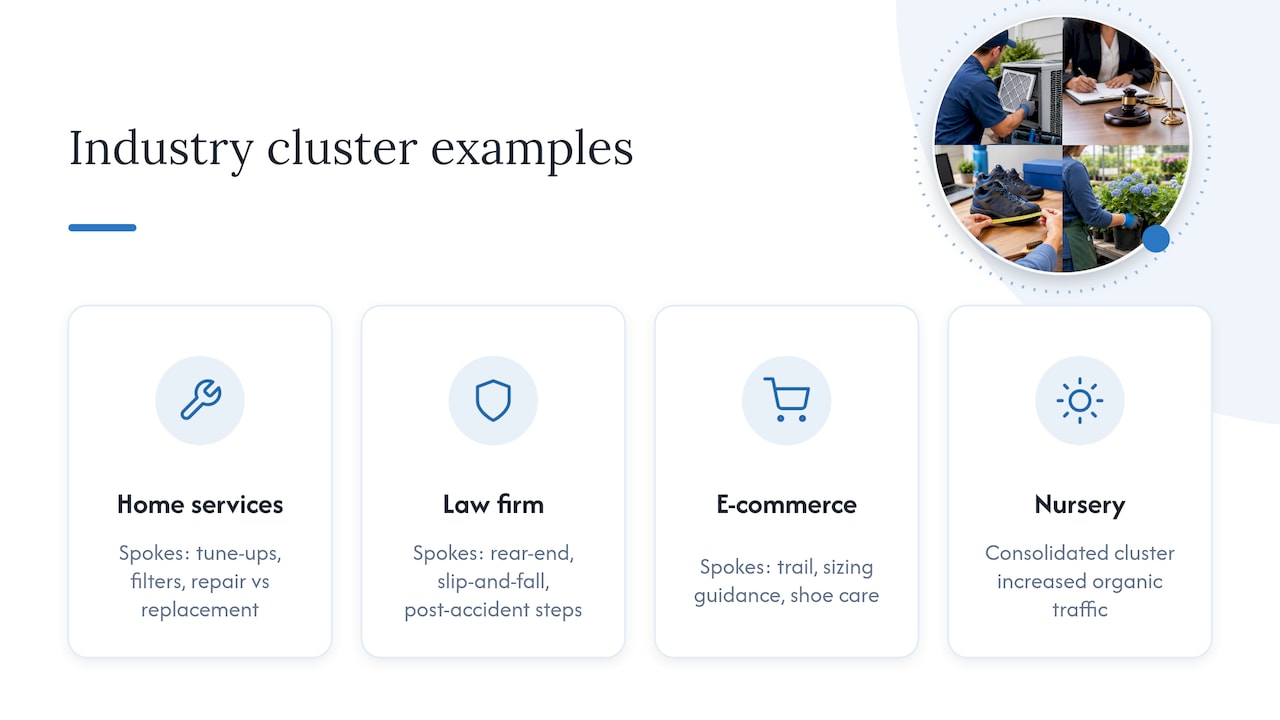
Cluster structure tends to look different by industry, but the underlying logic holds everywhere. A home services company in Scottsdale might build a pillar on HVAC maintenance with spokes covering seasonal tune-ups, filter replacement schedules, and when a repair versus a replacement makes financial sense, each spoke answering one question a homeowner would type into a search bar.
A law firm’s cluster often centers on a practice area, say personal injury, with spokes addressing specific scenarios like rear-end collisions, slip-and-fall claims, or what to do immediately after an accident. Because each spoke owns a distinct intent, the firm avoids three pages competing for the same “personal injury lawyer” search while still building out comprehensive coverage of the topic.
E-commerce brands frequently build clusters around product categories rather than individual SKUs: a pillar on running shoes might link to spokes on trail-specific footwear, sizing guidance, and shoe care, giving search engines and AI systems a coherent picture of the brand’s authority in that category.
We’ve seen the same pattern work in our own client base. A garden nursery we worked with consolidated overlapping plant-care content into a structured cluster and saw a measurable jump in organic traffic as a result of the reorganized, interlinked content. The specific industry changes the topics, but the structural discipline, one pillar, clearly scoped spokes, consistent internal linking, stays constant.
Tools and software recommendations for building and managing topic clusters
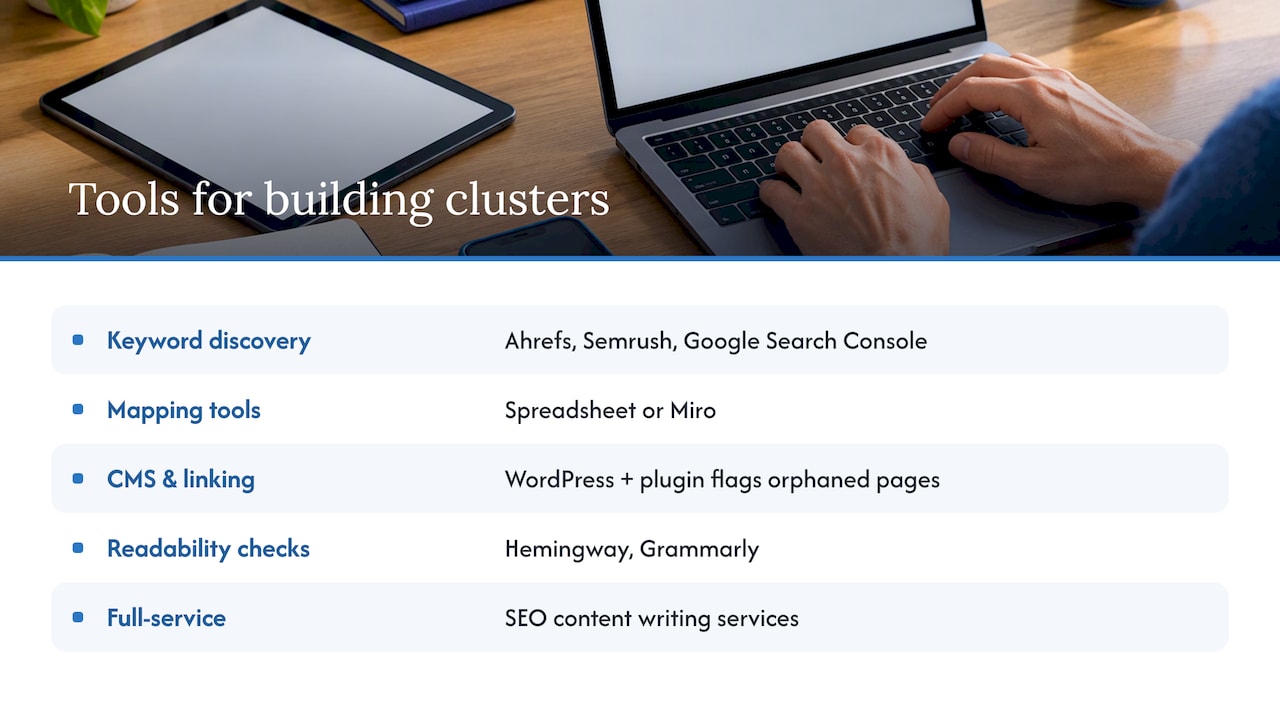
A handful of tools cover most of what a cluster build requires, and most SMBs already own at least one of them. For keyword and topic discovery, Ahrefs, Semrush, and Google Search Console’s own query data reveal the long-tail questions that should become spokes rather than afterthoughts. For mapping relationships between pillar and cluster pages, a simple spreadsheet or a visual tool like Miro works fine for teams who don’t need enterprise software.
Content management systems with strong internal linking and category structures, WordPress is the common choice for SMBs, make it easier to maintain the pillar-to-spoke relationships over time, especially with a plugin that flags orphaned pages or broken internal links. For readability and extractability checks, Hemingway Editor and Grammarly help confirm that each section opens with a direct answer rather than burying it under throat-clearing context.
Teams that produce supporting video or visual content for cluster pages sometimes also lean on creative tools built for faster asset production. AdSpark AI’s ad templates let you paste in a product URL and generate editable scripts and storyboards, which can speed up the supporting multimedia that strengthens page experience signals on commercial cluster pages.
For teams that want the audit, mapping, writing, and linking handled without assembling a stack of separate tools, our SEO content writing services build that structure directly into the content production process rather than treating it as a separate step.
How to coordinate topic clusters with content calendars and SEO campaigns
A cluster only works if publishing follows a sequence, and that sequence needs to live on your content calendar rather than in someone’s head. The pillar should publish first, even in a shorter initial form, so cluster pages have something to link back to immediately rather than sitting orphaned for weeks.
From there, schedule cluster pages in batches tied to your broader SEO campaign priorities. If a PPC campaign is already driving traffic to a particular service page, prioritize the cluster pages that support that same topic so organic and paid efforts reinforce each other instead of pulling in different directions. Search Engine Land notes that publishing a cluster ahead of a topic’s peak search interest gives a meaningful head start on both ranking and AI citation signals, which argues for building the calendar around anticipated seasonal demand rather than reacting after interest spikes.
Keep a standing slot on the calendar for pillar updates, not just new spoke content. A pillar that stops getting refreshed gradually loses its position as the most comprehensive resource on the topic, even if the spokes around it keep growing. Treat the pillar as a living document that gets revisited every time a new cluster page publishes.
Role of user intent and search journey in shaping topic clusters
Every cluster page should map to a specific stage in the reader’s search journey, not just a keyword. Someone searching a broad head term is usually still researching, which is exactly the audience a pillar page should serve with a complete overview and clear navigation into more specific questions. Someone searching a long-tail, highly specific phrase is often closer to a decision, and that’s the intent a cluster spoke needs to satisfy directly and quickly.
Mapping intent this way also prevents a common mistake: writing multiple spokes that all serve the same stage of the journey while leaving other stages uncovered. A well-built cluster typically has pages for awareness-stage questions, comparison or evaluation questions, and action-oriented questions like pricing or how to get started, so no part of the journey forces a reader to leave the cluster to find an answer. Getting this mapping right before writing a single page is what makes a cluster feel coherent to both readers and search systems, rather than a loose pile of related posts.
Strategies for updating and expanding topic clusters over time
A cluster is never finished. Search Engine Land’s guidance treats the pillar as a living resource that should be revised continually as new cluster pages publish, keeping it the single most comprehensive reference on the topic rather than letting it stagnate while the spokes around it multiply. Set a recurring review, quarterly works well for most SMB content volumes, to check whether the pillar still reflects your most current spokes and whether any spoke has been outranked by a competitor’s more specific content.
Expansion should follow gaps you can actually see in the data: a cluster page that gets strong impressions but weak click-through in Search Console often signals a title or opening paragraph that needs rewriting rather than a reason to add a new page. New spokes make sense when a genuinely new question emerges, whether from customer conversations, a shift in search behavior, or a new product or service line, not simply to pad the cluster with volume. Retiring or merging underperforming spokes matters just as much as adding new ones, since a thin page that never earned traffic dilutes the cluster’s overall topical signal instead of strengthening it.
What Scottsdale businesses get wrong about topic clusters
Most of the advice circulating about topic clusters treats them as a one-time project: build the pillar, publish ten spokes, move on. That’s backward. The businesses we see struggle are the ones who treat the pillar as a launch deliverable instead of a maintenance commitment, and within six months the pillar has fallen behind the very spokes it’s supposed to organize.
The other overrated idea is volume. Plenty of SMBs assume more cluster pages automatically means more authority, when a tightly scoped cluster of eight genuinely distinct pages will usually outperform twenty pages that blur together in intent. Pew Research found that users click traditional search links far less often when an AI summary appears, down to 8% of visits compared with 15% without one, which makes the case for extractable, precisely scoped content even stronger than it was before AI Overviews became common. Since fewer clicks are generally available, every cluster page needs to earn its place rather than existing as filler.
Prioritize the audit before anything else. Most sites already have the raw material for a strong cluster buried in old posts; the work is organizing it, not generating more of it.
— Brett
How we build topic clusters for Scottsdale businesses
We offer full cluster build services for business owners who’d rather not manage audits, keyword mapping, and internal linking on top of running a company. That work spans content strategy, SEO content writing, technical internal linking, and the on-page SEO that ties a cluster together into something search engines and AI tools can actually read as a coherent topic.

We have applied this structure across client work, including documented cases where restructured content drove measurable jumps in search visibility. If you want a second set of eyes on what your site already has before committing to a full rebuild, our Scottsdale SEO services page is the place to start, and a quick consultation is usually enough to tell you whether your existing content is a few links away from a working cluster or needs a fuller rebuild.
FAQ
Is SEO still worth it in 2026?
Yes, though the mechanics have shifted toward content that AI systems can extract and cite, not just content that ranks in a traditional ten-blue-links layout. Pew Research found that click-through drops when an AI summary appears, which makes structuring content for both AI citation and classic ranking more important, not less.
What are topic clusters in SEO?
Topic clusters are a content structure built around one pillar page covering a broad topic, linked to several narrower cluster pages that each target a specific subtopic or long-tail question. HubSpot explains that this structure strengthens topical authority and improves discoverability for both search engines and AI answer engines through consistent internal linking.
What is the 80/20 rule in SEO?
Applied to clusters, that means prioritizing the pillar topic and two or three spokes with clear commercial intent before expanding further.
Which strategy works best for fast, controllable website traffic: SEO, PPC, blogging, or organic social?
PPC delivers the fastest, most controllable traffic because you’re paying directly for placement rather than waiting on rankings to build. SEO, including topic clusters and blogging, takes longer but compounds over time and doesn’t disappear the moment you stop paying, which is why many Scottsdale businesses run PPC to generate traffic now while a cluster builds authority in parallel.
Sources
- SEO Starter Guide — Google Search Central
- Topic clusters for AI search — Search Engine Land
- Topic clusters: The next evolution of SEO — HubSpot
- Google users are less likely to click on links when an AI summary appears in the results — Pew Research Center