

SEO Content Strategy for Phoenix Businesses: A Practical Plan

Build a pillar page surrounded by three to five cluster pages tied to one revenue-driving service, prioritize local intent over broad keywords and repurpose each piece into multiple formats before you write anything new. That is the shortest path to better local visibility for a Phoenix business. Search engines and AI answer tools now reward sites that show clear topical authority with real proof behind it, not just page count. Webtechs has built this exact structure for Scottsdale and Phoenix-area clients, and the pattern holds: focused clusters beat scattered blog posts almost every time.
Key Takeaways
A pillar page supported by three to five cluster pages, built around one revenue-driving topic and reinforced with local Phoenix signals, is the fastest reliable path to better local search visibility.
| Point | Details |
|---|---|
| Start with local basics | Fix Google Business Profile, NAP consistency, and service-area pages before publishing new content. |
| Pick one revenue-tied pillar | Choose a topic connected to your highest-margin service, not the highest search volume. |
| Publish spokes before the pillar | Launching cluster pages first builds internal linking momentum for the pillar page. |
| Measure clusters, not single articles | Track rankings, leads, GBP actions, and AI citation mentions monthly. |
| Webtechs builds the full structure | Webtechs runs audit, cluster build, content writing, and reporting for Phoenix-area businesses. |
Table of Contents
- What Is an SEO Content Strategy, and Why Does It Matter in Phoenix?
- What Quick Local SEO Wins Should Phoenix Businesses Make First?
- What Are the Core Components of an Effective Content Plan?
- How Do You Build and Launch Your First Topic Cluster?
- How Long Does This Take, and What Does It Cost in Phoenix?
- Which KPIs Actually Show a Content Strategy Is Working?
- What Does a Real Phoenix-Area Result Look Like?
- What Should Phoenix Owners Prioritize First?
- How Webtechs Helps You Build This Without Doing It All Yourself
- Where to Learn More and Take the Next Step
- Frequently Asked Questions
- Sources
What Is an SEO Content Strategy, and Why Does It Matter in Phoenix?
An SEO content strategy is a plan for what you publish, how it connects, and how often, all built around a defined topical territory instead of random keyword chasing. It combines a pillar page (your broadest, most authoritative page on a core service) with cluster pages that answer narrower questions and link back to it. Done right, it maps directly to business outcomes:
- Visibility: consistent publishing on one topic signals expertise to Google and AI search tools alike.
- Local citations: content built around Phoenix neighborhoods and service areas earns mentions and links from local directories and news outlets.
- Leads: cluster pages targeting specific problems (“emergency AC repair in Tempe”) convert better than generic service pages.
Phoenix adds real texture here. Summer heat spikes drive seasonal search demand for HVAC, pool, and roofing services, and the metro’s sprawl means “near me” and neighborhood-specific searches carry more weight than in denser markets. A small-business content strategy that ignores that seasonality wastes months of runway.
What Quick Local SEO Wins Should Phoenix Businesses Make First?
Before you write a single cluster page, tighten these local signals. They cost little and often move rankings within weeks.
- Fully optimize your Google Business Profile: categories, service areas, photos, and weekly posts.
- Publish dedicated service-area pages for Scottsdale, Tempe, Mesa, Chandler, or wherever you actually work.
- Add localized FAQs that mirror how Phoenix customers phrase questions (“how much does AC repair cost in Phoenix in July?”).
- Confirm NAP (name, address, phone) consistency across your website, GBP, and directory listings.
Watch two signals monthly: whether you hold a map pack position for your top three services, and whether your local search intent examples match what customers actually type into voice assistants and mobile search.
Pro Tip: Build a short content piece around a recurring Phoenix event or pattern, like monsoon season roof damage or holiday retail traffic, and publish it a few weeks ahead of the seasonal spike. Search demand for these topics is predictable, and early publishing gives Google time to index and rank the page before the rush.

What Are the Core Components of an Effective Content Plan?
A working content plan has five moving parts, and skipping any one of them weakens the whole structure.
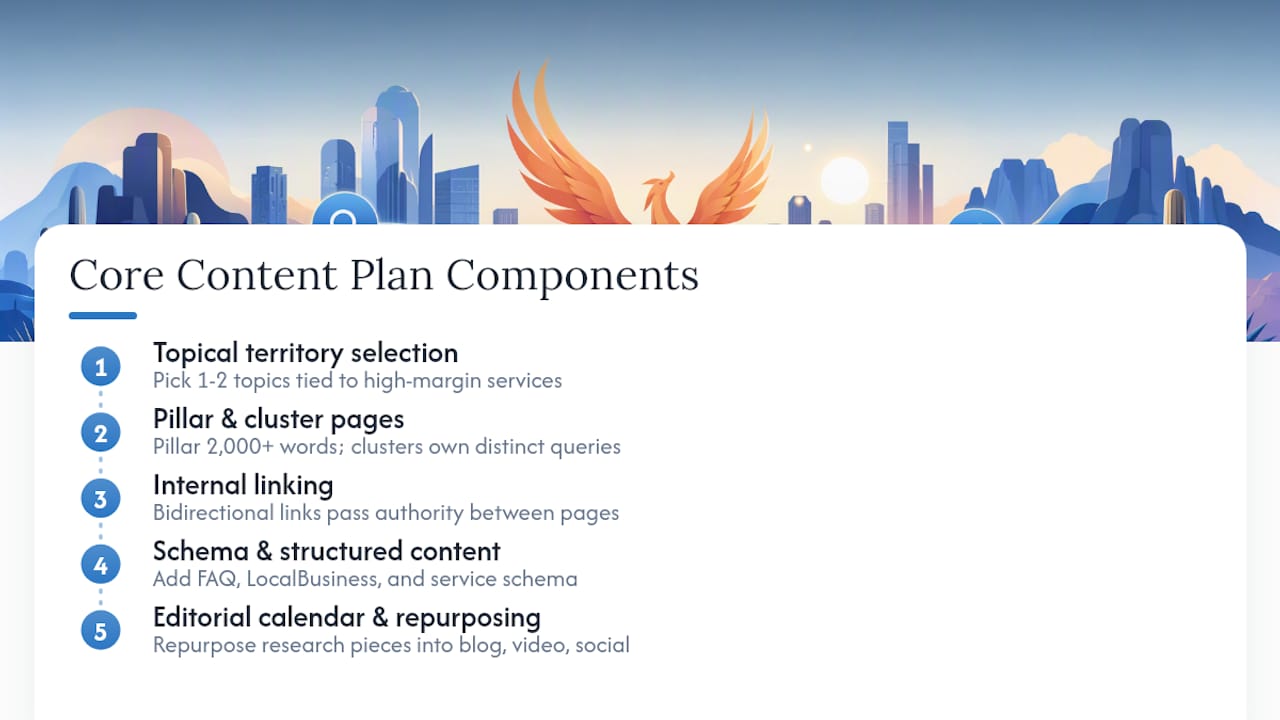
Topical territory selection comes first. Pick one or two subject areas that map directly to your highest-margin services, not everything you offer. A roofing company might choose “storm damage repair” over trying to cover every roofing topic at once.
Pillar and cluster pages follow. The pillar covers the topic broadly (2,000+ words, comprehensive); cluster pages go deep on specific angles, each one owning a distinct question or intent. Topic clusters organize this relationship so both search engines and AI tools can map how your pages relate to each other.
Internal linking connects every cluster page back to the pillar, and the pillar links out to each cluster. This passes authority between pages and helps Google understand the full scope of what you cover.
Schema and structured content (FAQ schema, LocalBusiness schema, service schema) make it easier for search engines to pull your content into rich results and AI summaries.
Editorial calendar and modular repurposing close the loop. Turn one research-heavy piece into a blog post, a short video script, and a handful of social posts instead of starting from scratch each time. That approach, sometimes called a modular content engine, keeps small teams producing consistently without burning out.
Pro Tip: Choose your pillar topic based on revenue, not search volume. A pillar on “commercial roofing Phoenix” tied to $15,000 jobs beats one on a high-traffic topic that never converts.
How Do You Build and Launch Your First Topic Cluster?
Follow this sequence for your first cluster, start to finish:
- Audit existing content. Find pages already ranking or getting engagement; these become your hub or an early spoke.
- Select one topic. Tie it to a service that drives real revenue.
- Map keywords and intent. Separate informational questions from ready-to-buy searches.
- Write content briefs. Outline headings, target questions, and internal links before drafting.
- Publish cluster pages first. Get three to five spokes live before the pillar goes up.
- Launch the pillar and interlink everything. Link every spoke to the pillar and vice versa.
- Promote and repurpose. Push each piece through email, social, and Google Business Profile posts.
A few tactical notes: run quick keyword checks against your GBP insights and Search Console data rather than expensive tools alone, and add FAQ schema to every cluster page during the brief stage, not after publishing.
On sequencing, publishing spoke content before the pillar isn’t just a nice-to-have. It builds internal linking signals early, so the pillar page doesn’t launch as an orphan asset with nothing pointing to it yet.
How Long Does This Take, and What Does It Cost in Phoenix?
Expect a real launch phase, not overnight rankings. Most clusters need 0 to 12 weeks to get published and indexed, another 3 to 6 months to show early ranking movement, and 6 to 12 months before you see dependable local rankings and citation growth. A comprehensive framework for topical authority recommends holding a topical territory for 12 to 18 months to fully compound results, so patience matters as much as execution.
Spend your first dollars on content quality and internal linking before chasing volume. A cost-effective SEO strategy built around fewer, better pages consistently outperforms a rushed blog dump.
Which KPIs Actually Show a Content Strategy Is Working?
Track a handful of metrics that connect to revenue, not vanity numbers.
- Local map pack and organic rankings for your pillar and cluster keywords.
- Organic leads and phone calls attributed to content pages.
- Google Business Profile views, clicks, and direction requests.
- Citation share in AI answer surfaces (does ChatGPT or Perplexity mention your business when someone asks about your service in Phoenix?).
- Assisted conversions where content touched the customer before they called or filled out a form.
Cluster-level performance matters more than any single article’s traffic. A small-business content strategy should measure engagement and conversions across the whole cluster, since one weak spoke can still support a strong pillar. Keep your monthly dashboard simple: rankings, leads, GBP actions, and one AI citation check.
What Does a Real Phoenix-Area Result Look Like?
Webtechs ran a focused SEO campaign for a music industry client that followed this same audit, cluster, promote, measure sequence. The result was a documented 4,490% increase in organic traffic, a scale of growth that reflects a highly targeted niche and shouldn’t be read as a typical baseline for every industry.
- Before: minimal organic visibility and inconsistent content publishing.
- After: sustained ranking growth and a measurable jump in qualified organic traffic.
- Methodology: full content audit, cluster architecture build-out, promotion across relevant channels, and ongoing measurement against baseline metrics.
The lesson isn’t the percentage. It’s that a structured audit-to-measurement process, applied consistently, produces compounding results over time, even in a competitive niche.
What Should Phoenix Owners Prioritize First?
Fix your Google Business Profile and local service pages before writing a single blog post. Then pick one pillar topic tied directly to revenue, and build three cluster posts around it before expanding further. Do it yourself if you have a few hours weekly and patience for a slow build. Hire help when you need speed or lack bandwidth for consistent publishing. Either way, original proof and steady consistency compound with both local search and AI answer engines over time.
How Webtechs Helps You Build This Without Doing It All Yourself
Webtechs is the alternative to hiring a full in-house content team for a Phoenix business that needs a pillar and cluster strategy built right the first time. Instead of guessing at keyword research or piecing together a content calendar between other jobs, you get a team that has already run this exact playbook for local service businesses, from audit through publishing to reporting.

Webtechs handles local SEO, professional content writing, topic-cluster builds, and Google Business Profile optimization under one roof, so your pillar page and cluster spokes come out of the same strategic plan instead of disconnected assignments. The music industry case study shows what a focused campaign can produce when the structure is right. If you want to see past work before committing to anything, browse the Webtechs portfolio and request a local SEO audit to find out which pillar topic makes sense for your business first.
Where to Learn More and Take the Next Step
- Topic clusters guide explains pillar and cluster architecture for planning.
- Small-business content strategy covers goal-setting and measurement.
- Modular content shows how to repurpose content efficiently.
- Does blogging help SEO? explains cadence and content type decisions for execution.
Frequently Asked Questions
What is the 80/20 rule in content strategy?
Focus resources there instead of spreading effort evenly across every topic.
How many cluster pages do I need to start?
Three to five cluster pages per pillar is enough to launch. You can expand the cluster later as you find new customer questions worth answering.
Should I hire an agency or do this myself?
Do it yourself if you have consistent weekly time and patience for a slower build. Hire an agency like Webtechs when you need faster execution or lack the bandwidth to publish consistently.
How do I know if my content strategy is working?
Watch local rankings, organic leads, Google Business Profile actions, and whether AI tools mention your business when answering related questions in your area.
Does this work for every type of Phoenix business?
The pillar and cluster approach works for most service-based and local businesses, though timelines vary by competition density and how established your current site already is.
Sources
- Topic clusters: The next evolution of SEO
- How to develop a small business content strategy – U.S. Chamber
- What is modular content & why it’s necessary today