

Scottsdale PPC: When Broad Match Beats Phrase Match (15–30% Rule)

If your Google Ads account has solid conversion tracking and Smart Bidding turned on, broad match paired with Target CPA or Target ROAS is the stronger play for discovery. If your tracking is thin or your budget can’t absorb a few weeks of learning, stick with phrase or exact match for control. Start by auditing your conversion tags this week before touching match types.
TL;DR:
- Broad match paired with Target CPA or Target ROAS requires strong conversion tracking and regular search-term management to be effective.
- Less than 15 to 30 conversions monthly, poor tracking quality, or lack of weekly oversight make broad match riskier and better suited for phrase or exact match.
- Search intent now guides match types more than shared words, with broad match casting the widest net and phrase match being more flexible but still controlled by negative keywords.
- Management costs include weekly review of search terms, negative keyword sculpting, and landing page optimization, with results typically observable within six weeks.
- Agencies should include comprehensive audits, clear scope, and performance tracking in their proposals, as well as understand that broad match needs ongoing discipline for success.
Table of Contents
- Broad Match vs Phrase Match in Scottsdale: Local Agencies Who Can Set This Up
- How Do You Decide Between Broad and Phrase Match?
- What’s the Real Difference Between Broad and Phrase Match Today?
- What Does a Scottsdale PPC Provider Typically Cost?
- How Long Until You See Results From a New Match-Type Strategy?
- How WebTechs.Net Applies This for Scottsdale Clients
- Get a Free PPC Audit From a Scottsdale-Based Team
- Sources
Broad Match vs Phrase Match in Scottsdale: Local Agencies Who Can Set This Up
Getting broad match and Smart Bidding to work together isn’t a settings toggle. It takes someone watching search-term reports weekly, sculpting negatives, and knowing when a “discovery” keyword has earned a promotion to your core campaign. That’s the part most Scottsdale advertisers underestimate, and it’s why a lot of small business owners end up hiring it out rather than white-knuckling it in-house.
WebTechs.Net is a Scottsdale digital marketing agency that manages PPC accounts alongside its SEO and web design work, and it’s a name that comes up when local business owners search for hands-on Google Ads help.
| Provider | Google Reviews | Core Services | Best For |
|---|---|---|---|
| Webtechs | 4.8★ (19 reviews) | PPC management, SEO (on-site and off-site), local SEO, Google Maps marketing, conversion tracking, landing page work | Scottsdale small to mid-sized businesses that need local PPC management paired with conversion-tracking setup |
WebTechs.Net’s PPC work sits inside a broader local SEO and web design practice, which matters more than it sounds. An agency that only touches your ad account has no visibility into whether your landing page is actually converting the clicks broad match sends it. WebTechs.Net builds and audits the landing pages, wires up call tracking, and manages the campaigns, so the conversion signal feeding Smart Bidding is built by the same team optimizing against it.
If you’re evaluating whether to hire out this work, here’s what a reasonable engagement looks like:
- A free initial audit of your current account structure, match types, and conversion tracking setup.
- A proposal that separates discovery spend from proven, performance-driving keywords.
- Monthly reporting that shows search-term trends, not just impressions and clicks.
- A clear plan for call tracking if your business runs on phone leads rather than form fills.
Ask for all four before you sign anything. An agency that skips the tracking audit is planning to run broad match blind.
How Do You Decide Between Broad and Phrase Match?
The decision isn’t really “broad vs phrase match” in the abstract. It’s whether your account has the conversion data and bidding setup to make broad match safe. Here’s the framework, whether you’re running this yourself or vetting an agency to run it for you.
Decision criteria that actually matter:
- Conversion volume. If you’re logging fewer than roughly 15 to 30 conversions a month, Smart Bidding doesn’t have enough signal to bid well on broad match’s wider net. Stick with phrase or exact until volume builds.
- Tracking quality. Enhanced Conversions and call tracking need to be live before broad match, not after. Garbage conversion data makes automated bidding worse, not better.
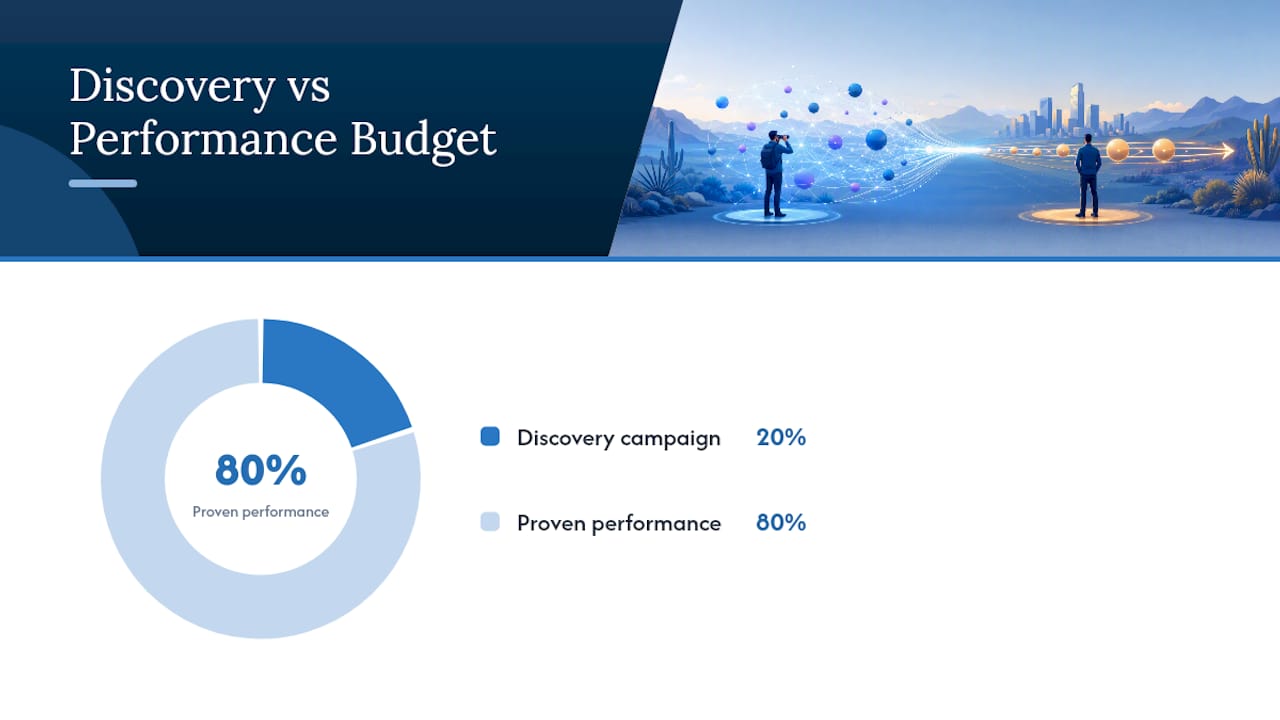
- Budget allocation. Most practitioners suggest putting 15 to 30 percent of incremental search budget into an isolated broad match discovery campaign, keeping it separate from your proven performance campaigns.
- Management capacity. Someone has to review search terms weekly. If nobody on your team (or your agency) is doing that, broad match will drift toward irrelevant traffic fast.
Questions worth asking any agency before you hand them your account:
- How do you decide when a broad match keyword graduates into a performance campaign?
- What’s your negative keyword review cadence, weekly or monthly?
- Are you running broad match on Smart Bidding, or manual CPC?
- How do you tie call leads back to specific keywords and ad groups?
Pro Tip: If an agency says broad match works fine on manual CPC, that’s a red flag, not a shortcut. Google Ads’ own guidance treats broad match as something to run only with automated bidding, because it needs per-auction adjustments manual bidding can’t make.
Other red flags: no mention of negative keywords at all, no call tracking for a lead-gen business, and vague answers about reporting cadence. A sample escalation path looks like this: launch broad match in a discovery campaign at 20% of budget, watch search terms for two to three weeks, promote converting queries into an exact match performance campaign, and prune the rest as negatives.
What’s the Real Difference Between Broad and Phrase Match Today?
Neither match type works the way it did five years ago. Google Ads now matches on meaning, not literal strings, for all three match types, including exact match. That single fact changes how you should think about broad vs exact match and phrase match vs exact match alike.
Broad match casts the widest net. It shows your ad for searches related to your keyword’s meaning, even without any shared words. A keyword like “running shoes” can trigger on “best sneakers for marathon training.” That’s powerful for discovery and dangerous without Smart Bidding steering the wheel.
Phrase match sits in the middle. It requires your keyword’s core meaning to be present, but it’s no longer strict about word order or exact phrasing. Google retired the broad match modifier (BMM) in 2021, and legacy BMM keywords quietly started behaving like phrase match. If you were running “+running +shoes” keywords, they’ve functioned as phrase match for a few years now, whether you noticed or not.
Exact match stays narrowest, but even it now allows for close variants, plurals, and rewordings with the same intent.
A concrete example: a phrase match keyword like “Scottsdale HVAC repair” can now trigger on “who fixes HVAC systems in Scottsdale” because Google reads the intent behind the phrase, not just its words. That’s a meaningful shift from how phrase match explained itself back in 2019.
Guardrails that still matter regardless of match type: review search terms weekly, add negatives for irrelevant categories (job seekers, DIY searchers, competitor brand names), and never launch broad match without Smart Bidding already active on the campaign, a point Search Engine Land’s analysis backs up with real account data showing conversion gains alongside rising negative-keyword workload.
What Does a Scottsdale PPC Provider Typically Cost?
Local PPC management in the Scottsdale market generally runs as a monthly retainer rather than a flat project fee, since campaigns need ongoing bid, keyword, and negative keyword adjustments. Retainers for small to mid-sized businesses commonly scale with ad spend and account complexity, a single-location service business managing a few thousand dollars in monthly ad spend sits at a different management tier than a multi-location retailer running six figures annually.
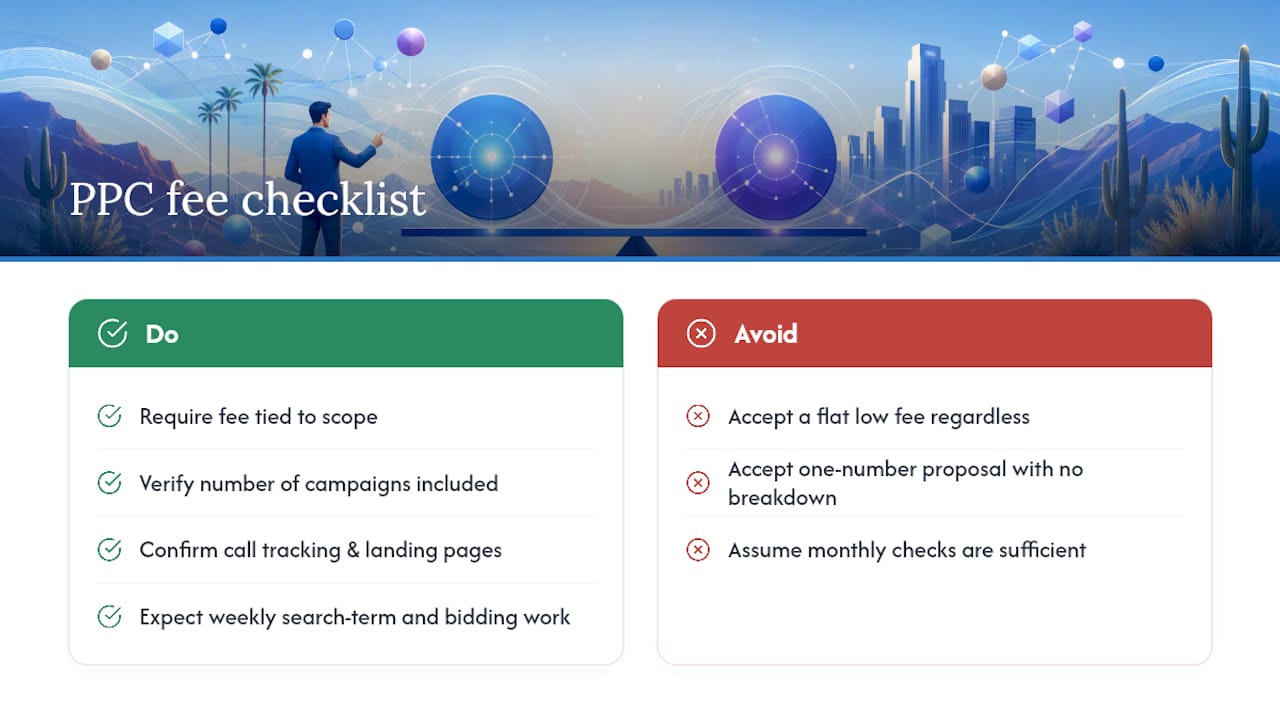
What you’re really paying for is the weekly discipline broad match requires: search-term reviews, negative keyword sculpting, landing page testing, and Smart Bidding target adjustments as conversion data accumulates. An agency charging a flat low fee regardless of spend or complexity is usually not doing that weekly work, they’re checking the account monthly at best.
When you request a proposal, ask for the fee structure to be tied explicitly to scope: number of campaigns, whether call tracking and landing page work are included, and what reporting cadence you get for that price. A proposal that quotes one number with no scope breakdown is hard to evaluate against a competing bid, and it’s a sign the agency hasn’t thought through what your account actually needs.
How Long Until You See Results From a New Match-Type Strategy?
Phrase and exact match campaigns that are already stable tend to show clean performance data within the first one to two weeks, since you’re working with a narrower, already-vetted keyword set. There’s less for Smart Bidding to learn.
Broad match behaves differently. Smart Bidding needs a learning period of several weeks to gather enough conversion signal before its bidding stabilizes. During that stretch, expect noisier results: some search terms that clearly don’t fit, cost per conversion that swings around, and a real temptation to panic and shut it off after day five. Resist that. The 15 to 30 percent budget allocation recommended for discovery campaigns exists precisely so a rough first two weeks doesn’t blow your whole monthly spend.
By week four to six, a well-managed broad match campaign should show which search terms are converting reliably. That’s when you promote those terms into your performance campaign and start pruning the rest as negatives. If you’re not seeing that separation emerge by six weeks, the account isn’t being managed with enough negative keyword discipline, or your conversion volume is too low for Smart Bidding to have learned anything useful yet.
How WebTechs.Net Applies This for Scottsdale Clients
The hybrid model works: a small, isolated broad match campaign running on Smart Bidding for discovery, paired with a phrase and exact match campaign carrying the keywords already proven to convert. WebTechs.Net has run this structure across local SEO and PPC case studies for Scottsdale service businesses, watching search terms weekly rather than checking in once a month.
The transition from discovery to performance isn’t automatic. It’s a manual review: a search term earns three or more clean conversions before it graduates into the tighter campaign, and anything irrelevant gets added as a negative the same week it shows up. That discipline, more than any single match-type setting, is what separates accounts that scale from accounts that stall.
Get a Free PPC Audit From a Scottsdale-Based Team
Webtechs is the alternative to guessing your way through match types alone. Instead of piecing together Smart Bidding settings and negative keyword lists on nights and weekends, you get a Scottsdale-based team that already runs this exact discovery-to-performance structure for local businesses.
Webtechs handles PPC management, conversion tracking setup, call tracking, and landing page optimization under one roof, so the conversion data feeding your Smart Bidding campaigns is built by the same people managing the bids. That matters more than most advertisers realize: an agency that only touches your ad account has no way to fix a landing page that’s leaking conversions before they ever reach Google’s bidding algorithm. Local knowledge also speeds things up. A Scottsdale-based team already understands the seasonal demand swings and competitive landscape specific to this market, which means less time spent explaining your business and more time spent testing keywords.
Request a free audit and portfolio review to see exactly where your current account stands before you commit to a new match-type strategy.
Sources
- About keyword matching options – Google Ads Help
- Why phrase match is losing ground to broad match in Google Ads — Search Engine Land
- Google Ads Keyword Match Types: 2026 Guide — Conversion Studio