

Five Step AI Content and SEO Workflow for Scottsdale SMBs by Webtechs
Yes, AI can speed up your content production and support better SEO results in Scottsdale, but only when it works as an assistant, not an autopilot. The winning approach pairs AI drafting with human fact-checking and local proof. Pick one service page or location page this week, run it through the five-step hybrid workflow below, and treat every AI draft as a first pass that a real person and Webtechs both stand behind before it goes live.
TL;DR:
- Using AI to generate initial drafts speeds up content creation but requires thorough human fact-checking to prevent hallucinated facts and inaccurate claims.
- Building each page around a specific customer problem, verified local facts, and tested technical SEO ensures better ranking and local relevance.
- Avoid mass-produced, duplicate pages and implement strict review processes to prevent penalties related to scaled content abuse and low-quality output.
- Proper technical setup, including structured data validation and monitoring, is essential for AI-assisted pages to appear in search features and rankings.
- Combining AI drafting with ongoing technical and local SEO work provides the best ROI, especially for small businesses seeking scalable, compliant content.
Table of Contents
- What AI Can and Can’t Do for Local SEO
- Five-Step Hybrid Workflow a Scottsdale Small Business Can Use Today
- Publishing Checklist: Crawlability, Structured Data, and Monitoring
- Failure Modes and Guardrails to Avoid Search Penalties
- Typical Timeline and Cost Shape for Agency-Assisted vs. DIY
- Evaluating AI Content Tools for SEO: Criteria, Pricing, and Red Flags
- Integrating AI-Generated Content With Traditional SEO Strategies
- Legal and Ethical Considerations of AI Content in SEO Campaigns
- Webtechs’s Local Perspective on AI-Assisted Content
- Get a Local SEO Audit From Webtechs
- Sources
- FAQ
What AI Can and Can’t Do for Local SEO
AI tools are genuinely useful for the front end of content work. They’re weak at the parts that actually build trust with Google and with customers.
Where AI earns its keep:
- Turning customer questions (“Do you fix AC units on weekends in Scottsdale?”) into topic ideas and outlines
- Generating multiple draft angles for a service page so you’re not staring at a blank screen
- Suggesting internal links between related pages on your site
- Repurposing a blog post into social captions, email copy, or a short video script
Where it falls short: AI models still hallucinate facts and sometimes invent sources or statistics that don’t exist. Purely AI-generated text also carries no copyright protection under current US law, which matters if you’re building content assets you plan to defend. And there’s no secret AI trick that bypasses ranking fundamentals. Google’s own guidance states there are no additional technical requirements for a page to be cited in AI Overviews or AI Mode beyond being crawlable, indexable, and genuinely helpful. Production method is secondary. What matters is whether the page actually answers the searcher’s question better than the alternatives.
That’s the real dividing line: use AI to move fast on the parts that don’t require judgment, and keep a human in the loop on anything involving facts, pricing, service areas, or claims about your business.
Five-Step Hybrid Workflow a Scottsdale Small Business Can Use Today
You don’t need a content team to do this right. You need a process, and about half a day per page.
- Define one customer problem and search intent. Pick a specific need, phrased the way a Scottsdale customer would search it. “Emergency plumber Scottsdale weekend rates” beats “plumbing services” every time.
- Collect first-party facts before you write anything. Gather your actual offers, service-area boundaries, licensing details, before-and-after photos, and current Google Business Profile info. AI can’t invent this, and it shouldn’t try.
- Use AI for ideation and outlining, then hand it to a human editor. Generate two or three draft variants, but require a subject-matter reviewer, ideally someone who actually knows your business, to check every fact, claim, and local reference before it moves forward.
- Complete the technical SEO layer. Titles, meta descriptions, header structure, structured data, mobile rendering, page speed, and accessibility all need attention before publishing, not after.
- Publish, then monitor and iterate. Watch Search Console for indexing status, track calls and form fills tied to the page, and revise based on what’s actually converting.
Pro Tip: Build a simple “local proof” checklist you reuse for every page: one customer photo, one specific neighborhood or landmark reference, and one detail only someone who actually works in Scottsdale would know. That’s the difference between a page that reads like a template and one that reads like your business.
Semrush’s 2026 analysis of ranking pages found human-written content classified at an 80.5% probability for position 1, compared to 10% for AI-generated content. The study is observational, not a controlled experiment, but it lines up with what this workflow assumes: heavy human involvement still correlates with the pages that win.
Publishing Checklist: Crawlability, Structured Data, and Monitoring
Before an AI-assisted page can show up anywhere, including inside Google’s AI features, it has to clear a set of basic technical hurdles. Miss these and the best writing in the world won’t matter.
- Confirm the page returns an HTTP 200 status and isn’t blocked by robots.txt or a stray noindex tag
- Make sure important content exists as real text, not locked inside images or content that only renders after heavy JavaScript execution
- Add JSON-LD structured data that matches what’s visible on the page, then validate it with Google’s Rich Results Test
- Keep your Google Business Profile current: service areas, hours, categories, and photos all need regular updates
- Check mobile rendering and page speed, since both affect page experience scoring
- Confirm indexing status inside Search Console rather than assuming a published page gets indexed automatically
- Set up conversion tracking so calls, form fills, and leads tie back to the specific page that generated them
Google notes there are no special technical hoops for AI Overview or AI Mode eligibility beyond standard crawlability and indexability, according to its AI features guidance. Structured data won’t guarantee an AI citation either. Google’s documentation on structured data recommends using accurate, complete properties and validating markup rather than treating schema as a ranking shortcut.
Failure Modes and Guardrails to Avoid Search Penalties
Most AI content problems trace back to scale, not the technology itself. One well-reviewed page is fine. Two hundred near-identical pages targeting every possible keyword combination is a different story.
- Scaled content abuse. Google’s spam policies specifically call out mass-produced, near-duplicate pages built primarily to manipulate rankings rather than help a reader.
- Hallucinations and invented citations. Require a human fact-check pass on every AI draft before it publishes, especially anything involving pricing, credentials, or statistics.
- Weak operational discipline. Build single-purpose pages, keep version history, and route every draft through an actual editorial review, not a quick skim.
- Warning signs to watch for. A sudden traffic drop, unusually low time-on-page, or a manual action notice in Search Console all suggest something in your content or technical setup needs attention fast.
The pattern behind most penalties isn’t “used AI.” It’s “published at a volume and quality level no human ever reviewed.”
Typical Timeline and Cost Shape for Agency-Assisted vs. DIY
Doing this yourself costs less in dollars and more in hours. A solo owner using AI tools plus free technical checkers can produce a solid page in a few hours of active work, spread across a day or two once research and photo-gathering are factored in. The catch is that most owners don’t have a spare afternoon every week, and technical SEO tasks like structured data and Search Console monitoring have a real learning curve.
Agency-assisted work shifts the cost from time to a monthly or project fee, but compresses the calendar. A content and local SEO retainer typically covers ongoing page production, technical audits, and performance monitoring rather than a single one-off page. Custom web design and content writing projects tend to run on a project-fee basis, while ongoing SEO, hosting, and content work run monthly. Webtechs doesn’t publish blanket pricing because scope varies by business size and competitive market, and current rates are available directly through the Scottsdale SEO services page.
The realistic middle ground for most small businesses: DIY the easy pages using the five-step workflow above, and bring in outside help for the technical layer, the pages tied directly to revenue, or anything where a mistake would actually cost you customers.
Evaluating AI Content Tools for SEO: Criteria, Pricing, and Red Flags
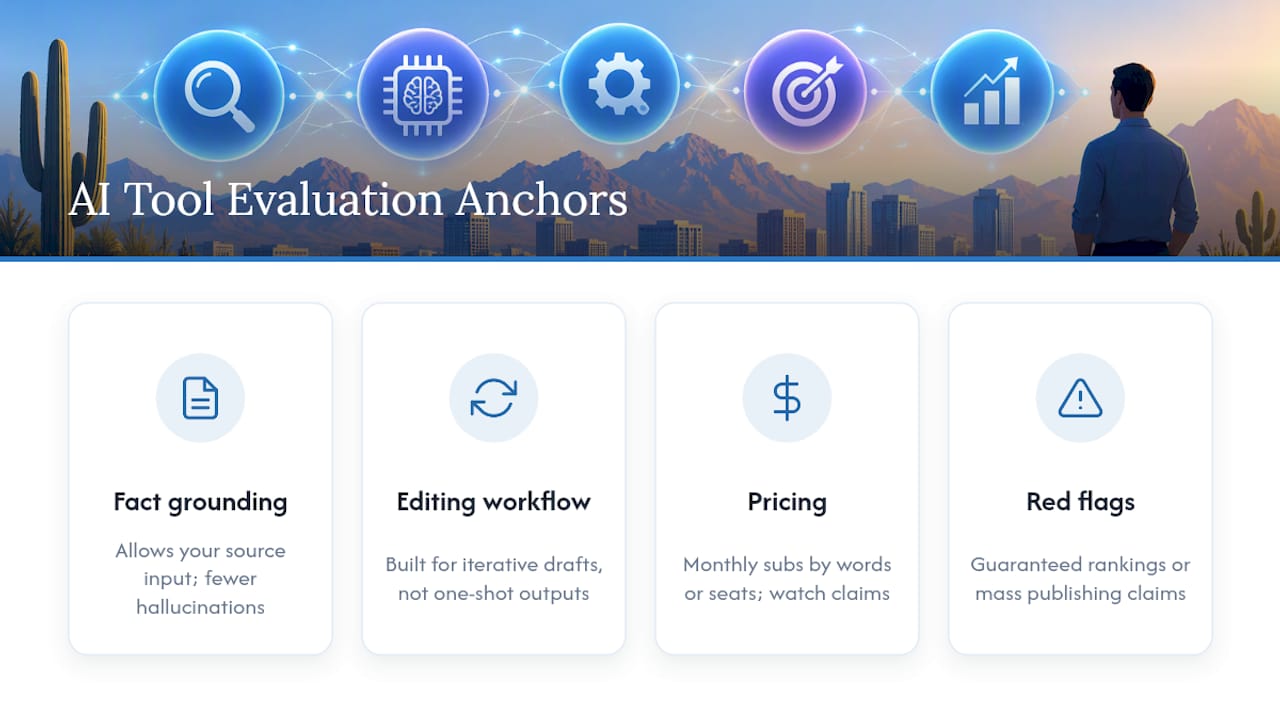
Not every AI writing tool is built for search content, and picking the wrong one wastes both time and money. Before subscribing to anything, check four things.
Fact-grounding and citation behavior. Does the tool let you feed it source material, or does it generate freely from training data alone? Tools that accept your own facts, pricing, and service details as input produce far fewer hallucinations than ones that write purely from a prompt.
Editing and revision workflow. Look for tools built around iterative drafts rather than one-shot generation. OpenAI’s own guidance on writing treats every output as a draft that improves with added context and human review, not a finished product.
Pricing structure. Most legitimate tools run on monthly subscriptions tied to word volume or seat count. Be wary of anything promising unlimited “SEO-optimized” content at a flat low price with no mention of editing support.
Red flags worth walking away from. Any tool that promises guaranteed rankings, claims to bypass Google’s guidelines, or encourages publishing dozens of pages per day without review is selling a shortcut that Google’s spam systems are specifically built to catch.
Integrating AI-Generated Content With Traditional SEO Strategies
AI content doesn’t replace keyword research, internal linking, or technical SEO. It slots into the same process you’d run with a human writer, just faster at certain stages.
Start with the keyword and intent research you’d normally do, whether that’s a simple list of customer questions or a full local SEO checklist. Feed that research into the AI tool as context rather than a bare topic prompt. The draft that comes back still needs the same on-page treatment any page needs: header hierarchy that matches search intent, internal links to related service pages, and image alt text that describes what’s actually shown.
The technical side doesn’t change either. Structured data, mobile performance, and Core Web Vitals matter exactly as much for an AI-assisted page as for one written entirely by hand. What changes is where your time goes: less spent staring at a blank page, more spent verifying facts and connecting pages into a coherent site structure. Businesses that treat AI as a research and drafting accelerant, then apply the same SEO discipline they’d use anyway, tend to see the workflow pay off. Those that treat AI as a replacement for strategy usually end up with a pile of unlinked pages nobody finds.
Legal and Ethical Considerations of AI Content in SEO Campaigns
Two issues come up constantly for small businesses experimenting with AI content, and both deserve a straight answer.
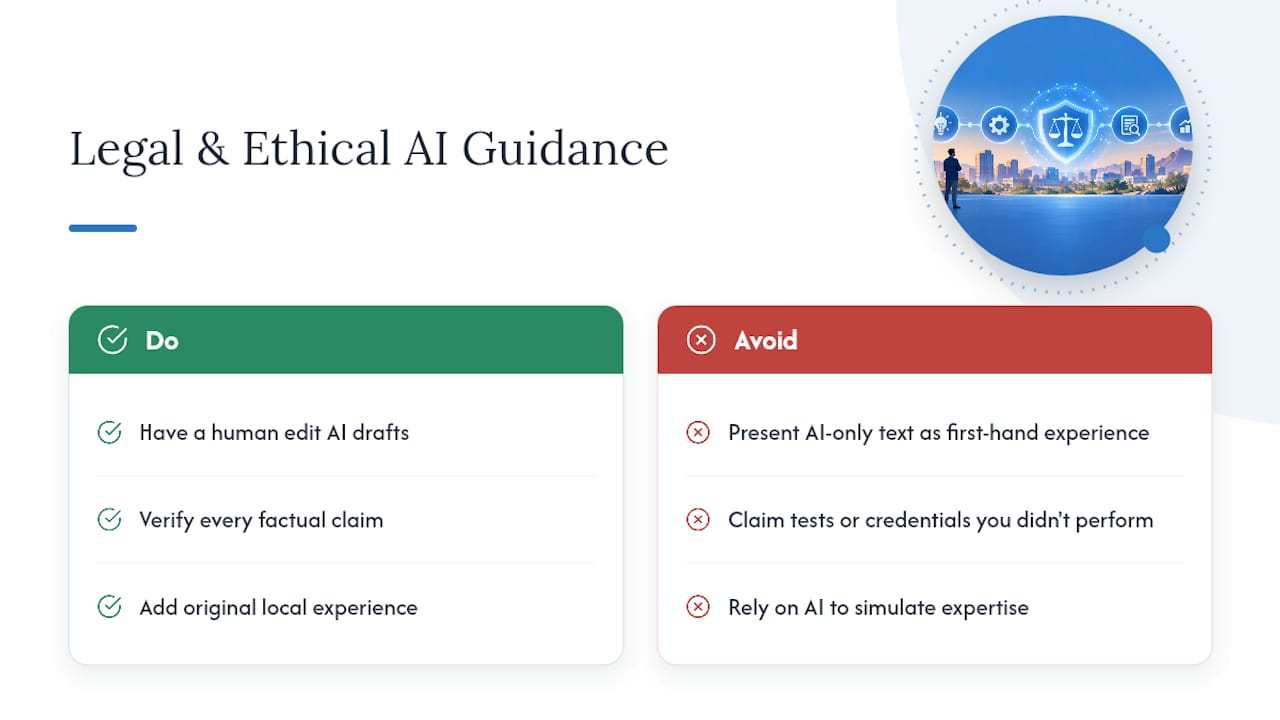
Copyright. Content generated entirely by AI, with no meaningful human authorship, currently receives no copyright protection under US law. If you’re building content you consider a business asset, that’s a real consideration. The safer path: use AI for drafting, but ensure a human materially edits, restructures, or adds original material, which strengthens your claim to authorship.
Disclosure and honesty. Google doesn’t require you to label content as AI-assisted, but misrepresenting AI-generated claims as first-hand customer experience or credentialed expertise is a different problem. If a page implies “our technician says” or “we tested this,” that has to be true. Practitioner guidance on using AI for content writing authentically recommends a firm human-verification step for exactly this reason: every factual claim gets checked, and original local experience gets added, not simulated.
The underlying principle: AI can help you write faster, but it can’t testify to your business’s experience, licensing, or track record. Only you can do that, and Google’s helpful-content guidance consistently rewards content that demonstrates real, first-hand expertise over content that merely sounds authoritative.
Webtechs’s Local Perspective on AI-Assisted Content
Webtechs has a long history of building websites and running SEO campaigns for Scottsdale small businesses. That history shapes how the hybrid workflow gets applied here: AI speeds up ideation and first drafts, but every page still goes through a review focused on accuracy, local specificity, and whether it actually reflects the client’s business.
A typical 30/90-day engagement starts with a technical and content audit, then moves into page production, which might include SEO content writing, Google Maps optimization, or a local landing page buildout, alongside ongoing monitoring of what’s actually driving calls and leads. The tools change faster than the fundamentals do. What hasn’t changed is that a page written for a real Scottsdale plumber, dentist, or retailer needs to sound like it, not like a template stretched over a keyword.
— Brett
Get a Local SEO Audit From Webtechs
Webtechs is the alternative to guessing which AI tools actually help versus which ones create liability: a Scottsdale-based team that runs the hybrid workflow for you, pairing AI-assisted drafting with hands-on local SEO, technical checks, and human verification before anything publishes.

That means you get pages built around real service-area facts and your Google Business Profile, structured data that’s actually validated, and content a real editor has reviewed for accuracy, not just grammar. Whether you need a single landing page fixed or a full SEO content writing program running month over month, the process stays the same: audit first, then build, then measure what’s actually converting into calls and leads.
If you want to see what that looks like before committing, check the portfolio of past work or head straight to the Scottsdale SEO services page to request an audit and get a 30/90-day plan scoped to your business.
Sources
- AI features and your site | Google Search Central
- Does AI Content Rank in Search? Data Study — Semrush
- OpenAI Academy — Writing guidance
FAQ
Is There an AI That Can Do SEO?
No single AI tool handles SEO end to end. AI tools can assist with keyword research, drafting, and outlining, but tasks like technical audits, structured data validation, and Google Business Profile management still require human oversight and, often, hands-on agency support like the services Webtechs offers in Scottsdale.
Is SEO Still Worth It in 2026?
Yes. Google’s own guidance confirms that AI features still rely on the same core quality systems and search index that traditional search results use. Pages that aren’t crawlable, indexable, and genuinely helpful won’t surface in AI Overviews any more than they’d rank in classic search results.
What Is AI SEO Called Now?
There’s no single official industry term yet. Practitioners use phrases like AI-assisted SEO, generative-engine optimization (GEO), or answer-engine optimization (AEO), while Google itself simply refers to “AI features in Search” and recommends continuing standard SEO fundamentals.
Is SEO Still Relevant With AI in Search Results?
Yes, and arguably more relevant, since AI Overviews and AI Mode pull from the same indexed, crawlable content that ranks in traditional results. A page invisible to Google’s crawlers stays invisible to its AI features too.
Does Webtechs Offer AI Content Writing Services for Scottsdale Businesses?
Webtechs offers SEO content writing services that combine AI-assisted drafting with human review, local SEO expertise, and Google Maps optimization for Scottsdale small businesses. Current service details and scope are available on the SEO content writing services page.