
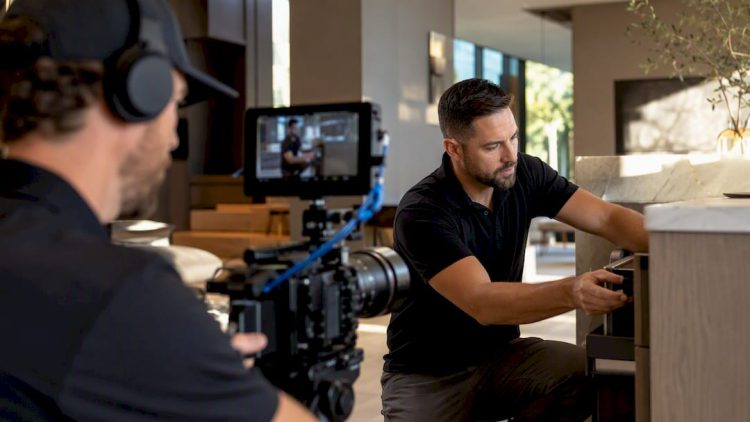
Script to Schema: One Team for Scottsdale Website Video Marketing
The right approach is a short homepage hero video paired with three to five pillar videos built around your customers’ actual questions, each one hosted on its own optimized watch page. That combination covers the funnel from first impression to final decision. Most Scottsdale businesses don’t need a video library. They need a handful of the right videos, produced well and set up for search, which is exactly what a local partner can plan and execute—from the first script to the last line of schema markup.
TL;DR:
- Focusing on three to five well-produced pillar videos aligned with your sales funnel stages maximizes impact over random video production.
- Optimizing watch pages with transcripts, schema markup, and descriptive metadata significantly boosts search visibility and organic reach.
- Embedding videos on relevant pages, such as service or product pages, encourages longer visitor engagement and builds trust faster.
- Using a single, integrated vendor for video production, hosting, and SEO simplifies workflow and ensures videos are optimized for search from the start.
- Compliance with privacy, disclosure, and accessibility rules should be built into your video strategy to avoid legal issues and broaden audience reach.
Table of Contents
- Which Video Types Actually Belong on Your Website
- How Video Moves the Metrics That Matter
- How to Host and Embed Video on WordPress Without Slowing Your Site
- Build a 3 to 5 Pillar Video Content Strategy Mapped to the Funnel
- How to Choose a Scottsdale Video Marketing Partner
- Local Regulations and Compliance Considerations for Video Content in Scottsdale
- Real Benefits of Video Marketing for Scottsdale Businesses
- WebTechs.Net’s Perspective on Video Marketing Investment
- How Webtechs Handles Video Marketing for Scottsdale Websites
- Sources
- FAQ
Which Video Types Actually Belong on Your Website
Not every page needs a video, and not every video belongs on every page. Match the format to the job the page is doing.
- Hero video: 15 to 30 seconds, homepage only, shows what you do and who you do it for. No narration required. Silent autoplay with captions works fine.
- Explainer or demo video: 60 to 90 seconds on service or product pages, walks through how the offering actually works.
- Testimonial video: 30 to 60 seconds, placed near pricing or contact pages, where buyers need reassurance before they act.
- FAQ clips: 20 to 40 seconds each, answering one specific question, ideal for support pages and long service descriptions.
- Short social snippets repurposed to site pages: cut from longer footage, embedded in blog posts or landing pages to boost dwell time.
Each format plays a different funnel role. Hero videos build awareness, demos and explainers move a visitor toward consideration, and testimonials and FAQ clips close the gap at decision time. Every video needs open captions or a caption toggle and a full transcript nearby. That’s not optional polish. It’s what makes the video usable for visitors with sound off and readable for search engines that can’t watch anything at all.
How Video Moves the Metrics That Matter
Video changes how long people stay and how much they trust what they’re looking at, but only when the content matches what the visitor came to find. A demo video on a service page that actually answers “how does this work” holds attention longer than generic footage of an office or a team meeting.
Fast fact: Pages that optimize both the video and its landing page with transcripts, descriptive metadata, and structured data see a real lift in organic visibility and search ranking potential.
That means the video itself is only half the job. The watch page around it needs a clear title, a written summary, and a transcript that search engines can crawl the way they’d crawl any other block of text. VideoObject schema on that page increases the odds of a rich result in search, which puts a thumbnail and play button directly in the results a competitor’s plain text listing can’t match.
Track these by funnel stage:
- Awareness: view count, average watch time, hero completion rate
- Consideration: click-through rate from the video to a service or contact page
- Decision: assisted conversions, meaning did the video play a role before the form got submitted
How to Host and Embed Video on WordPress Without Slowing Your Site
Self-hosting a video file directly on your WordPress server is the single fastest way to hurt page speed. Large video files strain Core Web Vitals and drag load times, which search engines factor into ranking. You have three real options: embed from YouTube or Vimeo, use a hosted CDN player like Jetpack VideoPress, or self-host with heavy compression and a lazy-load setup.
Embedding from YouTube costs nothing and gives you a built-in discovery audience, but you’re playing by YouTube’s branding and ad rules. A CDN-backed player such as Jetpack VideoPress keeps load times fast, drops in an ad-free player, and connects straight to your WordPress dashboard for basic analytics. Self-hosting gives you full control but only makes sense with serious compression work and a content delivery network behind it.
Whichever route you choose, the implementation checklist looks the same:
- Build a dedicated watch page for each pillar video, not just an embed buried on a service page.
- Add a full, accurate transcript directly on that page.
- Implement VideoObject schema with the transcript URL, thumbnail, and duration.
- Lazy load the video so it doesn’t block the rest of the page from rendering.
Pro Tip: Ask any developer or agency to hand over a poster image and a compressed MP4 alongside the master file. Without both, you’ll be back in a follow-up round of production work before the video ever goes live.
Build a 3 to 5 Pillar Video Content Strategy Mapped to the Funnel
Random videos produced whenever someone has time rarely move the needle. A working video content strategy organizes around three to five content pillars, and every video you shoot maps to one of them and to a specific stage of the buyer’s decision.
A workable pillar set for a Scottsdale service business might look like this:
- Brand story pillar: hero video, top of funnel, refreshed once a year
- How it works pillar: demo and explainer videos, middle of funnel, one new video per quarter
- Proof pillar: testimonials and short case studies, bottom of funnel, added as new clients agree to participate
- Support pillar: FAQ clips, post-purchase and pre-sale, produced in batches of five or six at once
For a small budget, prioritize the hero and three pillar videos first, then repurpose that same footage into shorter clips for social. Set a cadence you can actually sustain, even if that’s one new pillar video per quarter, and write a one-page brief for each: goal, KPI, call to action, and where it gets distributed. A mature video program also loops in whoever handles sales and customer service, since they usually know which questions come up most and which videos actually shorten the sales cycle.
How to Choose a Scottsdale Video Marketing Partner
Proposals from video vendors tend to look similar on the surface. The differences show up in what’s actually delivered and how the work gets measured afterward.
- Check portfolio relevance. Ask for examples in a similar industry or business size, not just polished reels from a national brand.
- Confirm video SEO capability. A partner who only shoots and edits, without touching transcripts, schema, or watch pages, leaves half the value on the table.
- Ask about technical delivery. Will they hand you web-optimized MP4s, captions, and a poster image, or just a raw export?
- Ask who owns the files. Master files and raw footage should belong to you, not stay locked in someone else’s archive.
- Ask for a reporting plan. What gets measured, how often, and in what format.
- Request references you can actually call.
Red flags worth walking away from: vague timelines with no milestone dates, no mention of hosting or page speed, and pricing quoted with zero breakdown between production, editing, and SEO implementation. Costs vary widely by scope, but a simple hero video runs far less than a five-video pillar package with full SEO setup, so ask for an itemized quote before you compare any two proposals side by side.
Local Regulations and Compliance Considerations for Video Content in Scottsdale
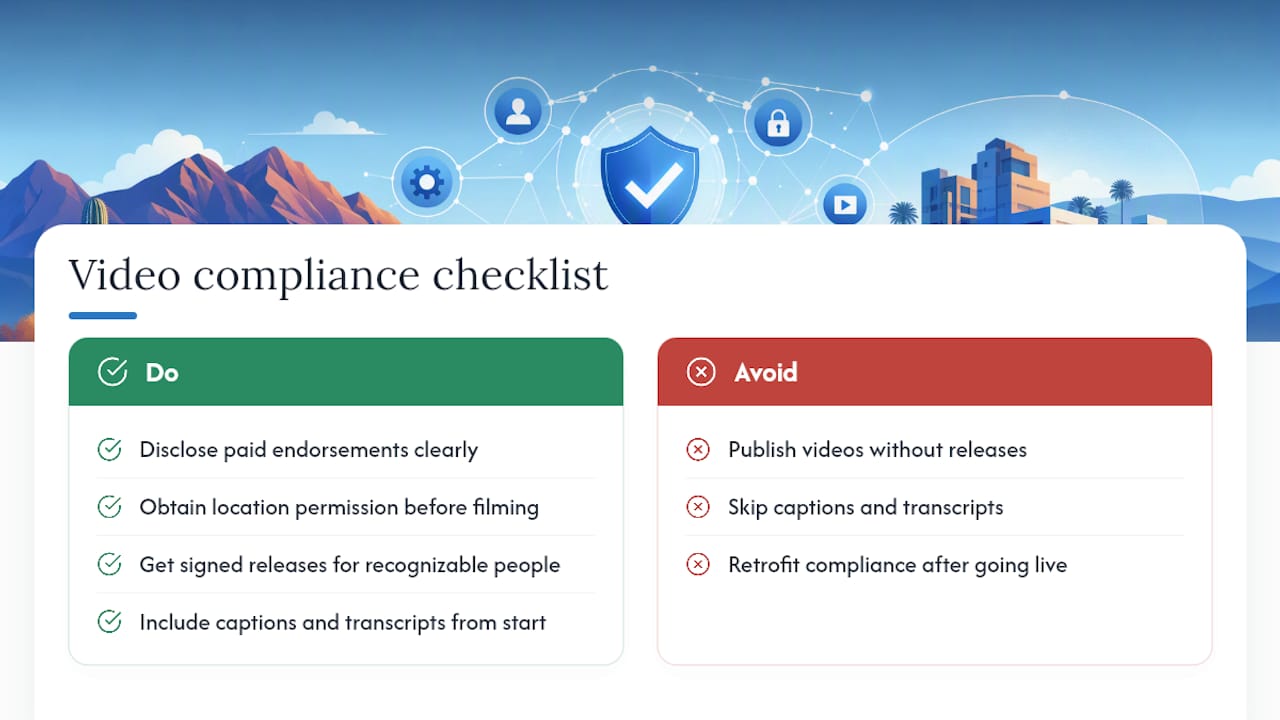
Video content aimed at Scottsdale customers still has to follow standard advertising and privacy rules that apply across Arizona and federal law, even though there’s no city-specific video ordinance governing business websites. If a testimonial video includes a paid endorsement or a client discount in exchange for appearing on camera, that relationship needs a clear, visible disclosure, consistent with general FTC endorsement guidance that applies to any business operating in the United States.
Filming in public spaces around Old Town Scottsdale or on private commercial property requires basic location permission, and any video that features a recognizable customer, employee, or bystander should have a signed release on file before publication. This matters more than most SMB owners assume. A testimonial pulled down after a dispute over usage rights is a wasted production budget and a scramble to replace a bottom-of-funnel asset right when you need it most.
Accessibility compliance is the other piece that gets overlooked. Captions and transcripts aren’t just an SEO tactic. They support ADA-related web accessibility expectations that apply to business websites generally, and a growing number of complaints nationally have targeted sites with video content that has no caption option at all. Building captions and transcripts into every video from the start avoids a retrofit later and keeps the content usable for visitors who browse with sound off, which happens to be most mobile traffic anyway.
None of this requires a legal team for a typical service business, but it does mean building release forms and disclosure language into your production process from day one, not bolting it on after a video is already live.
Real Benefits of Video Marketing for Scottsdale Businesses
Scottsdale’s business landscape runs heavy on home services, medical and dental practices, real estate, hospitality, and professional services, and all five categories share one thing: buyers comparison shop hard before they call. A homepage hero that shows a real crew, a real office, or a real product in thirty seconds answers the trust question faster than a paragraph of text ever will.
A local HVAC or landscaping company adding a demo video to its main service page typically sees visitors spend meaningfully longer on that page, simply because the video answers “what actually happens when you hire this company” before the visitor has to dig for it. A dental or medical practice that adds a short testimonial reel near its booking page reduces the hesitation that keeps new patients from filling out a contact form. Real estate agents who add neighborhood walkthrough videos to listing pages give out-of-state buyers, common in a market like Scottsdale, a reason to inquire without a plane ticket first.
The pattern across all of them: video works best when it replaces a specific piece of missing information, not when it’s added as decoration. A restaurant showing off its patio at sunset helps. A restaurant showing off its patio at sunset with zero mention of hours, location, or a reservation link wastes the opportunity. The businesses that see real engagement gains treat every video as answering one question a real customer actually asks, then make sure the page around that video is built to be found in search in the first place.
Visual content generally earns far more engagement than text alone, a pattern that shows up across marketing research on visual formats, and Scottsdale’s competitive local market rewards businesses that use that advantage on their own site rather than relying only on social feeds where content disappears within a day or two.
WebTechs.Net’s Perspective on Video Marketing Investment
Most video marketing advice treats production and search visibility as separate jobs, handled by separate vendors, at separate points in the process. That split is where a lot of budget quietly disappears. A beautifully shot video sitting on a slow, unoptimized page with no transcript and no schema is a video almost nobody outside your social following will ever find.
Webtechs builds production, WordPress implementation, and video SEO as one connected process rather than three handoffs between different vendors, because a video that isn’t set up to be found isn’t doing its job. Readers can look through Webtechs’s portfolio for examples of past web and video work across Scottsdale-area businesses.
— Brett
How Webtechs Handles Video Marketing for Scottsdale Websites
If you’ve been comparing freelance videographers against national production houses, here’s the gap both tend to leave open: neither one typically follows through on the SEO side once the video is delivered. An integrated alternative is to have one team handle the shoot, the WordPress build, and the video SEO work, so you’re not stitching together a videographer, a developer, and an SEO contractor on three separate invoices and three separate timelines.
A typical project starts with a short consult to map out which pillar videos your site actually needs, followed by a production schedule and a technical brief covering transcripts, schema, and watch pages before a single frame gets shot. Webtechs’s website video production services cover that full path from script to a live, search-optimized watch page, and the video SEO work that goes with it is built the same way, on top of the core web design and SEO services Webtechs has run for Scottsdale businesses for more than 25 years. Request a consult to get a production brief scoped to your site.
Sources
- Video marketing strategy (Sprout Social)
- Video marketing SEO: How to rank on search engines (TechTarget)
- How to upload a video to WordPress (Jetpack)
- Video schema: How to use VideoObject markup (SEMrush)
FAQ
How Much Does Video Marketing Cost?
Costs vary by scope, from a single homepage hero video to a full pillar set with SEO implementation included. Webtechs doesn’t publish flat video production pricing, so request a quote directly through Webtechs based on the specific videos your site needs.
What Influencers Live in Scottsdale, Arizona?
Scottsdale is home to a range of creators across fitness, real estate, hospitality, and lifestyle content, though no single publicly verified directory tracks all local influencers. For most SMBs, a stronger first move is producing owned video content and testimonials rather than chasing influencer partnerships before your own site has a solid video foundation.
Which Platform Is Best for Video Marketing?
There’s no single best platform. YouTube works well as a searchable home base for longer pillar videos, while short-form platforms suit quick, repurposed clips, and your own website’s watch pages matter most for search visibility and conversions since you control the surrounding SEO there completely.
What Does a Video Marketer Do?
A video marketer plans, produces, and distributes video content mapped to funnel stages, then measures its impact on engagement and conversions. That role increasingly includes video SEO work such as transcripts, schema, and watch page setup, which is why an integrated partner like Webtechs handles production and search optimization together instead of treating them as separate jobs.