

30 Second Review Replies for Arizona Businesses, 4 Move Framework

When a customer posts a review, reply promptly with a short, human message that thanks them, mirrors a specific detail from what they wrote, addresses the substance without admitting fault, and invites them offline if there’s a real problem to solve. That single habit protects your reputation with future customers browsing Google Business Profile, Yelp, or Trustpilot, and it often shapes their decision more than the review itself.
TL;DR:
- Respond to negative reviews on the same day, using a brief, personalized message that thanks the reviewer and references specific details they mentioned.
- Maintain a clear four-move response framework by thanking the reviewer, mirroring their detail, addressing the impact, and inviting offline communication.
- Use careful, non-argumentative wording when replying to negative reviews, always apologizing for the customer’s feelings rather than admitting fault or making legal claims.
- Reply to positive reviews with personalized references to their comments, reinforcing your business values and encouraging future engagement without offering incentives.
- Implement a review response workflow with clear ownership, response approval rules, tracking, and response time SLAs to ensure timely and consistent engagement across platforms.
Table of Contents
- How Fast Should You Respond to Reviews?
- The 4-Move Framework for Replying to Any Review
- What’s the Safest Way to Respond to a Bad Review?
- How Should You Reply to Positive Reviews?
- How Do You Spot and Report Fake Reviews?
- How Do You Build a Review-Response Workflow That Scales?
- How Does WebTechs.Net Help Arizona Businesses With This?
- An Arizona Perspective on Review Replies
- Get Help Managing Reviews and Local Search
- Sources
How Fast Should You Respond to Reviews?
Every new review needs a 30 second triage before you write a word. Sort it first, then act.
- Negative reviews: reply promptly the same day.
- Positive reviews: reply within a couple of days, in batches if you’re busy.
- Suspicious reviews: flag first, respond second (or not at all until you know it’s real).
- Buy-time script: “Thanks for flagging this. We’re looking into it and will follow up shortly.” Post that immediately if you can’t write a full reply yet.
- Escalation trigger: legal threats, false claims about safety, or reviews naming an employee by name go straight to a manager, not the front-line staffer checking alerts.
Speed matters because Google Business Profile publicly timestamps your reply, and reviewers get notified the moment you respond, so silence reads as indifference even when you’re simply behind on notifications, according to Google’s own guidance on managing customer reviews.
The 4-Move Framework for Replying to Any Review
Every reply, regardless of star rating, follows the same four moves. Skip one and the response feels either cold or defensive.
- Thank them by name. “Thanks, Maria” beats “Thank you for your review.”
- Mirror a specific detail. Reference the actual thing they mentioned, not a generic phrase.
- Address the substance. Apologize for the impact on their experience, never for a legal fault you haven’t confirmed.
- Close forward. Invite them to call, email, or return, rather than continuing the debate publicly.
Keep replies to 2 to 4 sentences, under roughly 150 words. Longer replies read as defensive, and most readers skim past them anyway.
Pro Tip: Never copy-paste the same reply twice in a row. Personalization signals genuine attention, and it’s the detail that keeps your responses from reading like a bot wrote them.
Quick examples by star level:
- 5-star: “Thanks, James! Glad the team got your AC fixed same-day during that July heat wave. We appreciate you taking the time to write this.”
- 3-star: “Thanks for the honest feedback, Lisa. Sounds like the wait time on your visit wasn’t up to our usual standard. We’d like to make it right. Can you call our office this week?”
- 1-star: “We’re sorry your visit didn’t go the way it should have, David. We’d like to understand what happened. Please call us at [number] so we can address this directly.”
- Silent 1-star (no text, just a rating): “We’re sorry to see this rating. If something went wrong, we’d genuinely like to hear about it. Feel free to reach us at [number] anytime.”
Treat every one of these as a marketing opportunity, not paperwork. A well-written reply reinforces your brand values for the hundreds of people who read it without ever posting themselves, a point Bazaarvoice makes well in its guidance on responding to negative reviews.
What’s the Safest Way to Respond to a Bad Review?
The words you choose in a negative review reply can either calm a situation or hand a lawyer ammunition. The fix is simple: apologize for how the customer felt, never for a fault you haven’t verified.
- Say this: “I’m sorry your experience didn’t meet our usual standard.”
- Not this: “We’re sorry we messed up your order” or “That was our mistake.”
- Offer a concrete next step. A phone number or direct email beats “please reach out,” which sounds like a brush-off.
- Never argue in public. If a customer replies again, one calm acknowledgment is enough. Move the real conversation to a call.
- Loop in a manager or legal counsel when the review alleges discrimination, injury, fraud, or names an employee in a way that could invite a defamation claim.
Pro Tip: *Draft your apology language once, get a second set of eyes on it, and reuse the pattern rather than the exact wording.
This distinction, sympathy without admission, is the single most useful skill in effective apology wording for businesses, and it works whether the complaint is about a late plumber in Tempe or a cold entree in Scottsdale.
How Should You Reply to Positive Reviews?
Positive reviews are the easiest wins you’ll get all week, so don’t waste them on a generic “thanks for your review.”
- Reference something specific they wrote about, a product, a staff member, a detail about their visit.
- Thank them by name and reinforce what your business actually stands for.
- Invite a next step: a return visit, a referral, or sharing their experience with friends. Never offer anything in exchange for the review itself.
- Batch these replies once or twice a day rather than reacting to each notification, since positives don’t carry the same urgency as complaints.
A sample reply: “Thanks so much, Karen! We’re glad Miguel got your kitchen remodel done ahead of schedule. Hope to see you again for the next project.”
How Do You Spot and Report Fake Reviews?
Fake reviews tend to share a pattern: vague language with no specific details, an account with no other review history, a rating posted right after a competitor launches a promotion, or language that doesn’t match anything your business actually offers.
Once you spot one, documentation matters more than outrage. Screenshot the review, note the date and reviewer profile, and log any correspondence before you report it.
| Platform | How to report | What to expect |
|---|---|---|
| Google Business Profile | Flag as inappropriate from the review menu in your profile dashboard | Google reviews the flag against its policies; removal can take anywhere from minutes to 30 days |
| Yelp | Use the “Report Review” link inside Yelp for Business Owners | Yelp’s moderation team investigates; outcomes vary by case |
| Trustpilot | Flag through Trustpilot Business tools and submit supporting evidence | Trustpilot Business documents the exact reporting steps in its help center |
Removal isn’t guaranteed on any platform, so pair reporting with a calm public reply that doesn’t confirm or deny the specifics, according to legal guidance on responding to fake online reviews. Trustpilot’s own process for flagging and replying is laid out clearly in its business help documentation.
How Do You Build a Review-Response Workflow That Scales?
One person forgetting to check their alerts shouldn’t be your entire review strategy. A simple workflow fixes that.
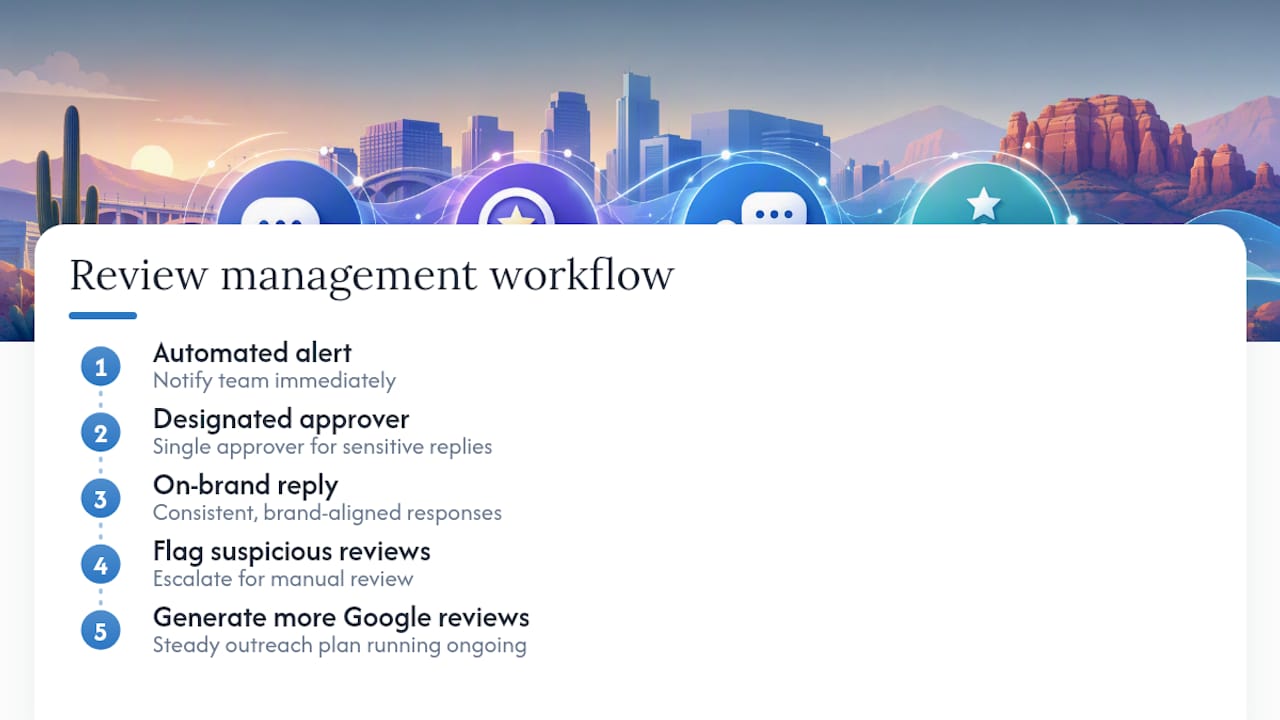
- Assign ownership. One person (owner, office manager, or marketing lead) checks alerts daily; a second person backs them up during vacations.
- Set approval rules. Anything involving a refund, legal language, or an angry multi-paragraph complaint needs manager sign-off before posting.
- Track it. A shared spreadsheet or ticket with columns for date, platform, star rating, response status, and resolution outcome keeps nothing falling through the cracks.
- Set SLAs. Same-day replies for negatives, 48 hours for positives, no exceptions during busy seasons.
- Rotate phrasing. Keep two or three variations of each template so replies don’t read as copy-pasted across dozens of reviews, a detail that matters both to human readers and to how naturally your business comes across in search results.
How Does WebTechs.Net Help Arizona Businesses With This?
Small businesses across Scottsdale and the greater Valley often skip review replies simply because nobody owns the task. A common recommendation is to use automated alerts so reviews never sit unanswered for days, and to have a single designated approver for anything sensitive. Pairing a steady reply habit with a plan to generate more Google reviews tends to do more for local visibility than either tactic alone.
An Arizona Perspective on Review Replies
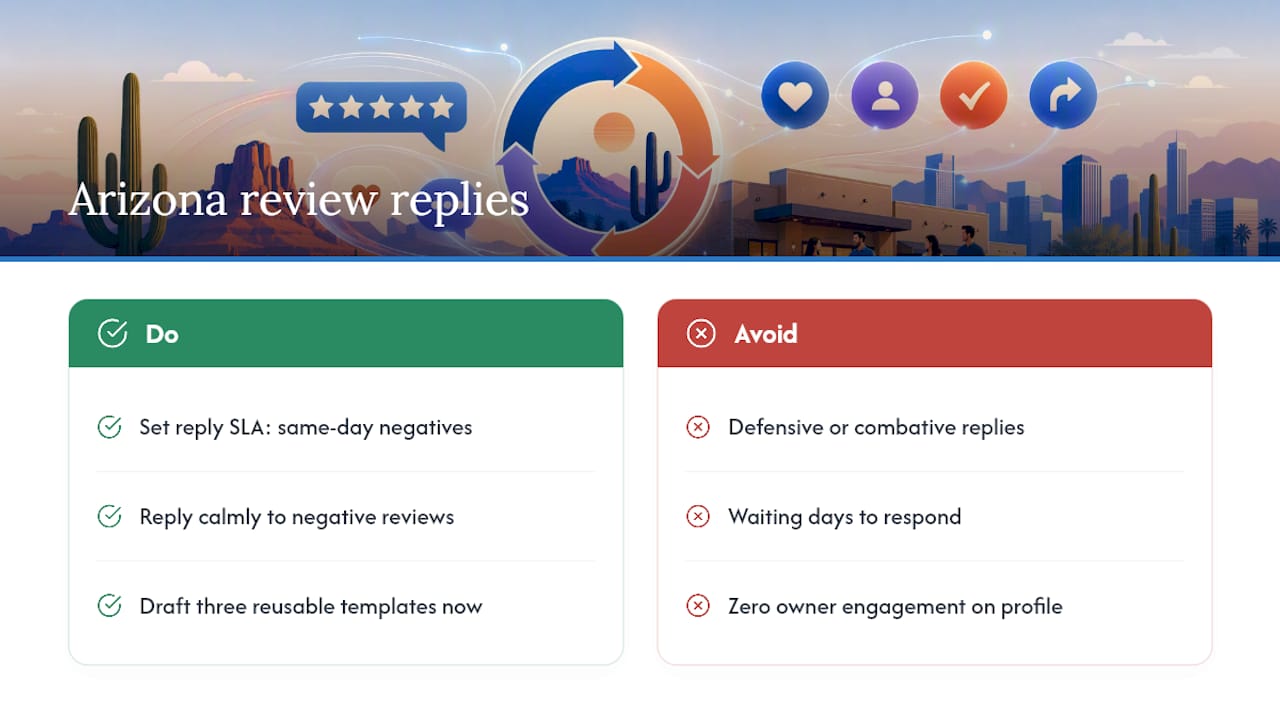
Arizona’s small-business market runs on word of mouth more than most owners admit. A slow or defensive reply to a negative review in a market where Nextdoor groups and neighborhood Facebook pages amplify local news spreads faster than most owners expect. A calm, prompt reply, even to a rough one-star review, tends to read as more credible to a new customer scrolling Google Business Profile than a wall of five-star reviews with zero owner engagement.
Two things to do this week: set a firm reply SLA (same day for negatives, 48 hours for positives) and draft three reusable templates now, not after the next bad review lands. Having the language ready removes the hesitation that turns a five-minute task into a three-day delay.
— Brett
Get Help Managing Reviews and Local Search
There are ways to handle this yourself with a spreadsheet and a calendar reminder, and plenty of Arizona business owners do exactly that. If you’d rather hand it off, Some agencies build the reply workflow into broader local SEO plans, pairing Google Business Profile management with consistent visibility work that keeps reviews and rankings moving in the same direction. That means someone else is watching for alerts, drafting on-brand replies, and flagging suspicious reviews before they sit unanswered for a week.
Take a look at our portfolio of local Arizona work to see how this fits into a full local SEO plan, or reach out for a consult to get review monitoring set up before your next slow response costs you a customer.
Sources
- Manage customer reviews – Google Business Profile Help
- How to respond to negative reviews: examples and best practices | Bazaarvoice
- How to reply to reviews — Trustpilot Business
- The do’s and don’ts of an effective business apology