
30 Day Local SEO Checklist for Scottsdale Small Businesses
Claim and verify your Google Business Profile, fix your name/address/phone data everywhere it appears online, and start collecting reviews this week. Those three moves alone shift most Scottsdale small businesses noticeably in local search within a matter of weeks. The rest of this local SEO checklist compounds from there, with citations, on-page fixes, and links paying off over the following months, and a full 30-day plan below turns it into a sequence you can actually execute.
TL;DR:
- Claim and verify your Google Business Profile immediately because it influences most local search visibility, especially in the Map Pack.
- Ensure your business name, address, and phone number are consistent across all online directories and your website to boost trust signals.
- Regularly request and respond to reviews to improve your local rankings and demonstrate active customer engagement.
- Create detailed local service pages with natural language, embedded maps, and schema markup to enhance organic and voice search visibility.
- Focus on building relevant backlinks from local organizations and sources, and analyze competitors monthly to identify new opportunities.
Table of Contents
- Priority Local SEO Checklist: What To Do First
- How Do You Claim and Optimize a Google Business Profile?
- Why Does NAP Consistency Still Matter for Local Rankings?
- How Do You Get More Reviews and Respond the Right Way?
- What On-Page Changes Improve Local Search Visibility?
- Which Local Links Actually Move the Needle for Small Businesses?
- What Should You Track to Prove Local SEO Is Working?
- Your 30-Day Local SEO Action Plan
- Optimizing for Voice Search in Local SEO
- Leveraging Local Social Media Channels for SEO Impact
- Using Localized Keywords and Search Intent Analysis
- Competitor Analysis Specific to Local SEO
- Optimizing for ‘Near Me’ and Proximity-Based Searches
- Why This Checklist Is Built the Way It Is
- Ready to Put This Checklist to Work?
- Further Reading and Templates
Priority Local SEO Checklist: What To Do First
Not every task on a local SEO checklist deserves the same urgency. Work through these in order.
- P1, this week: Claim and verify your Google Business Profile, fix your NAP across your website and top directories, and pick the most specific primary category. Budget a short amount of time; a business owner can do this alone.
- P2, weeks 2 to 3: Launch review requests, publish a real location or service page, and add LocalBusiness schema. Budget five to eight hours, or hand it to a freelancer familiar with schema markup.
- P3, weeks 3 to 4: Clean up remaining citations, chase two or three local backlinks, and set a weekly Google Business Profile posting habit. Budget ongoing time, or outsource to an agency for consistency.
How Do You Claim and Optimize a Google Business Profile?
Google Business Profile drives most of what shows up in the Map Pack, so it earns the first hour you spend on any local SEO strategy. Verification usually runs through a phone call, text, email, or postcard mailed to your Scottsdale address; postcards may take some time to arrive, so start that step immediately even if you’re not ready to touch anything else.
Once verified, the details matter more than most owners assume:
- Choose the single most specific primary category available. “HVAC contractor” beats “Contractor” every time.
- Add every relevant secondary category and list specific services, not just broad offerings.
- Write a complete business description using natural language, not a keyword dump.
- Upload multiple real photos of your storefront, team, and finished work. Stock images hurt more than they help.
- Add booking or quote request links directly on the profile.
Pro Tip: Treat your profile like a second website. Post updates regularly, answer every question in the Q&A tab before a competitor answers it incorrectly, and respond to reviews promptly.
Why Does NAP Consistency Still Matter for Local Rankings?
Search engines cross-reference your business name, address, and phone number across the web to confirm you’re a real, stable business. Mismatches, a suite number here, a missing “LLC” there, an old phone number on a directory you forgot existed, dilute that trust signal and can hold back your Google Business Profile even after you’ve optimized everything else.
Run a quick audit by searching your business name plus your city, then write down one canonical NAP format and use it everywhere. Fix these first:
- Your own website footer and contact page
- Google Business Profile, Apple Maps, and Bing Places
- Facebook and Yelp business listings
- Your local chamber of commerce or industry association directory, ensuring consistency
Set a regular reminder to recheck, since directories update independently and drift happens quietly.
How Do You Get More Reviews and Respond the Right Way?
Review count and recency both factor into Map Pack placement, and Scottsdale’s service categories, from HVAC to salons to home repair, tend to reward businesses that ask consistently rather than sporadically.
Build a simple system:
- Ask soon after service completion, while the experience is fresh.
- Send a direct review link by text message, which typically gets opened faster than email.
- Keep the ask short: one line thanking them, one line with the link.
- Respond to every review, positive or negative, promptly.
Aim for a steady flow of new reviews over time rather than a single push, as consistent activity signals an active, trustworthy business.
Pro Tip: When you respond to a negative review, mention the specific issue by name. A generic “sorry for your experience” reads as canned; naming the actual problem shows you read it.
What On-Page Changes Improve Local Search Visibility?
Your Google Business Profile gets you into the Map Pack. Your website earns the organic blue links underneath it, and neglecting either one costs local market share. Build a dedicated page for each service or location, and give each one real substance:
- Write 500 or more words of genuinely local detail: neighborhoods served, specific project examples, local testimonials.
- Put the service and city in your H1 and title tag naturally, “Scottsdale Roof Repair,” not a stuffed string of keywords.
- Embed a Google Map on your contact or location page.
- Add LocalBusiness, Service, and Review schema markup so search engines and AI-generated overviews can pull accurate business details.
| Check | Tool | What it tells you |
|---|---|---|
| Core Web Vitals | Google PageSpeed Insights | Load speed, interactivity, visual stability |
| Mobile usability | Google Search Console | Pages with mobile display issues |
| Schema validity | Google Rich Results Test | Whether structured data is readable |
Which Local Links Actually Move the Needle for Small Businesses?
You don’t need hundreds of backlinks. You need a handful of relevant ones from sources tied to Scottsdale. Realistic targets include:
- The Scottsdale Area Chamber of Commerce and industry-specific associations
- Local news outlets covering small business features or community events
- Vendors and suppliers who list client or partner businesses
- Event sponsorships, even small ones, that come with a website mention
Prioritize based on relevance and domain trust over sheer volume, and treat outreach as an ongoing habit, not a one-time sprint.
What Should You Track to Prove Local SEO Is Working?
Set up Google Search Console and GA4 before you make any other changes; without a baseline, you can’t prove progress later. Google Business Profile Insights adds calls, direction requests, and map views on top of that.
- Track Map Pack rank separately from organic keyword rank; they respond to different signals.
- Watch calls, direction requests, and booking form submissions as your core conversion KPIs.
- Check rank tracking and reporting monthly rather than daily, since local rankings fluctuate normally.
Your 30-Day Local SEO Action Plan
- Week 1: Claim and verify Google Business Profile, fix the most visible NAP mismatches (website, Google, Facebook, Yelp), and connect Google Search Console and GA4.
- Week 2: Publish one location or service page with genuine local detail, send your first batch of review requests, and add LocalBusiness schema to your homepage.
- Weeks 3 to 4: Finish citation cleanup across remaining directories, reach out to two or three local link targets, and review your early metrics to adjust priorities for month two.
Optimizing for Voice Search in Local SEO
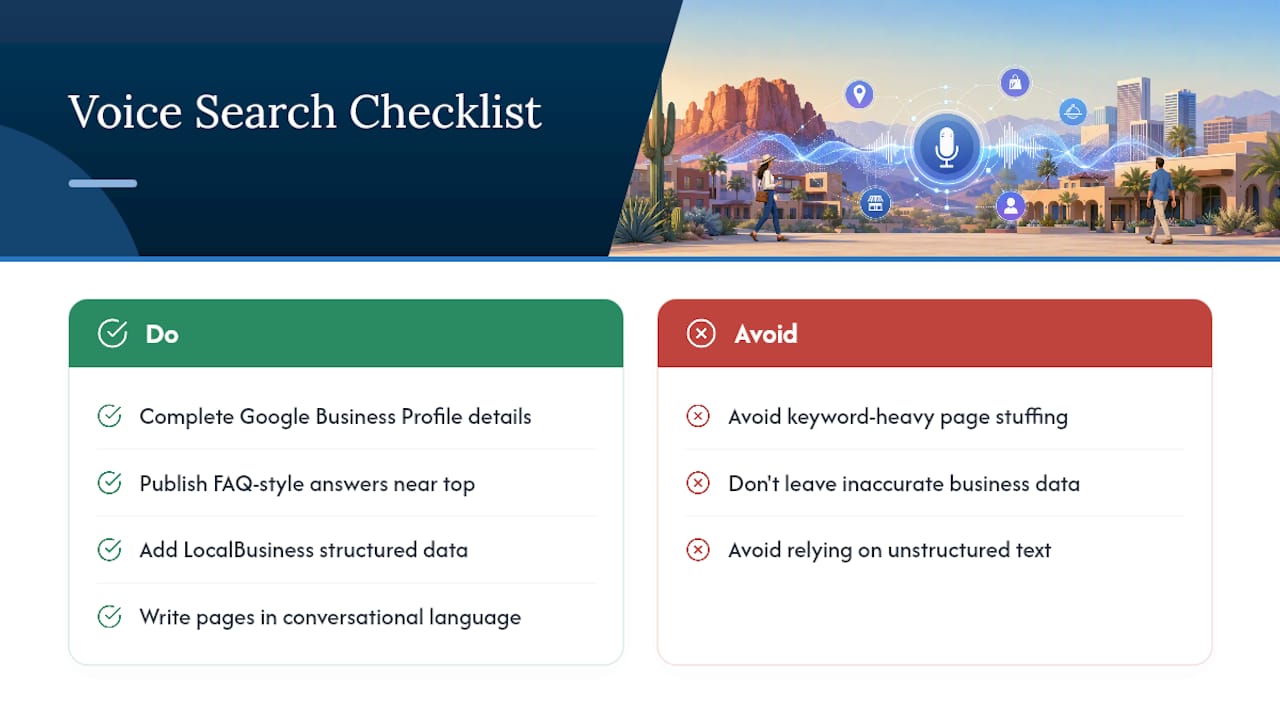
Voice queries lean conversational: “who fixes garage doors near me” instead of “garage door repair Scottsdale.” That shift changes what you optimize for, because voice assistants pull answers from structured, specific data rather than long-form keyword-heavy pages.
Your Google Business Profile does most of the heavy lifting here. Complete hours, an accurate address, and specific service categories give Google’s assistant a clean answer to pull from when someone asks a location-based question out loud. FAQ-style content on your website helps too, since voice search tends to favor pages that answer a direct question in a direct sentence near the top.
Structured data plays a bigger role than most owners realize. LocalBusiness schema tells search engines and voice assistants exactly what you are, where you are, and what you offer, without forcing an algorithm to guess from unstructured text. Pages written in natural, conversational language, the way a customer would actually phrase a question, tend to match voice queries better than pages stuffed with keyword variations.
Review content matters here too. Voice assistants sometimes read review snippets aloud when answering “best” or “top-rated” queries, so reviews that mention specific services in natural language (“fixed our AC same day”) double as voice search fuel. None of this requires a separate strategy from the rest of your local SEO checklist; it requires making sure your existing data is accurate, specific, and written the way people actually talk.
Leveraging Local Social Media Channels for SEO Impact
Social media doesn’t directly move your Google ranking the way a backlink or a review does, but it feeds the same trust signals search engines and customers both look for. An active Facebook or Instagram profile with recent posts, local photos, and community engagement tells a visitor, and indirectly Google, that you’re a real, operating Scottsdale business.
Local Facebook groups and Nextdoor threads matter more than a generic follower count. When someone asks for a plumber or a hair stylist recommendation in a Scottsdale neighborhood group, an active, responsive business page gets mentioned. That mention often turns into a direct visit or call, and sometimes into a review or a link from a local blogger who found you through social first.
Cross-link your social profiles and your website consistently. Use the same business name, hours, and contact details on Facebook, Instagram, and LinkedIn that you use on your Google Business Profile, reinforcing the same NAP consistency that matters for citations. Geotag your posts and photos when the platform allows it, since location tags help surface your content to nearby users browsing by area.
Posting frequency beats posting perfection. A quick photo of finished work with a one-line caption, shared weekly, does more for local visibility than a polished campaign published twice a year. Treat social channels as a supporting layer of your local SEO strategy, not a replacement for the Google Business Profile and website work that carries the most ranking weight.
Using Localized Keywords and Search Intent Analysis
Generic keywords lose to localized ones in nearly every local search scenario. “Pool repair” is a losing bet against “pool repair Scottsdale AZ” or “pool resurfacing Old Town Scottsdale,” because the second and third versions match how people actually search when they want someone nearby, today.
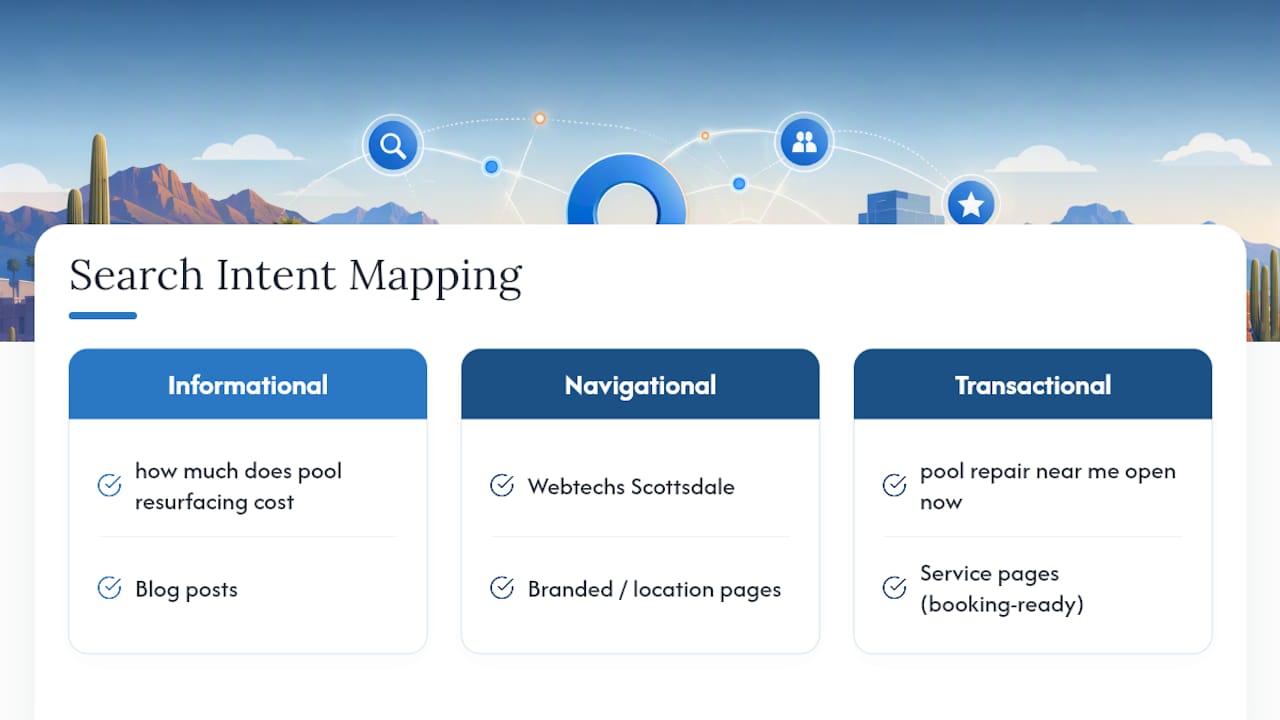
Start by mapping search intent into three buckets: informational (“how much does pool resurfacing cost”), navigational (“Webtechs Scottsdale”), and transactional (“pool repair near me open now”). Your service pages should target transactional and navigational intent directly, while blog content can capture informational searches earlier in a customer’s decision process.
Neighborhood-level specificity often outperforms city-wide keywords for service businesses. If you serve Old Town, McCormick Ranch, and DC Ranch, mentioning each by name on your service pages, in photo captions, and in your Google Business Profile description helps you show up for hyper-local variations you’d otherwise miss entirely.
Tools like Google’s “People Also Ask” boxes, the autocomplete suggestions in Google Maps, and even the questions customers ask in phone calls or emails reveal real local phrasing worth targeting. A landscaping company that keeps hearing “desert landscaping” from callers should use that exact phrase on its site, not the more generic “xeriscaping” term an outsider might assume is standard.
Match your keyword choices to buyer readiness. Someone searching “best HVAC company Scottsdale reviews” is closer to booking than someone searching “why is my AC not cooling,” and your site should have distinct pages built for each stage rather than one page trying to catch every query.
Competitor Analysis Specific to Local SEO
Pull up the Map Pack for your top two or three keywords and study who actually ranks, not who you assume your competitors are. The businesses showing up for “roofing contractor Scottsdale” might surprise you, and they’re the ones worth analyzing.
Check their Google Business Profile completeness first. Note their review count, average rating, response rate, and how recently they posted an update. If a competitor has 150 reviews and you have 20, that gap tells you exactly where to focus your next quarter of effort.
Look at their website’s location pages next. Do they have a dedicated page for each service area, or one generic page trying to cover everything? Weak competitor pages, thin content, no local specifics, missing schema, represent an opening you can outproduce without much difficulty.
Citation and backlink analysis rounds out the picture. Tools built for this kind of audit can show which directories and local sites link to a competitor but not to you, giving you a direct list of outreach targets rather than a guessing game. If three competitors all have a link from the same local news feature or chamber directory, that’s a strong signal it’s worth pursuing for your own site.
Revisit this analysis quarterly, since Map Pack rankings shift as competitors add reviews, fix their own NAP issues, or launch new location pages. Competitor analysis isn’t a one-time task on a local SEO checklist; it’s a recurring check that keeps your priorities honest.
Optimizing for ‘Near Me’ and Proximity-Based Searches
“Near me” searches assume Google already knows where the searcher is standing, which shifts weight toward proximity and away from pure keyword matching. A business three miles from the searcher with a complete profile often beats a business with better content sitting eight miles away, because distance is a direct ranking input for these queries.
You can’t move your physical address, but you can control the signals that help Google understand your exact service area. List specific service areas in your Google Business Profile settings rather than leaving the default radius. If you serve Scottsdale, Paradise Valley, and North Phoenix, name all three explicitly instead of assuming the algorithm will infer your reach.
Consistency between your listed address and your actual service radius matters too. A business claiming to serve a 50-mile radius from a single storefront address sends a weaker signal than one with realistic, clearly defined coverage. For multi-location businesses, a separate, verified Google Business Profile for each physical location outperforms a single profile trying to represent several addresses.
On-page content should reflect proximity language naturally. Phrases like “serving Old Town Scottsdale and surrounding neighborhoods” or “just minutes from the Scottsdale Waterfront” help both search engines and readers confirm relevance. Mobile page speed carries extra weight here too, since most “near me” searches happen on a phone, often while someone is standing in a parking lot deciding where to go next. A slow-loading location page loses that customer before they ever see your hours or reviews.
Why This Checklist Is Built the Way It Is
Most local SEO checklists dump thirty or forty tasks on a business owner with no sense of sequence, which is how good intentions turn into a half-finished Google Business Profile and a spreadsheet nobody opens again. The order matters as much as the tasks themselves. GBP and NAP fixes work fast because they touch the exact signals Google already weighs heaviest for the Map Pack; reviews and citations take longer because they accumulate. Scottsdale’s market rewards this sequencing especially well, since so many local categories, home services, salons, boutique retail, are crowded enough that a business with a genuinely complete profile and consistent reviews can outrank a bigger, better-funded competitor who never finished the basics. That gap is where WebTechs.Net has spent years working with Scottsdale small businesses, building out the local case studies and proof points that show a prioritized approach beats a scattershot one nearly every time.
— Brett
Ready to Put This Checklist to Work?
Running through this entire local SEO checklist alone, on top of running your business, is where most owners stall out around week two. There are alternatives to hiring a full-time marketing employee for local SEO: one team can handle your Google Business Profile, NAP cleanup, schema, and review system together, instead of you piecing it together from a dozen tabs and tutorials.
Webtechs has built location and service pages, GBP optimization, and local SEO retainers for Scottsdale businesses across categories from roofing to hair salons, and typically structures engagements around a short audit before recommending a monthly retainer or a one-time project fix, depending on how much of this checklist you’ve already tackled. If you’re not ready for a retainer yet, a professional web design project alone can fix the location page gaps slowing down your organic side. Browse the portfolio to see completed local projects, then request a quote to find out where your business stands today.
Further Reading and Templates
BrightLocal’s downloadable checklist and templates cover every task in more granular detail, while Search Engine Journal’s compounding stack guide explains the sequencing logic behind foundation, trust, and authority work. Backlinko’s local SEO guide offers a first-30-day playbook worth comparing against your own progress, and Webtechs’ Scottsdale SEO FAQ page answers common cost and timeline questions specific to this market.