

Case Study Writing That Ranks Locally, 4–6 Hours for Scottsdale SMBs

A marketing case study turns one client’s win into a proof point that ranks in Google and closes new business. For Scottsdale small and mid-sized businesses, the payoff is specific: higher local search visibility and a steady flow of sales-qualified leads who already trust you before the first call. Experienced marketing teams have built these for local clients for years, and the structure below reflects what actually gets published and used.
TL;DR:
- A dedicated case study page with measurable results improves Google ranking and provides social proof tailored to local prospects.
- The optimal format is the Situation, Challenge, Solution, Results structure, averaging 500 to 1,500 words, with a strong snapshot at the top.
- To gather effective evidence, keep client interviews brief, focused on specific numbers, timelines, and emotional quotes, supported by matching analytics data.
- Visual elements like before/after charts and authentic photos boost credibility, while distribution across website, social media, and email maximizes return.
- Secure written client permission, review drafts together, and avoid exaggeration or vague language to maintain trust and compliance.
Table of Contents
- Why Case Studies Matter for Scottsdale Small and Mid-Sized Businesses
- What Is the Best Case Study Format and Word Count?
- How Do You Collect the Right Evidence From a Client?
- What Design Elements Make a Case Study More Credible?
- How Do You Publish and Promote a Case Study for Local SEO?
- Which Metrics Should You Include, and How Should You Present Them?
- How Do You Write a Case Study That Actually Reads Well?
- What Common Mistakes Should You Avoid in Case Study Writing?
- What Legal and Ethical Steps Should You Take Before Publishing?
- What Do Strong Case Study Examples Look Like?
- An Agency’s View on What Case Study Production Actually Takes
- Get a Case Study Written and Working for Your Business
- Sources
Why Case Studies Matter for Scottsdale Small and Mid-Sized Businesses
A well-documented case study does two jobs at once. It gives a hesitant buyer social proof from someone who looks like them, a Scottsdale roofer, a north Phoenix hair salon, a garage door company down the road. And it gives Google a page packed with the kind of specific, keyword-relevant language that generic service pages never contain: neighborhood names, industry terms, and real numbers.
Agencies that publish well-documented case studies report higher conversion rates and shorter sales cycles, largely because the content leads with measurable results and before/after metrics instead of vague promises. That specificity is exactly what local search rewards, too. Case study pages naturally pick up long-tail, intent-rich phrases, and they pair well with Google Business Profile posts that link back to the full story.
A few reasons this format outperforms a standard testimonial:
- It shows the process, not just the outcome, which builds more trust with skeptical buyers.
- It contains natural local and industry keywords a generic landing page won’t.
- It gives your sales team a document to send instead of a cold pitch.
- It can be repurposed into social posts, PDFs, and email content without extra writing.
Pro Tip: Publish your strongest case study on its own URL, not buried in a blog category. A dedicated page ranks better and is easier to hand to a prospect.
What Is the Best Case Study Format and Word Count?
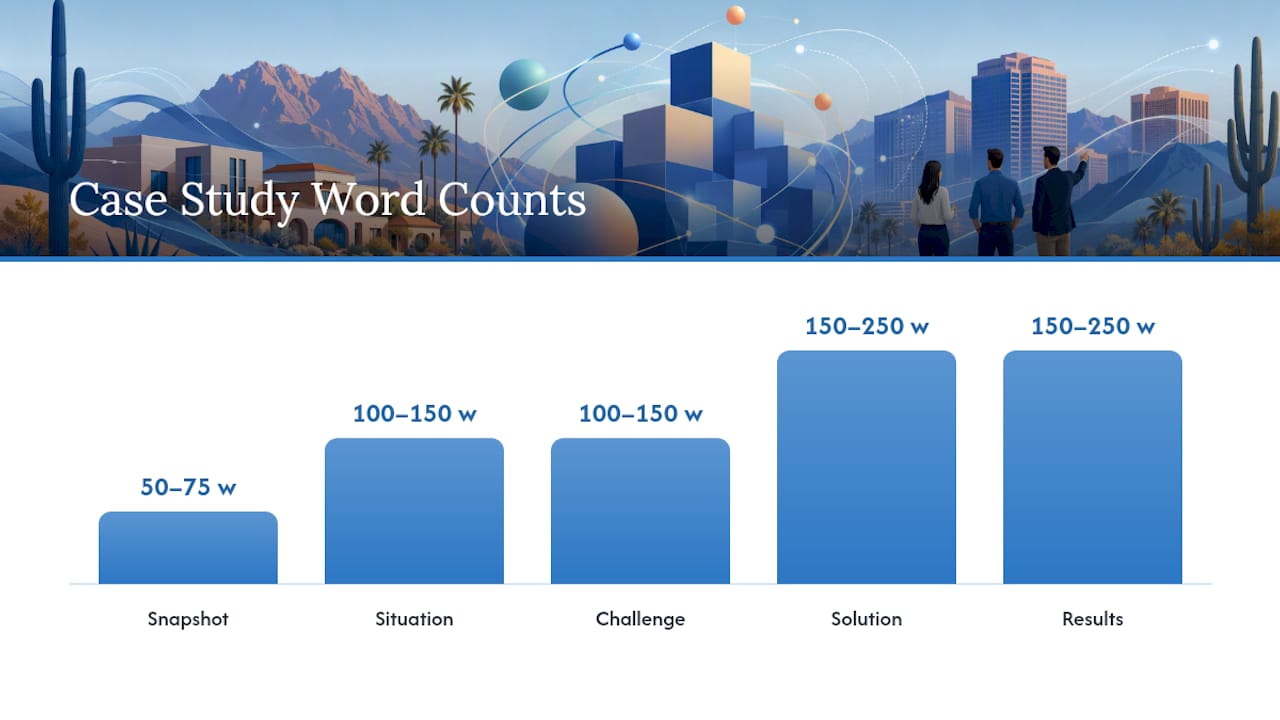
The four-part structure known as Situation, Challenge, Solution, Results (SCSR) is the format that performs best for marketing case studies, and most published examples run between 500 and 1,500 words. Anything shorter feels thin. Anything longer loses the skimmer.
Here’s the practical breakdown for a single case study page:
- Snapshot box (50 to 75 words). Headline result up top, plus two or three hard metrics. This is what a skimmer reads first, so put your best number here.
- Situation (100 to 150 words). Who the client is, what their business does, and the local market context.
- Challenge (100 to 150 words). The specific problem, not a generic pain point. “Our garage door company wasn’t showing up for emergency repair searches” beats “we needed more visibility.”
- Solution (150 to 250 words). What was actually done, in plain language, without turning it into a service brochure.
- Results (150 to 250 words). Before/after numbers with a clear timeline, plus a client quote if you have one.
Placement matters as much as content. Drop a pull quote right after the Challenge section to build tension, and put another near the end of Results to close on emotion rather than a spreadsheet. A chart or before/after screenshot belongs between Solution and Results, where the reader is primed to want proof.
For sales use, create two extra formats from the same material: a one-page PDF for email attachments and a single paragraph summary your sales team can paste directly into a proposal.
How Do You Collect the Right Evidence From a Client?
Skip the long survey. The best case study interviews are short, structured, and pre-sent, and they stay focused on three areas: the problem, the solution, and the measurable result. Send the client five to seven questions in advance so they can pull real numbers instead of guessing on the call.
A workable question set looks like this:
- What was happening in your business before we started working together?
- What made you decide to fix it now instead of waiting?
- What specific numbers can you share, before and after, and over what time period?
- What surprised you most about the process?
- Would you say this to another Scottsdale business owner considering the same fix?
Keep the actual interview to 15 or 20 minutes. Longer conversations produce more filler, not more usable material. Record it, but don’t transcribe the whole thing. Pull the two or three lines that carry emotion or specificity and build the narrative around those.
Data collection runs parallel to the interview. Pull analytics screenshots, ranking reports, or sales figures from the same date range the client references, and note the exact timeline: start date, milestone dates, and the date results were measured. A result without a timeline reads as unverifiable, and buyers notice the gap even if they can’t name it.
What Design Elements Make a Case Study More Credible?
Visuals do the persuading that paragraphs can’t. A snapshot box with the headline metric, a pull quote, and at least one chart or screenshot lets a skimmer absorb company, main result, and methodology within seconds of landing on the page.
Three elements consistently earn their place:
- A before/after chart. Traffic, rankings, revenue, whatever the client’s real metric is. A simple bar chart beats a paragraph describing the same numbers.
- A screenshot of the actual result. A Google ranking, a Google Business Profile insight panel, an analytics dashboard. Authenticity reads instantly.
- A styled client quote callout. Pull it out of body text and set it in a larger font or a colored box so it breaks up the page visually.
Avoid stock photography of generic office handshakes. It signals template content and undercuts the specificity you worked to build into the writing. If you have real photos of the client’s storefront, product, or team, use those instead, even if they’re not professionally shot. A slightly imperfect real photo outperforms a polished fake one on trust.
How Do You Publish and Promote a Case Study for Local SEO?
Writing the case study is half the job. Getting it in front of the right people locally is the other half, and it’s the step most Scottsdale SMBs skip.
Start with placement: publish on a dedicated page in your main navigation, not buried three folders deep. Add schema markup where relevant so search engines can parse the review or article data cleanly. From there, distribute the case study across social, email, and sales channels rather than letting it sit as a static page.
A practical publishing checklist:
- Publish on a standalone URL under a visible “Case Studies” or “Results” navigation item.
- Add a short excerpt to your Google Business Profile as a post, linking back to the full page.
- Cut the headline result into two or three social posts spaced a week apart.
- Send the one-paragraph summary version to your email list.
- Hand the PDF version to your sales team for use in proposals.
Repurposing a single strong case study across these channels produces better ROI than churning out several thin ones. One well-promoted story beats five that nobody sees past the publish button.
Which Metrics Should You Include, and How Should You Present Them?
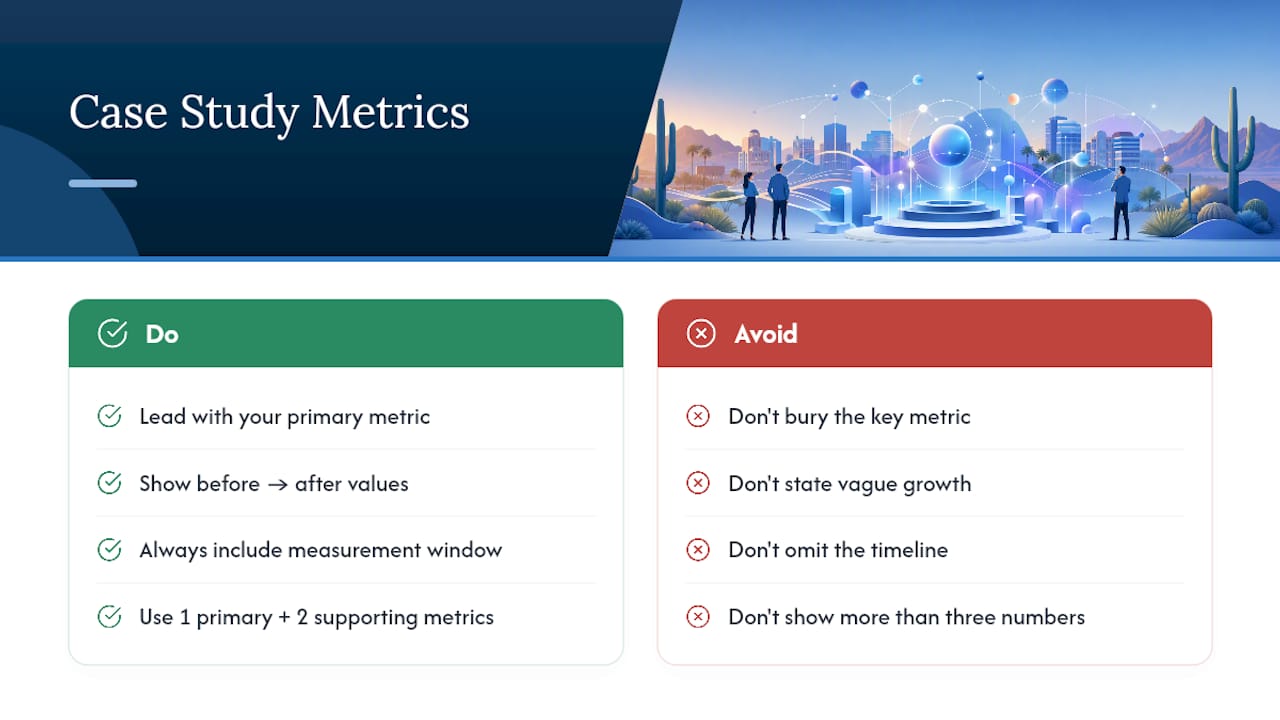
Lead with the number that matters most to your specific business, not the one that’s easiest to measure. Readers decide quickly whether a case study is worth their time, so the best metric belongs in the headline and the snapshot box, not buried in paragraph four.
Good metrics to consider, depending on the client’s goals: organic traffic growth, keyword ranking improvements, phone calls or form submissions, revenue change, or review count growth. Pick one primary metric and two supporting ones. Three total numbers is the sweet spot. More than that dilutes the impact.
Present every number with before/after framing and an explicit timeline. “Organic traffic grew” means nothing. “Organic traffic grew from 340 to 1,200 monthly sessions over five months” gives a reader something concrete to evaluate. The timeline also protects you from the appearance of cherry-picking, since a defined window signals the number wasn’t massaged to look better than it is.
A simple table format works well for presenting multiple metrics at once:
How Do You Write a Case Study That Actually Reads Well?
The biggest mistake in case study writing isn’t a lack of data. It’s writing the client’s story like a spec sheet instead of a story. Give the business a name and a face early, even if you anonymize details later. “A Scottsdale HVAC company” is fine, but “Dave, who runs a three-truck HVAC operation near Old Town” is memorable.
Structure the narrative around tension and resolution the way any good story works. What was actually at stake if the problem went unsolved? Lost revenue, a competitor pulling ahead, a slipping reputation. Naming that stakes moment before you introduce the solution makes the eventual results land harder.
Use the client’s own words wherever you can. A single unpolished quote, “I honestly didn’t think a website redesign could do this,” carries more weight than three paragraphs of polished marketing copy. If you’re looking for more technique on this front, approaches to human-centered storytelling offer useful detail on building emotional through-lines without overselling.
Cut every sentence that describes a feeling instead of showing a fact. “The client was thrilled” is filler. “The client called back three times in the first week to ask when they could hire us for a second location” shows the same enthusiasm with evidence behind it.
What Common Mistakes Should You Avoid in Case Study Writing?
Exaggeration is the fastest way to lose a reader’s trust. If a result took eight months, don’t imply it happened in six weeks. If growth was strong but not dramatic, resist the urge to round up. Buyers who’ve read a dozen inflated case studies can smell one from the first paragraph, and once they doubt one number, they doubt all of them.
Vague language is the second most common failure. “Significant improvement” and “impressive results” say nothing. Replace every vague qualifier with the actual figure, or cut the sentence.
A few other pitfalls worth flagging:
- Burying the result. If the reader has to scroll past three paragraphs of company background before hitting a number, you’ve lost most of your audience.
- Skipping the timeline. A result with no date range invites skepticism.
- Writing for the client, not the prospect. The case study exists to persuade a future buyer, not to flatter the client you interviewed.
- Forgetting a call to action. Every case study should end with a clear next step, not just trail off after the last metric.
- Overloading on jargon. If a Scottsdale small business owner wouldn’t say it out loud, don’t put it in the case study.
What Legal and Ethical Steps Should You Take Before Publishing?
Get written permission before a case study goes live, every time, no exceptions. A quick email confirmation works, but a simple signed release is better protection for both sides, especially if the case study includes specific revenue figures or business names.
Confidentiality needs the same care. If a client shares internal numbers, confirm exactly what can be public. Some clients are comfortable with exact revenue figures; others want percentage growth only, with no dollar amounts. Ask directly rather than assuming, and put the agreed scope in writing.
Give the client a chance to review the draft before publication. This isn’t just good manners. It catches factual errors, protects against misquotes, and prevents disputes after the piece is live. Most clients only ask for minor wording changes, and the review step tends to build goodwill rather than slow things down.
If the case study will appear in ads or be sent to a specific competitor of the client’s, ask first. Some businesses are fine being featured publicly but don’t want their story used in paid promotion aimed at a direct rival. It’s a small conversation that avoids a real problem later.
What Do Strong Case Study Examples Look Like?
The clearest way to understand the format is to look at a finished example rather than a template alone. WebTechs.Net’s own SEO case study portfolio shows the SCSR structure applied across different Scottsdale-area industries, including a garage door repair company that saw a 1,620% increase in relevant traffic after a targeted local SEO overhaul.
What separates a strong example from a mediocre one usually comes down to specificity in three places: the challenge section names the actual problem instead of a generic pain point, the results section anchors every number to a real timeline, and the quote section uses the client’s actual phrasing instead of a polished paraphrase.
If you’re building your first case study, pull up two or three published examples in your own industry and note what order the information appears in. Most follow the same rhythm: hook, context, tension, resolution, proof. Once you see that pattern a few times, writing your own version gets considerably easier.
An Agency’s View on What Case Study Production Actually Takes
Most people overestimate how long a good case study takes to produce. For an experienced team, the realistic window is four to six hours total: interview, drafting, and design combined. What takes longer isn’t the writing. It’s waiting on the client to approve data or send screenshots.
The outcomes worth chasing aren’t abstract. They show up as ranking movement, call volume, and page traffic you can point to on a dashboard, the kind of documented wins visible across Webtechs. The fastest way to speed up approval is to send the draft with the numbers already filled in, so the client is confirming facts instead of writing from scratch. That single change cuts most review cycles in half.
— Brett
Get a Case Study Written and Working for Your Business
Webtechs is the alternative to hiring a freelance writer or handling this in-house for Scottsdale businesses that want a case study written, designed, and actually promoted, not just typed up and forgotten in a folder. A DIY draft can capture the basics, but it usually misses the local SEO structuring, the schema, and the promotion checklist that turns a nice story into a lead-generating page.

A typical engagement includes a short pre-sent interview, drafting in the SCSR format, a designed snapshot box and visuals, and a publish-ready page built for your site. Turnaround runs on the same timeline discussed above, four to six hours of production once the interview is complete, plus normal review time on your end. If design support is part of the project, the team can also handle the page layout through professional web design so the finished case study matches your site rather than looking bolted on.
Take a look at the full portfolio of past client work to see examples across different Scottsdale industries, then reach out to get a quote for your own case study project.
Sources
- How to write customer case studies | U.S. Chamber of Commerce
- How to write a marketing case study that lands you more clients | AgencyAnalytics
- How to write a case study | Scale Growth Digital
- The power of case studies for small business websites | Salesforce