

Arizona Website Copywriting Rates: $2,500–$6,500, Agency or Freelance
Most small-business website copy runs $1,500 to $10,000 per project, with a typical 5 to 10 page site landing between $2,500 and $6,500. Per-page pricing runs $100 to $1,500 depending on complexity, while some writers bill $0.10 to $1.00 per word or $50 to $150 an hour. Before requesting quotes, nail down your page count, SEO needs, and how much research the writer will need to do.
TL;DR:
- Small-business website copy typically costs between $1,500 and $10,000, with project scopes from 3 to over 15 pages affecting the final price.
- Higher rates apply for pages requiring high conversion focus, industry-specific compliance, or extensive research, especially under tight deadlines.
- Project-based pricing is recommended for well-defined scopes, while hourly or retainer models suit undefined or ongoing work.
- Local Arizona businesses benefit from regional pricing and industry experience, which can improve search relevance without the premium of coastal agencies.
- Choosing between a freelancer and an agency depends on scope; freelancers are cost-effective for small projects, whereas agencies offer integrated SEO and design for larger rebuilds.
Table of Contents
- Website Copywriting Rates at a Glance
- Which Pricing Model Should You Choose?
- What Actually Moves Your Copywriting Quote
- Real Budget Scenarios for Arizona Small Businesses
- What Every Copywriting Quote Should Spell Out
- How to Hire a Website Copywriter Without Getting Burned
- Why Local Agency Experience Justifies the Higher End of the Range
- Does Your Location Affect What You’ll Pay?
- Does More Experience Mean a Better Website?
- Freelancer or Agency: Which Fits Your Budget?
- Budget, ROI, and the One Question That Actually Matters
- Get Website Copy, Design, and SEO Built as One Package
- Where These Numbers Come From
- Sources
Website Copywriting Rates at a Glance
Once you know your page count and goals, three price tiers usually cover it. A starter package ($1,500 to $3,000) fits a simple brochure site with light messaging work. A mid-tier project ($3,000 to $7,000) covers a small-business site with real brand voice and SEO built into each page. A premium project ($7,000 and up) typically involves stakeholder interviews, competitive research, and copy built to hit specific conversion or ranking targets.
Per-page rates vary just as much depending on what that page needs to do:
- Homepage: $300 to $1,500+, since it carries your core positioning and usually needs the most revisions
- Service or product pages: $150 to $600 each, often priced lower per page when bought as a set
- High-conversion sales or landing pages: $500 to $2,500+, reflecting specialist persuasion writing
- About/contact pages: $100 to $300, generally the least research-intensive
Freelance website copywriters typically charge $1,500 to $10,000 for a full site, with individual pages ranging from around $300 for something simple to $1,500 or more for a homepage built to convert. Hourly and per-word billing show up less often for full sites but matter for smaller jobs.
| Pricing anchor | Typical range | Best fit |
|---|---|---|
| Per project (3 to 5 pages) | $1,500–$3,000 | Simple brochure sites |
| Per project (5 to 10 pages) | $2,500–$6,500 | Standard small-business sites |
| Per page | $100–$1,500+ | Adding or replacing individual pages |
| Per word | $0.10–$1.00 | Blog posts, short landing copy |
| Hourly | $50–$150/hr | Edits, consulting, undefined scope |
Per-word rates in particular can swing wide. Market data puts them anywhere from $0.10 to $1.00 depending on specialization, with the top of that range reserved for niche technical or financial copy that demands subject-matter fluency.
Which Pricing Model Should You Choose?
Website copywriters bill four main ways, and each one shifts the risk between you and the writer differently.
- Per project: You get a fixed price for a defined set of pages. This works best once you know exactly what you’re building, and it’s the model most pricing guides recommend for website work because it aligns cost with outcome rather than time spent.
- Per page or per word: Useful for small additions, like a new landing page bolted onto an existing site. The downside: this model rewards volume, not persuasion, so a writer paid per word has less incentive to trim a bloated page down to something tighter and more effective.
- Hourly: Makes sense for open-ended work such as reviewing existing copy, light consulting, or fixing a handful of underperforming pages where the scope isn’t fully known upfront.
- Retainer: Fits businesses that need copy on an ongoing basis, blog posts, landing pages, email sequences, rather than a single one-time build. Retainers commonly fall between $1,000 and $6,000 a month depending on volume and scope.
Freelance pricing guidance generally backs this same logic: project pricing once scope is clear, hourly for undefined support, retainers for ongoing work. Hybrid arrangements, a project fee plus a smaller monthly retainer for updates, are common too.
What Actually Moves Your Copywriting Quote
A handful of factors push quotes up or down more than anything else.
- Research depth: Stakeholder interviews, customer surveys, and competitor audits take real hours, and a writer who skips them usually produces generic copy that undersells you.
- SEO requirements: Keyword research and on-page optimization require a different skill set than persuasive writing alone, and writers who do both well charge for it.
- Industry complexity: Legal, medical, and financial sites cost more because compliance review and technical accuracy slow everything down.
- Timeline pressure: Rush jobs routinely carry a premium, sometimes 20% to 50% above standard rates.
- Revision rounds: Most quotes include two rounds; extra rounds beyond that often get billed separately.
These same drivers show up consistently across pricing benchmarks for website copy, which list page count, research scope, SEO, and timeline as the biggest swing factors in any quote.
Pro Tip: Ask upfront whether SEO keyword research is included or billed separately. This single line item causes more quote confusion than anything else in a copywriting proposal.
Real Budget Scenarios for Arizona Small Businesses
Matching your project to a real-world scenario makes budgeting far less abstract than staring at a price range.
- Starter brochure site (3 pages): Minimal research, basic on-page SEO, straightforward messaging. Expect $500 to $3,000 total, reflecting smaller-scope package pricing common among independent writers and small studios.
- Standard small-business site (5 to 8 pages): Includes brand voice development and SEO on your key pages, homepage, services, about, contact. Budget $2,500 to $6,500, the most common range for local service businesses.
- Expanded site with service pages (10 to 15 pages): Deeper industry research plus SEO across a full site architecture. Costs typically land $5,000 to $10,000, especially when the business serves multiple locations or service categories.
- One high-conversion landing or sales page: A single, heavily optimized page built to convert traffic from a specific campaign. Specialist rates run $500 to $2,500+, with deliverables usually limited to that one page plus a short strategy note.
Reviewing landing page examples built to convert before you request quotes gives you a much clearer sense of what “high-conversion” actually looks like in practice, rather than relying on a writer’s word for it.
What Every Copywriting Quote Should Spell Out
A vague quote is how scope creep happens. Before you sign anything, confirm the proposal lists:
- Exact deliverables: page count, meta titles and descriptions, calls-to-action, hero copy for each page
- Number of revision rounds included, and the cost of additional rounds
- Timeline with milestones, not just a single final deadline
- Format of the handoff: copy delivered ready to paste into your CMS, or a plain document you’ll need to format yourself
- Who owns the final copy and whether any licensing restrictions apply
- Which SEO tasks are included (keyword targeting, meta tags) versus billed as add-ons
- Whether conversion testing or analytics setup is part of the package or a separate line item
A quote missing more than one or two of these items is worth a follow-up email before you commit.
How to Hire a Website Copywriter Without Getting Burned
A short discovery call tells you almost everything you need to know before signing a contract.
- Ask about process. How do they gather information about your business, and how many drafts happen before final delivery?
- Request results, not just samples. Ask for a before-and-after example, ideally with a traffic or conversion number attached.
- Clarify the revision policy in writing. Verbal promises about “unlimited revisions” mean nothing once the invoice arrives.
- Check references directly. A quick call to a past client surfaces things a portfolio never will.
- Consider a small paid test project first. A single page at an agreed rate tells you more about fit than any proposal document.
Red flags to walk away from: no portfolio at all, a scope that shifts every time you ask a clarifying question, vague talk about “content strategy” with no concrete deliverables list, or a freelancer who won’t disclose that the work is being outsourced.
Pro Tip: Before hiring, ask specifically whether they’ve written for your CMS platform. A writer unfamiliar with WordPress blocks or Shopify’s content editor can slow your launch by weeks, even if the copy itself is excellent.
Why Local Agency Experience Justifies the Higher End of the Range
Webtechs has built websites and SEO campaigns for Scottsdale-area small businesses since 1997, long enough to see which copy decisions actually move the needle on local search rankings and which ones just look nice. That track record matters when you’re weighing a freelancer’s per-word rate against an agency’s project fee.
The value isn’t the copy alone. It’s copy built alongside on-site and off-site SEO strategy from a team that already understands how Arizona search behavior differs from national trends. Clients working with Webtechs have reported measurable growth in online engagement and sales after a rebuild that paired new copy with technical SEO work, the kind of result that’s harder to replicate when copy and SEO come from two vendors who never talk to each other.

Paying more for that coordination often costs less than untangling a mismatched site later.
Does Your Location Affect What You’ll Pay?
Yes, though probably less than you’d expect if you’re comparing quotes from writers in different cities. Copywriters based in major metro areas with high costs of living, San Francisco, New York, tend to anchor their hourly and per-project rates higher simply because their overhead is higher. A writer in a lower-cost market can often deliver comparable quality for 20% to 30% less.
For Arizona businesses, this cuts both ways. Scottsdale and Phoenix sit in a mid-range cost bracket nationally, so local writers and agencies typically price closer to national averages than to coastal premiums. That’s an advantage if you’re hiring locally: you get a writer who understands regional search behavior, local competitors, and Arizona-specific customer language, without paying a big-city markup for it.
Remote hiring adds another wrinkle. A business owner in Scottsdale can hire a copywriter anywhere in the country, which means location-based pricing differences increasingly come down to the writer’s chosen market rather than yours. The practical takeaway: don’t assume a lower quote from an out-of-state writer means better value. Factor in whether they understand your local customer base, your competitors, and the search terms Arizona buyers actually use, since generic copy written for a national audience often underperforms copy built around local specifics.
Does More Experience Mean a Better Website?
Generally, yes, though the relationship isn’t perfectly linear. A brand-new freelance copywriter might charge $0.10 to $0.20 per word or $25 to $50 an hour, reflecting a limited portfolio and less proven ability to translate business goals into persuasive copy. A mid-career writer with five or more years of experience and a track record of measurable results typically charges two to three times that.
What you’re actually paying for at the higher end isn’t just better sentences. It’s strategic judgment: knowing which pages need heavy persuasion versus which need simple clarity, understanding how to structure a page for both search engines and human readers, and recognizing when a client’s stated request isn’t actually what will solve their problem. A state-of-the-industry pricing report notes that senior writers who bring strategic packaging and measurement into their process, not just word count, consistently command premium fees.
That said, more experience doesn’t automatically mean the right fit. A veteran copywriter who specializes in SaaS landing pages may not be the strongest choice for a local landscaping company’s service pages. When evaluating experience, look for relevant experience: has this writer worked with businesses similar to yours in size, industry, or sales model? A writer with three years of experience in your exact niche often outperforms a ten-year generalist.
Freelancer or Agency: Which Fits Your Budget?
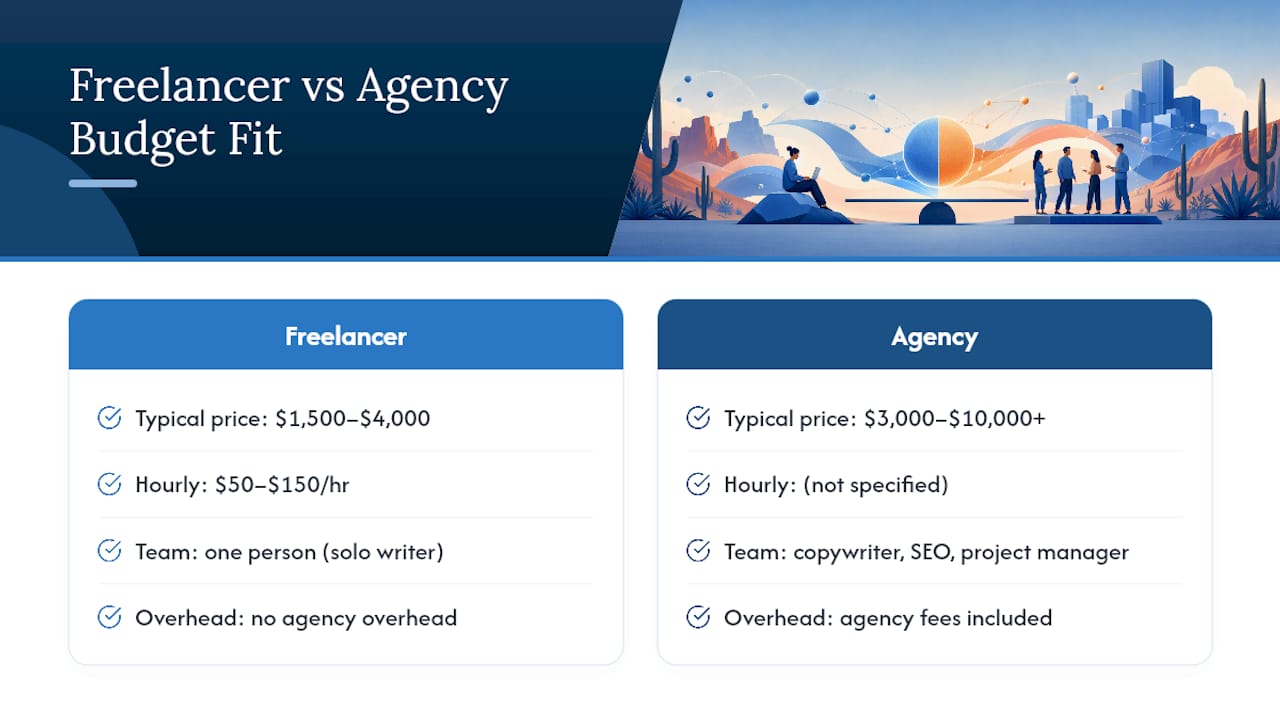
Freelance copywriters generally cost less upfront. A solo writer might quote $1,500 to $4,000 for a standard small-business site, with hourly rates in the $50 to $150 range for smaller jobs. You’re paying for one person’s time and skill, with no agency overhead layered on top.
Agencies typically charge more, often $3,000 to $10,000 or higher for comparable scope, because you’re paying for a team: a copywriter, an SEO specialist, sometimes a project manager coordinating the two, as seen in agencies like Goodson Tech. That coordination is exactly where the extra cost earns its keep. A freelance copywriter working in isolation from your SEO strategy can write compelling copy that still underperforms in search results, simply because keyword placement and site structure weren’t part of the same conversation.
The right choice depends on what you’re solving for. If you need a single, well-written page and already have SEO handled elsewhere, a freelancer is often the more cost-effective route. If you’re building or rebuilding a full site and want copy, design, and search visibility working together from day one, an agency’s higher fee usually reflects less coordination risk on your end, not just a bigger invoice.
Budget, ROI, and the One Question That Actually Matters
Two rules of thumb help here. First, spend proportionally more on copy and design early, since a weak first version of your site costs you leads every single day it stays live. Second, once your site is solid, shift budget toward traffic (SEO, ads) rather than endlessly rewriting copy that’s already working.
Message-driven changes to a website usually show measurable results within 60 to 90 days, faster than most SEO timelines, slower than paid ads. Before you approve any copy, ask one question: what’s the single action I want a visitor to take on this page? If the writer can’t answer that clearly, neither will your visitors.
— Brett
Get Website Copy, Design, and SEO Built as One Package
Hiring a freelance writer, then a separate SEO consultant, then a designer to make it all fit together, works, but it also means three invoices, three timelines, and nobody accountable when the pieces don’t align. Webtechs packages website copy with design and SEO as one project from the start, so the copy is written with your keyword strategy already baked in, not bolted on afterward.

For a Scottsdale or greater Arizona small business, that bundling typically means a faster launch and one point of contact instead of three. You can see how past projects came together on the Webtechs portfolio, or get a scoped quote through the professional web design page to see exactly what a bundled copy and design package would run for your specific site. If you already have a page count and rough timeline in mind, that’s the fastest way to get a real number back.
Where These Numbers Come From
The pricing ranges in this guide draw from established industry benchmarks, including the WhatShouldICharge copywriting pricing guide, the Waco3 freelance pricing guide, and AWAI’s State of the Industry pricing report. Cross-referencing multiple sources helps confirm these ranges reflect actual market rates rather than one outlet’s estimate.
Sources
- Website Copywriting Pricing | What to Charge | WhatShouldICharge
- Freelance Copywriting Pricing Guide (2026 Rates + Calculator) | Waco3
- State of the Industry Report: AWAI’s 2025 Copywriting Pricing Guide