

Multi-Location SEO: A Scalable Playbook for Businesses

Multi-location SEO works when you run it as a system: one authoritative corporate domain with centralized data controls, plus unique local pages and a verified Google Business Profile for every physical storefront. That two-layer structure, brand hub plus local spokes, is what separates businesses that dominate local search in every market from those that barely show up in one.
SEO is evolving, not dying. The shift is toward authoritative, trust-based systems rather than keyword hacks, and multi-location businesses that build those systems now hold a compounding advantage.
Three actions to take this week:
- Claim and verify a Google Business Profile for every physical location
- Publish modular location pages under one domain (e.g., yourdomain.com/locations/scottsdale)
- Add UTMs and Location IDs to every GBP link so leads trace back to the right storefront
| Dimension | Hiring an agency | Building in-house |
|---|---|---|
| Speed to launch | Faster (platform access, existing templates) | Slower (tool setup, training) |
| Cost structure | Monthly retainer | Salary + software |
| Data ownership | Confirm in contract | Full control |
| Best for | 10+ locations, limited internal bandwidth | 3–5 locations, strong marketing team |
For Scottsdale businesses ready to hire, Webtechs (webtechs.net) has managed local SEO for small and mid-sized businesses since 1997 and handles the full stack: GBP management, location pages, citations, and per-location reporting. When evaluating any other local agency, check for documented multi-location case studies, bulk GBP capability, and a sample dashboard before signing.
Table of Contents
- How do you choose the right multi-location SEO partner?
- What does a scalable multi-location SEO rollout actually look like?
- Webtechs brings Scottsdale businesses a proven local SEO system
- Key Takeaways
- Why the systems approach beats the campaign approach
- Authoritative sources and further reading
How do you choose the right multi-location SEO partner?
The build-vs.-hire decision usually comes down to two things: how many locations you manage and how much internal bandwidth you actually have. In-house management is viable for a small number of locations with a capable marketing coordinator. Beyond that scale, the operational complexity of bulk GBP management, citation syncing, and per-location reporting makes agency support worth the cost.
Ten questions to ask any agency before you sign:
- Can you show a case study with per-location traffic or ranking lifts?
- Which platform do you use for bulk GBP management?
- How do you handle GBP verification for new locations?
- Who owns the GBP listings if we part ways?
- What does your citation management process look like at scale?
- How do you prevent duplicate or ghost listings?
- Can I see a sample per-location dashboard?
- How do you tag GBP links for attribution?
- What’s your review acquisition process for individual locations?
- What’s your escalation path if a listing gets suspended?
Pro Tip: Ask for data ownership in writing before the contract is signed. Some agencies retain GBP access after a relationship ends, which can leave you locked out of your own listings.
Pricing varies by scope. A retainer covering GBP management, citation cleanup, and basic reporting for multiple locations typically starts in the range of a few hundred to a few thousand dollars per month, depending on service depth, review acquisition systems, and whether backlink work is included. Project-based engagements (initial audits, location page builds) are usually one-time fees. For cost-conscious SEO approaches that still produce measurable results, prioritize citation accuracy and GBP optimization before investing in content production.
Red flags to walk away from:
- Promises of a #1 ranking within 30 days
- Location pages that swap only the address and city name
- No ability to show per-location reporting
- Inconsistent NAP across their own agency directories
- Ghost listings they haven’t addressed for existing clients
What does a scalable multi-location SEO rollout actually look like?
The franchise SEO playbook that works in 2026 is a systems problem first. Programmatic templates, a central data repository, and bulk GBP tools prevent the exponential complexity that kills manual programs past 10 locations.
Phased rollout:
- GBP verification (weeks 3–6): Claim and verify each profile. Use bulk verification via Google Business Profile Manager where eligible. Each location needs its own profile with accurate, distinct information.
- Location pages (weeks 4–8): Publish under subfolders, not subdomains or microsites. Subfolders consolidate domain authority and prevent index fragmentation. Only create pages that map to real business assets, not every geographic keyword variation.
- Citations and reviews (weeks 6–10): Sync NAP data to aggregators (Data Axle, Neustar Localeze). Set up a review acquisition sequence per location. NAP consistency and fresh reviews are now central to AI-driven local visibility, not just traditional rankings.
- Local content and links (weeks 8–16): Add neighborhood proof points, local staff bios, and location-specific FAQs. Build local backlinks through chamber partnerships, local press, and community sponsorships.
Tools by function: GBP bulk management (Google Business Profile Manager, Yext), listing sync (Moz Local, BrightLocal), review management (Podium, Birdeye), call-tracking (CallRail), dashboards (Google Looker Studio with location-segmented views).
UTM template: Tag every GBP website link as utm_source=google&utm_medium=organic&utm_campaign=gbp&utm_content=location_[LocationID]. This ties every click and conversion to the correct storefront inside Google Analytics 4. UTMs and Location IDs are the difference between knowing which location drives revenue and guessing.
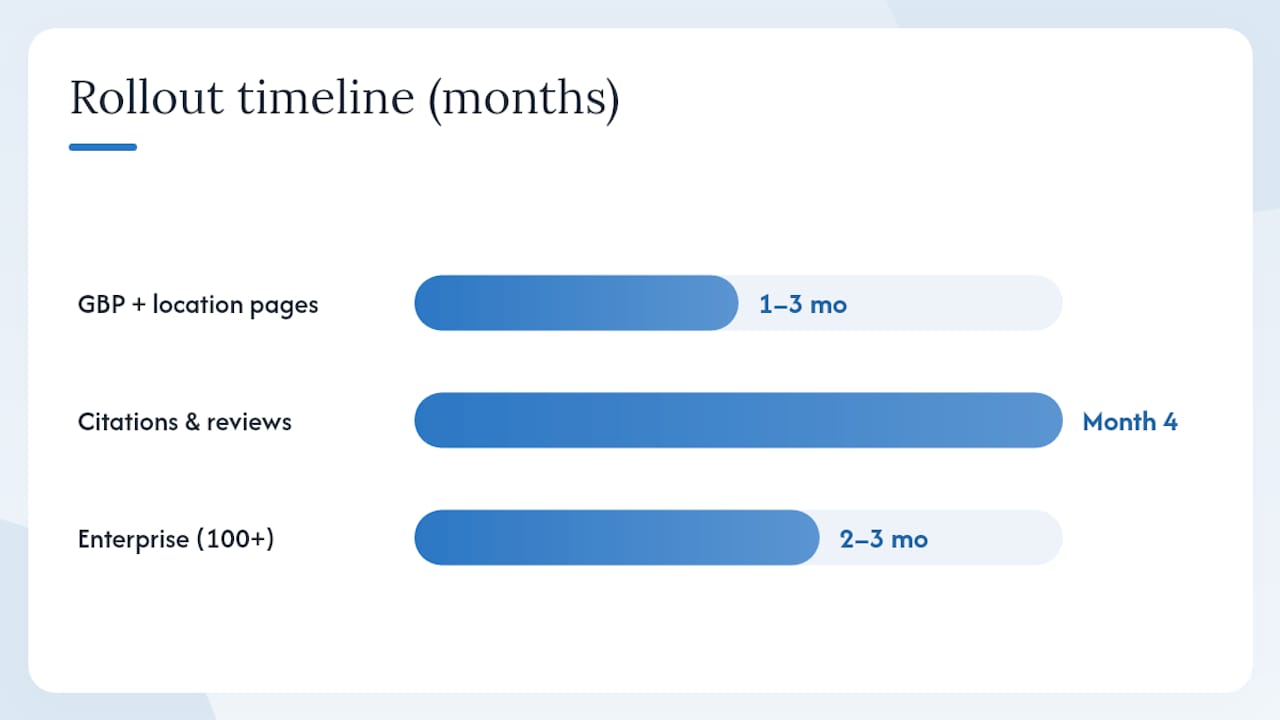
Timeline: A 10–50 location rollout typically reaches full GBP verification and location page publication by month three, with citation cleanup and review systems stable by month four. Enterprise programs (100+ locations) add two to three months for data governance and platform configuration.
Pro Tip: Avoid thin location pages by requiring five non-negotiable unique blocks in every template: a local staff bio, three location-specific testimonials, a neighborhood landmarks section, location-specific FAQs, and a unique service variant relevant to that market. Unique, localized content on each page is what keeps Google from treating them as doorways.
Webtechs brings Scottsdale businesses a proven local SEO system
Scottsdale businesses managing multiple locations need more than a vendor who knows SEO in the abstract. They need someone who understands the local market, can build the location-page infrastructure, and handles the operational details that most teams don’t have time for.

Webtechs has worked with small and mid-sized businesses in Scottsdale since 1997, covering the full multi-location stack: GBP optimization, modular location pages, citation management, review systems, and per-location reporting. Clients in service verticals like auto repair and hair salons have reported measurable gains in local search visibility and inbound leads. The garage door repair case study documents a 1,620% increase in organic traffic, a concrete example of what a well-executed local SEO system produces.
The approach follows the two-layer model: centralized data governance at the corporate level, with unique local content and GBP management at the location level. Every client gets per-location attribution so you can see which storefront is performing and where to invest next.
To get started, request a discovery audit or review the Webtechs portfolio to see relevant work. Onboarding typically begins within one to two weeks of a signed agreement.
Key Takeaways
Multi-location SEO requires one authoritative domain, verified GBPs for every location, unique local content, and attribution systems that tie every lead back to the correct storefront.
| Point | Details |
|---|---|
| Two-layer system | Run one corporate domain plus unique local pages and a verified GBP per location. |
| GBP per location | Every physical location needs its own Google Business Profile with distinct, accurate information. |
| Unique location pages | Use modular templates with local staff, testimonials, and neighborhood content to avoid thin pages. |
| UTM attribution | Tag GBP links with UTMs and Location IDs so every conversion traces back to the right storefront. |
| Webtechs | Scottsdale-based agency managing the full multi-location stack since 1997, with documented client results. |
Why the systems approach beats the campaign approach
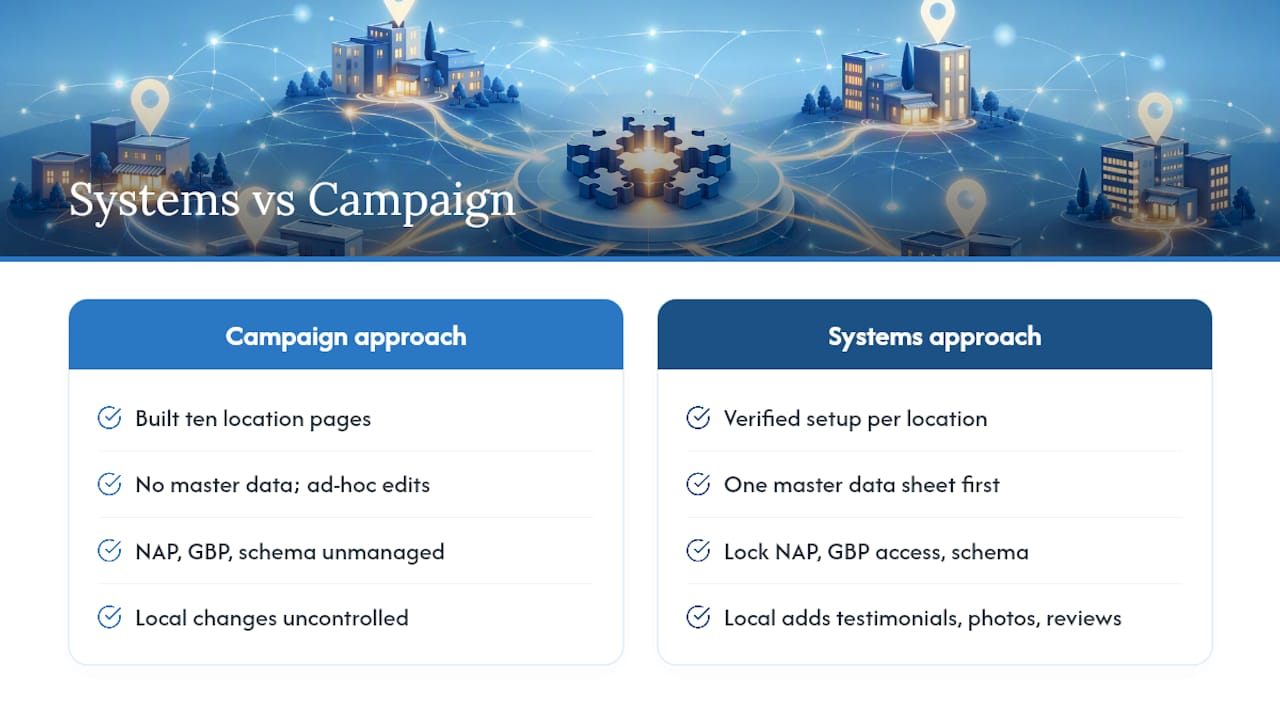
Most multi-location SEO failures share the same root cause: someone treated it like a campaign instead of an infrastructure problem. They built ten location pages in a sprint, claimed the GBPs, and moved on. Six months later, half the listings have wrong hours, three have duplicate profiles, and nobody can tell which location is actually driving calls.
The businesses that get this right treat it the way a franchise operations team treats a store opening checklist. Every location gets the same verified setup, the same template with required unique blocks, the same UTM structure. Modern GBP profiles act as entity anchors for AI-driven search, which means a poorly maintained profile doesn’t just hurt rankings. It makes the location invisible to AI overviews and map features that increasingly drive foot traffic.
The tension worth naming: corporate teams want control, and local managers want flexibility. The fix isn’t choosing one. Lock down NAP data, GBP access credentials, and schema markup at the corporate level. Give local managers a defined lane: they can add testimonials, update local photos, and respond to reviews. That split prevents the data corruption that causes GBP suspensions while still producing the local authenticity that franchise SEO requires at scale.
One master data sheet, enforced quarterly, is the single most underrated governance tool in this entire system. Every address, phone number, and business category lives there first, then syncs outward. Without it, you’re patching inconsistencies forever.
Authoritative sources and further reading
The recommendations in this playbook draw from the following sources. Each one goes deeper on a specific pillar:
- Guidelines for representing your business on Google
- The franchise SEO playbook you need to win in 2026
- Multi-location search visibility: Winning in Google & AI
- Franchise SEO: Boost Your Visibility and Visits with a Multi‑Location Strategy
- Multi-Location SEO: Boost Local Visibility for Each Location
- Multi-Location SEO: How to Scale Without the Chaos
- Local SEO for multiple locations
- Is SEO dead or evolving in 2026?
- Multi-location SEO structure: geographic pages that make sense