
Google Ads vs Facebook Ads: Which One Wins for You?

Google Ads wins when people are already searching for what you sell. Facebook (Meta) Ads win when you need to put your product in front of people who don’t know they want it yet. The smartest move, once you have budget to spare, is running both as a funnel: Meta creates the demand, Google captures it.
Quick recommendations by goal:
- E-commerce launch: Start with Meta (Facebook/Instagram) to build awareness, then add Google Shopping once you have data.
- Local services (plumber, HVAC, dentist): Start with Google Search. People searching “emergency plumber Scottsdale” are ready to call.
- B2B lead gen: Google Search for high-intent queries; layer in Meta retargeting once you have traffic.
- Brand building / new product: Meta first. You’re creating demand that doesn’t exist in search yet.
- Scaling an existing campaign: Run both platforms together as a full funnel.
Table of Contents
- What are Google Ads and Meta (Facebook) Ads, exactly?
- How do Google Ads vs Facebook Ads compare side by side?
- Which platform should you choose for your specific goal?
- What should you budget for Google Ads or Facebook Ads?
- What creative and targeting practices actually move the needle?
- How do you set up tracking and avoid attribution mistakes?
- What does Webtechs recommend for Scottsdale businesses?
- How do you pick the right platform in three steps?
- Key Takeaways
- The case for running both platforms, not choosing
- Webtechs handles your paid media so you don’t have to guess
- Useful sources
What are Google Ads and Meta (Facebook) Ads, exactly?
Google Ads is a pay-per-click advertising platform built around search intent. When someone types “best roofing company Scottsdale” into Google, your ad can appear at the top of results before any organic listing. Beyond search, Google Ads also covers Shopping (product listings with images and prices), Display (banner ads across millions of websites), and YouTube video ads. You bid on keywords, and Google’s auction determines placement based on bid and ad quality.
Meta Ads (which covers Facebook and Instagram) works on discovery. Nobody searches for your product; Meta’s algorithm finds people whose interests, behaviors, and demographics suggest they’d want it. Placements include Facebook and Instagram feeds, Stories, Reels, in-stream video, and Messenger. Meta’s Advantage+ campaigns automate audience and creative combinations, and Pew Research Center data shows a large share of U.S. adults use Facebook, giving Meta an enormous addressable pool.
How do Google Ads vs Facebook Ads compare side by side?
| Dimension | Google Ads | Meta (Facebook/Instagram) Ads |
|---|---|---|
| User intent | High: actively searching | Low to medium: browsing, discovering |
| Targeting | Keywords, location, device, audience lists | Demographics, interests, behaviors, lookalikes |
| Ad formats | Search, Shopping, Display, YouTube | Feed, Stories, Reels, Advantage+, Catalog |
| Typical CPC | $2–$4 (higher in competitive verticals) | $0.62–$1.14 |
| Measurement | Conversion tags, GA4, last-click or data-driven | Meta Pixel, Conversions API, view-through |
| Creative role | Copy-led; headline and offer drive performance | Visual-first; creative quality is the primary lever |
| Scalability | Capped by search volume | Broad; scale by expanding creative and audiences |

Benchmark data puts average Facebook CPC around $0.62–$1.14, while Google Search CPC typically runs $2–$4 or higher depending on vertical. That gap looks like a clear win for Meta until you factor in conversion rates. Search clicks convert at a higher rate because the user already wants what you’re selling. A local plumber’s Google Search ad converts a “plumber near me” click far better than a Facebook ad shown to someone scrolling through vacation photos.
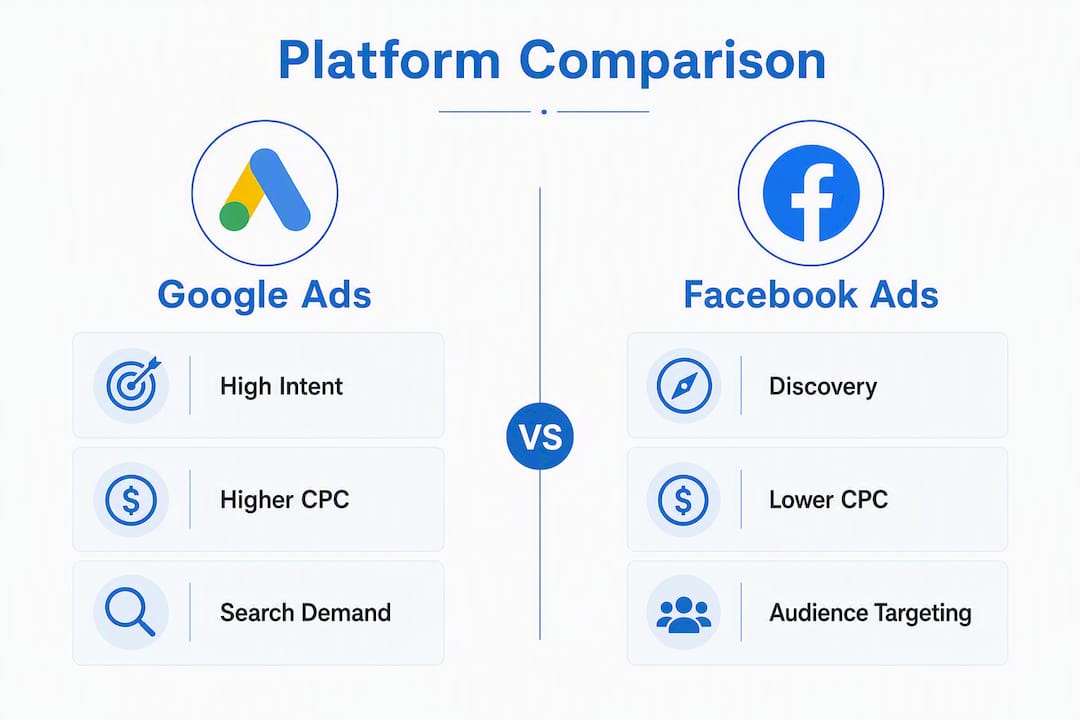
Google captures existing demand; Meta creates demand. That single distinction explains most of the strategic decisions below.
Pro Tip: Cheaper CPC on Meta does not mean cheaper customers. A $0.70 click that converts at 1% costs more per lead than a $3.50 Google click that converts at 8%. Always measure cost per acquisition, not cost per click.
Which platform should you choose for your specific goal?
Awareness and new product launches: Meta. If nobody is searching for your product yet, Google has nothing to harvest. Meta lets you build that awareness with video and feed ads.

Local service businesses: Google Search, almost always. A Scottsdale HVAC company running search ads on “AC repair Scottsdale” reaches people with immediate purchase intent. Pair it with a Google Business Profile for maximum local coverage.
E-commerce conversions: Both, sequenced. Meta’s catalog ads and Reels drive discovery; Google Shopping captures people comparing products. Retargeting on Meta after a Google-driven site visit is one of the highest-ROI moves in e-commerce.
B2B lead generation: Google Search for bottom-funnel queries (“enterprise HR software demo”), then Meta retargeting for nurturing. B2B buyers research for weeks; staying visible on both channels shortens the cycle.
When search volume is low: Google Ads hits a ceiling when nobody is searching for your category. A new product or niche service with minimal search volume needs Meta to generate interest first.
Layering the second platform: Once your primary channel is profitable, add the second. The funnel logic is straightforward: Meta warms cold audiences, Google closes them when they search. Most scaling brands run this combination because it compounds results faster than either channel alone.
What should you budget for Google Ads or Facebook Ads?
Neither platform sets a mandatory minimum. Both support daily budgets as low as a few dollars, and you can pause or scale at any time.
What $10/day actually gets you:
- On Meta, $10/day can generate meaningful impressions and test creative performance, though the algorithm needs time to learn. Expect limited reach in competitive markets.
- On Google Search, $10/day in a competitive vertical like legal or insurance may buy only a handful of clicks. In lower-competition local categories, it can drive real leads.
What $20/day unlocks:
- Meta: enough daily spend to exit the learning phase faster and gather statistically useful data within two weeks.
- Google: a workable test budget for local service keywords in mid-competition markets like Scottsdale.
| Budget | Meta (Facebook/Instagram) | Google Search |
|---|---|---|
| $10/day | Creative testing; limited reach | 3–8 clicks/day in local markets |
| $20/day | Faster learning phase; broader reach | 6–15 clicks/day; viable for local services |
| $50+/day | Scale with Advantage+; retargeting | Competitive verticals; multiple ad groups |
The real question is never “how much per click” but how much per lead or sale. A $20/day Google campaign that generates two qualified calls per day at $10 per call beats a $10/day Meta campaign generating zero conversions, regardless of CPC.
What creative and targeting practices actually move the needle?
Meta (Facebook/Instagram)
- Lead with a visual or video hook in the first two seconds. Thumb-stopping matters more than brand consistency in the feed.
- Test at least three to five creative variations per ad set. Meta’s algorithm performs best when it has multiple creative options to optimize against.
- Use Advantage+ campaigns for top-of-funnel awareness. Let the algorithm find your audience rather than over-constraining it with narrow targeting.
- Keep video under 15 seconds for feed placements; add captions since most users watch without sound.
- Don’t touch campaigns during the 7–14 day learning phase. Premature edits reset the algorithm’s data gathering and extend the learning window.
Google Ads
- Match your headline to the keyword. If someone searches “emergency plumber Scottsdale,” your headline should say exactly that.
- Put your strongest offer in headline 1. Price, guarantee, or speed of service all outperform generic brand names.
- Landing page relevance is the highest-leverage fix for underperforming search campaigns. A page that mirrors the ad’s keyword and offer converts dramatically better than a generic homepage.
- Use negative keywords aggressively to cut irrelevant spend, especially in broad-match campaigns.
Pro Tip: For both platforms, mobile page speed is non-negotiable. A landing page that loads in under three seconds on mobile retains far more of the traffic your ads pay to send there.
How do you set up tracking and avoid attribution mistakes?
Reliable measurement is where most small-business campaigns fall apart. Follow this sequence:
- Install Google Ads conversion tracking before spending a dollar. Set up conversion actions (form fills, calls, purchases) directly in Google Ads or import goals from GA4.
- Install the Meta Pixel and Conversions API on your site. The Pixel alone misses a growing share of conversions due to browser privacy restrictions; the Conversions API sends server-side data that fills those gaps.
- Connect GA4 to both platforms. GA4 gives you a cross-channel view and lets you see assisted conversions, not just last-click.
- Set up call tracking for any campaign driving phone leads. Call tracking tools assign unique numbers to each channel so you know which platform drove the call.
- Watch for red flags: If Meta reports 50 conversions but your CRM shows 10 leads, your Pixel is likely counting page views as conversions. If Google shows a 0.1% conversion rate on a well-trafficked campaign, check that your conversion tag fires on the confirmation page, not the landing page.
Attribution models matter too. Last-click attribution undervalues Meta’s role in the funnel because Meta often touches a customer first, but Google gets credit for the final click. Data-driven attribution in GA4 distributes credit more accurately across touchpoints.
What does Webtechs recommend for Scottsdale businesses?
The businesses Webtechs works with in Scottsdale that see the strongest paid-media results almost always run a full-funnel approach: Google Search for immediate demand capture, Meta for building the audience that feeds it.
For a local service business with a $1,500/month ad budget, a practical split is roughly 60% Google Search and 40% Meta retargeting. For an e-commerce brand launching a new product, flip that ratio until search volume builds.
DIY is viable for simple single-keyword Google campaigns or basic Meta awareness ads. Once you’re managing multiple ad groups, creative testing, and cross-channel attribution, the complexity compounds quickly. Webtechs handles PPC campaign management, conversion tracking setup, landing-page optimization, and creative production, so campaigns run on data rather than guesswork.
- PPC management: campaign structure, bidding strategy, negative keywords, and ongoing optimization
- Tracking setup: Google Ads tags, Meta Pixel, Conversions API, and GA4 integration
- Creative production: ad copy, video, and static visuals for Meta placements
- Landing-page builds: conversion-focused pages matched to ad intent
How do you pick the right platform in three steps?
- Ask: Is there search demand for what I sell? Search Google Trends or the Google Keyword Planner for your core terms. If monthly search volume is strong, start with Google. If it’s thin, start with Meta.
- Ask: Can I produce strong visual creative? Meta rewards creative quality above almost everything else. If you can’t produce at least three compelling visuals or a short video, your Meta results will be limited. Google Search needs only strong copy.
- Ask: What’s my conversion infrastructure? Both platforms waste money without a fast, relevant landing page and working conversion tracking. Fix those before scaling spend on either channel.
Red flags that should push you to reconsider your platform choice:
- Running Google Ads with no conversion tracking in place
- Running Meta ads with a single creative and a narrow audience
- Spending more than $500 without a dedicated landing page
Key Takeaways
Google Ads captures existing demand through search intent; Meta Ads create demand through discovery, and combining both platforms as a funnel consistently outperforms either channel alone.
| Point | Details |
|---|---|
| Platform match to goal | Google Search for high-intent buyers; Meta for awareness, discovery, and retargeting. |
| CPC vs. cost per result | Meta CPC runs $0.50–$2.00; Google Search runs $2–$4, but conversion rates favor Google for bottom-funnel goals. |
| Budget viability | $20/day is a workable test budget on both platforms; measure cost per lead, not cost per click. |
| Tracking first | Install conversion tags, Meta Pixel, Conversions API, and GA4 before scaling any campaign. |
| Webtechs full-funnel management | Webtechs manages PPC, tracking, creative, and landing pages for Scottsdale businesses running both platforms. |
The case for running both platforms, not choosing
The “Google Ads vs Facebook Ads” framing is useful for deciding where to start, but it’s a false choice at scale. The businesses that grow fastest treat these platforms as partners in a funnel, not competitors for a budget line.
What gets underestimated is the compounding effect. Meta introduces your brand to someone who wasn’t looking. Two weeks later, that person searches Google for exactly what you sell. Your Google Search ad closes the deal. Without Meta, that search might never happen. Without Google, the Meta impression never converts. Neither platform gets full credit in last-click attribution, which is exactly why so many advertisers underinvest in Meta and then wonder why their Google campaigns plateau.
The practical implication: start where your intent signal is strongest, get that channel profitable, then add the second. The cadence matters. Don’t split a $500/month budget across both platforms before either one has enough data to optimize. Get one working, then layer.
Webtechs handles your paid media so you don’t have to guess
Running paid ads across Google and Meta is straightforward to start and genuinely complex to scale. The gap between a campaign that breaks even and one that drives consistent ROI usually comes down to three things: tracking accuracy, landing-page relevance, and creative volume on Meta.
Webtechs has managed PPC campaigns for small and mid-sized businesses in Scottsdale since 1997, handling everything from initial campaign structure and conversion tracking to landing-page design and Meta creative production. The team also manages social media ad campaigns for businesses that need Meta handled end-to-end. If you want a free audit of your current paid-media setup or a recommendation on where to start, reach out to Webtechs directly at webtechs.net.
Useful sources
- Google Ads benefits and platform overview — Google Ads Help
- Grow your business with Google Ads — Google Ads Help
- What Is Facebook Advertising? — Coursera
- How to advertise on Facebook in 2026 — Hootsuite
- Meta Ads learning phase — Meta Business Help Center
- Google Ads vs Facebook Ads — Shopify
- Webtechs PPC and SEO services — WebTechs.Net