

Small Business Web Design: A Practical 2026 Guide

For most small businesses, the fastest path to real results is a conversion-focused few-page site built on a stable CMS, launched with a basic SEO setup, and ready to load in under three seconds. That’s the playbook. Everything below explains how to execute it.
Quick path by budget:
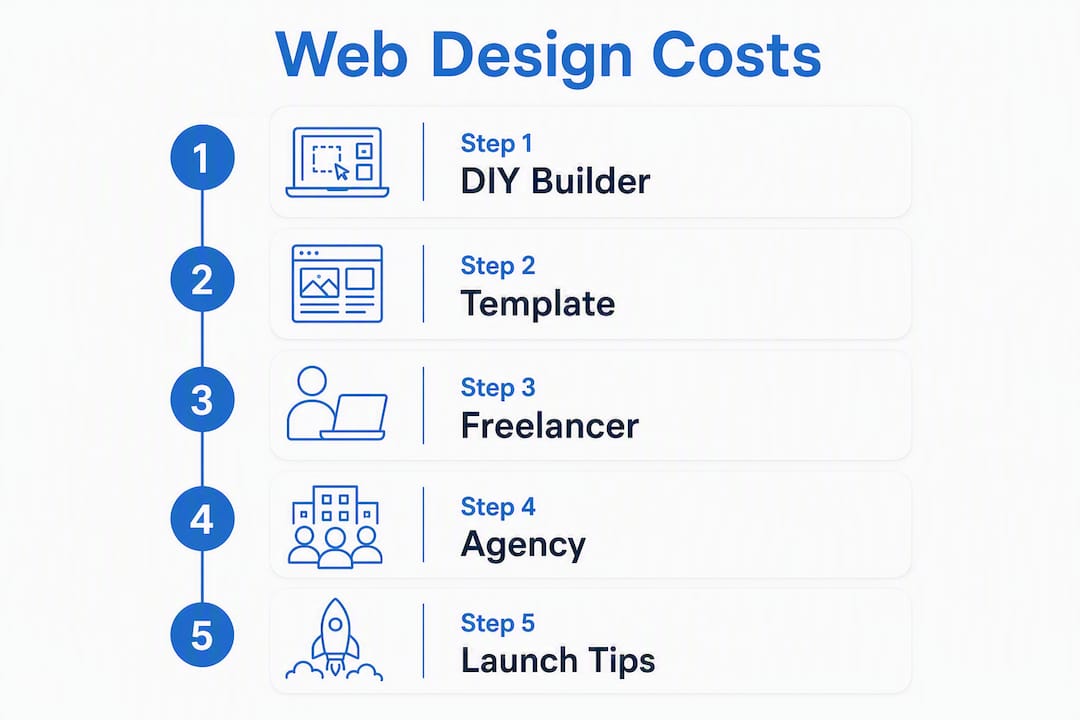
- Under $500: DIY with a website builder (Wix, Squarespace, or WordPress.com). Live in days. Limited custom functionality and SEO ceiling.
- $500–$3,000: Template-based site with customization. A freelancer or junior agency handles setup. Launch in 1–3 weeks.
- $2,000–$8,000: Freelancer-built custom site on WordPress or a similar CMS. Full control, better SEO foundation. Expect a few weeks.
- $5,000 and up: Small agency with discovery, design, development, and post-launch support. Several weeks depending on scope.
Content readiness is the single biggest variable in every timeline. Have your copy, photos, and pricing details ready before you sign anything.
Table of Contents
- How do you choose the right web design approach?
- What does small business web design actually cost?
- What pages and features does every small-business site need?
- DIY, template, freelancer, or agency: which build option fits you?
- How long does it take to launch a small-business website?
- What should you expect from a professional web design partner?
- Key Takeaways
- The part most guides skip
- Webtechs builds sites that work for Arizona small businesses
- Useful sources
How do you choose the right web design approach?
Start with one question: what do you need a visitor to do when they land on your site? Call you, book an appointment, fill out a lead form, or buy something? That primary conversion action shapes every decision that follows, from the number of pages to the CMS you choose.
Scope checklist before you talk to anyone:
- How many pages do you need at launch?
- Do you need e-commerce, online booking, or a client portal?
- What third-party tools must integrate (CRM, scheduling, payment processor)?
- Do you have copy and photos ready, or does the provider need to create them?
- Will you update the site yourself, or do you need ongoing support?
Once you know your scope, evaluate providers on trust signals. Portfolio case studies and client testimonials tell you whether a designer has solved your type of problem before. Clear pricing or price ranges signal professionalism. A described process with milestones means fewer surprises. According to Forbes Advisor, readable fonts, uncluttered layouts, and clear CTAs are the design basics that actually move conversions — so look for those in any portfolio you review.
Red flags to walk away from: opaque pricing with no ballpark, zero portfolio, vague timelines with no milestones, and no mention of post-launch support or hosting handover.

Pro Tip: Ask any provider: “Who owns the domain and files at the end of the project?” If the answer is anything other than “you do,” keep looking.
What does small business web design actually cost?
Pricing varies more than most guides admit, so here’s a realistic breakdown by delivery model.
| Delivery model | Typical price range | What’s usually included | What’s usually excluded |
|---|---|---|---|
| DIY builder | — | Hosting, templates, basic SEO tools | Custom design, advanced integrations |
| Template + customization | $500–$3,000 | Setup, theme customization, basic pages | Content writing, photography, SEO |
| Freelancer (custom) | $2,000–$8,000 | Custom design, CMS build, basic on-page SEO | Ongoing maintenance, content, hosting |
| Boutique agency | $5,000 and up | Discovery, design, development, QA, launch | Monthly SEO retainer, PPC, content |
Webtechs’s pricing guide breaks down local agency costs in more detail if you want Arizona-specific benchmarks.
Common add-ons that catch owners off guard:
- E-commerce setup: $500–$3,000+ depending on product count and payment gateway
- Professional content writing: $75–$200 per page
- Photography or stock licensing: $200–$1,500
- SSL certificate: often bundled with hosting, but verify
- Domain renewal: $10–$20/year
- Ongoing maintenance and hosting: $50–$300/month depending on provider
Pricing models fall into three buckets. Fixed-price packages give you a defined scope and a set fee — good for predictable budgets. Hourly rates ($75–$200/hr for experienced designers) work when scope is fluid. Monthly retainers cover ongoing SEO, content, and maintenance after launch.
Pro Tip: Launch with the minimum pages that cover your core conversion path, then add features. A five-page site that loads fast and converts beats a twenty-page site that launches six months late.
What pages and features does every small-business site need?
Five pages cover the core conversion path for most service businesses: homepage, services (or products), about, contact, and one focused landing page built around your primary keyword and call to action.
Mobile-first design isn’t optional. Most local searches happen on phones, and a layout that breaks on a 375px screen loses those visitors immediately. Visible CTAs above the fold, tap-friendly buttons, and a phone number that auto-dials are table stakes for responsive design for local businesses.
Speed matters just as much as layout. The Nielsen Norman Group cites the three-second rule as the performance benchmark for reducing abandonment: visitors who wait longer than three seconds tend to leave before the page finishes loading. The practical fixes aren’t complicated. Compress images before upload, choose a host with solid uptime and fast servers, and cut third-party scripts to only what you actually use. Hosting quality alone can swing load time by a full second or more — worth reading Webtechs’s small business hosting guide before you commit to a plan.
On the technical SEO side, request these at minimum: unique meta titles and descriptions on every page, a local business schema markup (especially if you serve a specific city or region), an XML sitemap submitted to Google Search Console, and on-page copy that naturally includes your target search terms. These aren’t advanced tactics — they’re the baseline that makes a new site findable.
DIY, template, freelancer, or agency: which build option fits you?
| Option | Best for | Key trade-off |
|---|---|---|
| DIY builder (Wix, Squarespace) | Solopreneurs, simple brochure sites | Fast and cheap; limited SEO ceiling and custom logic |
| Template + customization | Early-stage businesses, tight budgets | Faster than custom; may need redesign as you grow |
| Freelancer | Service businesses needing a custom CMS site | More control; quality varies widely |
| Small agency | Local businesses, e-commerce, growth-focused | Highest cost; best process, support, and long-term asset |
Zapier’s roundup of website builders confirms that builders have closed the gap on ease of use and basic SEO tools — but they still lag on custom interactions and advanced technical setups. For a simple five-page service site with no e-commerce, a builder is a legitimate choice. For anything with booking systems, complex integrations, or a serious local SEO strategy, WordPress or a comparable CMS gives you more room to grow. See Webtechs’s WordPress vs. Wix comparison for a direct platform breakdown.
Suitability at a glance:
- Solopreneur or side business: DIY builder, launch quickly and upgrade later
- Local service business (plumber, salon, consultant): Freelancer or boutique agency on WordPress
- E-commerce startup: Agency with WooCommerce or Shopify experience
- Funded startup needing brand-led design: Boutique agency with a discovery phase
How long does it take to launch a small-business website?
Timelines depend almost entirely on two things: the delivery model and how prepared you are with content.
- DIY builder: Same day to two weeks. The builder is ready; you’re the bottleneck.
- Template + customization: One to three weeks, assuming content is ready at kickoff.
- Freelancer: Two to six weeks. Revisions and content gaps are the most common delays.
- Small agency: Four to ten weeks or more for a full discovery-to-launch engagement.
Sprint-based agency models can compress delivery to 10–25 days when scope is fixed and the client arrives with content in hand. Single landing pages for MVP validation can go live in 48 hours through rapid-delivery services, though those are intentionally narrow in scope and not a substitute for a full site.
The most consistent project-killer isn’t a slow designer. It’s a client who hasn’t written their service descriptions, doesn’t have a professional headshot, and hasn’t decided on pricing. Prepare these before kickoff: page-by-page copy, final logo files, photography (or a clear brief for a photographer), and a decision on hosting. Scheduling milestone approvals in advance — rather than waiting until a designer asks — cuts weeks off the schedule.
What should you expect from a professional web design partner?
A well-run agency engagement moves through predictable phases: discovery (goals, audience, competitors), sitemap and content plan, design mockups for approval, development, quality assurance across devices, launch, and a post-launch support window.
Deliverables you should receive at project close:
- CMS login credentials and full admin access
- Design files (or at minimum, exported assets)
- Documentation on how to update content
- Hosting setup or handover instructions
- Basic on-page SEO configuration (meta tags, sitemap, Google Search Console verification)
Webtechs has been building sites for Arizona small businesses since 1997. Their portfolio shows live examples across local service verticals, and client testimonials speak to measurable gains in traffic and leads. That kind of track record is exactly what you’re looking for when evaluating any agency.
Pro Tip: Before your first agency meeting, bring three competitor URLs you respect and a one-sentence description of your ideal customer. That alone cuts the discovery phase in half.
Key Takeaways
A conversion-focused, performance-first website built on a stable CMS is the most reliable path to online results for small businesses at any budget level.
| Point | Details |
|---|---|
| Match approach to budget | DIY under $500, template $500–$3,000, freelancer $2,000–$8,000, agency $5,000+. |
| Prepare content before kickoff | Copy, photos, and pricing details ready at start cuts weeks from any timeline. |
| Hit the three-second rule | Compress images, choose quality hosting, and cut unused scripts to keep load time under three seconds. |
| Cover five core pages | Homepage, services, about, contact, and one conversion landing page cover most small-business needs at launch. |
| Webtechs for Arizona businesses | Webtechs offers custom web design, SEO, hosting, and content for small businesses across Arizona from its Scottsdale base. |
The part most guides skip
The conventional wisdom says “pick the right platform.” That’s not wrong, but it’s not where projects actually fail. They fail because a business owner hands a designer a folder of blurry iPhone photos, a Word doc that says “write something about us,” and a logo in the wrong format — then wonders why the site takes three months.
The platform matters less than the brief. A clear conversion goal, a finished set of page copy, and a single decision-maker who can approve mockups in 48 hours will get you a better site faster than any CMS debate. I’ve seen WordPress sites outperform expensive custom builds because the owner knew exactly what they wanted and had the content ready on day one. The tool is almost never the constraint.
Webtechs builds sites that work for Arizona small businesses
Webtechs has been designing and launching websites for small and mid-sized businesses across Arizona since 1997. The difference from a generic template shop is straightforward: every project starts with your conversion goal, not a theme library. You get a custom site, hosting guidance, on-page SEO setup, and content support under one roof, with a team that knows the Arizona market.
Browse the Webtechs portfolio to see live examples across local service verticals, or check the website design price list for transparent package ranges. When you’re ready to move forward, reach out through the Webtechs web design page with your page count, timeline, and primary conversion goal. That’s all you need to get a proposal started.
Useful sources
- How Long Do Users Stay on Web Pages? — Nielsen Norman Group — The research behind the three-second performance benchmark.
- Small Business Website Design Best Practices — Forbes Advisor — Practical design checklist with real examples.
- The 9 Best Website Builders for Small Business — Zapier — Honest comparison of builder strengths by use case.
- Cost of Website Design — Webtechs — Arizona-relevant pricing guidance from the Webtechs team.
- Best Website Hosting for Small Business — Webtechs — Hosting recommendations for performance and uptime.
- Webtechs Portfolio — Scottsdale, Arizona — Live examples of completed small-business sites.
- Website Design Price List — Webtechs — Transparent package pricing for planning your budget.