

PPC Management Pricing in 2026: Real Costs for SMBs

Most small and mid-sized businesses in Arizona and across the U.S. spend a moderate amount per month all-in on PPC, which means management fees plus actual ad spend combined. Management fees alone typically range from 10% to 20% of ad spend, or as a flat monthly retainer usually between $1,500 and $10,000 depending on the account size and complexity. This portion of your total PPC spend can vary, but these are the most common benchmarks for agency management. So if you plan to put a moderate monthly amount into Google Ads, budget an additional amount for management on top of that.
The three pricing models you will see in almost every agency quote:
- Flat monthly retainer: A fixed fee regardless of how much you spend on ads, typically within a moderate range per month for agencies.
- Percentage of ad spend: The agency takes a portion of your monthly ad budget as their fee.
- Hybrid: A base retainer plus a smaller percentage, common for accounts with larger monthly spend.
Hourly and performance-based models exist too, but most SMBs end up on one of the three above. The model matters as much as the number, and the next section explains exactly why.
Table of Contents
- What PPC management pricing models actually cost you
- Real price ranges and sample budgets by business size
- What does a PPC management fee actually pay for?
- What drives PPC management costs higher?
- How to budget total PPC spend and set realistic timelines
- How to evaluate PPC quotes and spot red flags
- Sample packages and how Webtechs structures PPC pricing
- Key Takeaways
- What fair PPC pricing actually looks like from the inside
- Webtechs PPC management for Arizona small businesses
- Benchmarks, calculators, and sources to verify PPC pricing
What PPC management pricing models actually cost you
Understanding the model behind a quote tells you more than the dollar figure alone. Each structure creates different incentives, and some of those incentives work against you.

| Pricing Model | Typical Cost Range | Best For | Watch Out For |
|---|---|---|---|
| Flat monthly retainer | $1,500–$10,000 per month | Predictable budgets, defined scope | “Set and forget” management with no deliverable guarantees |
| Percentage of ad spend | 10%–20% of spend | Scaling accounts, larger budgets | Agency earns more when you spend more — misaligned incentive |
| Hourly | Varies by freelancer and agency | Project work, audits, short engagements | Hard to predict monthly cost; attention varies by client load |
| Performance-based | Varies | Clear conversion goals, high risk tolerance | Complex to track; can favor quantity over lead quality |
| Hybrid (base + %) | Flat fee plus portion of spend | Mid-size accounts wanting stability + growth incentive | Requires clear contract language on triggers for percentage |
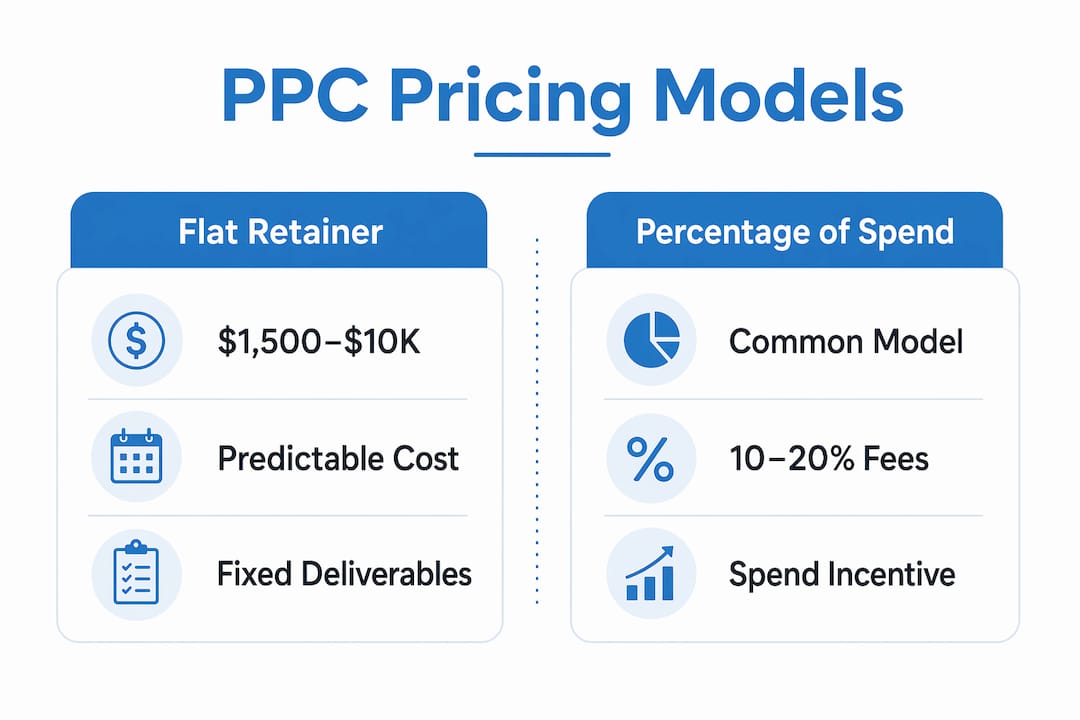
Flat retainer: predictable but potentially passive
You pay the same amount every month whether the account is thriving or struggling. That predictability is genuinely useful for budgeting. The risk is that a flat fee without defined deliverables can drift toward minimal attention over time.
Ask any agency quoting you a flat fee to specify exactly what you get each month: how many campaigns, how often bids are reviewed, what reporting looks like, and whether creative testing is included.
Percentage of ad spend: the most common model, with a catch
Percentage-of-spend models can create a conflict of interest because agencies earn more as you spend more. That does not make the model bad, but it does mean you need to ask whether the percentage applies to ad spend only, whether there is a monthly floor, and whether creative or tools are billed separately. At $10,000 in monthly ad spend, a 15% fee is $1,500. At $50,000, that same rate is $7,500. The work involved does not scale at the same rate the fee does.
Hourly: fine for audits, awkward for ongoing management
Freelancers commonly charge $50–$200 per hour, with monthly retainers ranging from $500 to $3,000 or more, depending on experience and account scope. Agency hourly rates for U.S.-based firms typically average $100–$149 per hour. For ongoing campaign management, hourly billing makes monthly cost hard to predict. It works well for one-time audits or account cleanups, less so for the week-to-week optimization a live campaign needs.
Real price ranges and sample budgets by business size
The numbers below reflect typical all-in costs. Ad spend and management fees are always separate line items.
Management fee ranges by ad-spend band
| Monthly Ad Spend | Typical Management Fee | Notes |
|---|---|---|
| Lower ad spends (<$2,500) | $500–$1,000+/mo | Management fees tend to be a larger proportion of spend at lower levels |
| Mid-range ad spends ($2,500–$10,000) | $1,500–$3,000/mo or ~10–20% of spend | Percentage model often used; boutique agencies common |
| Higher ad spends ($10,000–$50,000) | $3,000–$7,500+/mo or hybrid model | Hybrid models common; dedicated account manager typical |
| Very high ad spends (>$50,000) | $7,500+/mo or custom pricing | Enterprise tiers; multi-platform, ABM, advanced attribution |
Sample scenarios
Local service business (plumber, HVAC, landscaper in Arizona): A moderate monthly spend in Google Ads plus a typical management fee equals an all-in budget that can be a lean but workable starting point for a single-market, single-platform campaign. Add a one-time setup fee within a common range and your first month budget will be higher.
E-commerce testing budget: A moderate ad spend across Google Shopping and Meta, managed at a typical percentage of spend, results in a total budget combining ad spend and management fees. If the agency also handles creative production, add a moderate budget per asset for display or social ads.
Growth-stage SMB: A moderate to higher monthly ad spend on Google Search and Performance Max, managed at a hybrid rate with a base fee plus a percentage of spend, results in a management fee and total budget that generally fits within typical ranges seen for small-to-mid businesses, though some growth-stage accounts spend more.
Setup and onboarding fees
Setup fees are billed once, typically at the start of a new engagement. The standard range is $500–$2,500 for a new account build, keyword research, campaign structure, and conversion tracking setup. Some agencies waive the setup fee for longer contract commitments. Either way, your first-month budget will be higher than every month after it.
What does a PPC management fee actually pay for?
A management fee covers the work of running your campaigns, not the cost of the ads themselves. Here is what a solid retainer typically includes:
- Account and campaign setup: Keyword research, campaign structure, ad group organization, match-type strategy
- Bid and budget management: Daily or weekly bid adjustments, budget pacing, dayparting
- Ad copy and creative testing: Writing and rotating text ads, testing headlines and descriptions
- Conversion tracking: Setting up and verifying goal completions in Google Ads and Google Analytics 4
- Reporting: Monthly or bi-weekly performance reports covering clicks, cost per click, conversions, and cost per acquisition (CPA)
- Ongoing optimization: Negative keyword additions, Quality Score improvements, audience refinements
What is usually not included in a standard management fee: landing-page design or development, video ad production, custom display creative, third-party attribution tools, and CRM integration work. Hidden costs like landing pages ($1,000–$10,000 per page), creative assets ($200–$10,000+ per asset), and third-party tools ($120–$1,000+/month) can add significantly to your total spend if you do not clarify scope upfront.
The two metrics that matter most in any report: Return on ad spend (ROAS) and cost per acquisition (CPA). If an agency’s reporting leads with impressions and click-through rates but never mentions what a lead or sale actually cost you, that is a problem worth addressing before you sign anything.
Pro Tip: Always plan for the all-in cost — management fee plus ad spend — and demand reporting that ties both to business outcomes like leads, sales, and customer acquisition cost, not just traffic metrics.
What drives PPC management costs higher?
Not all campaigns cost the same to manage. These are the factors that push a quote up, and knowing them helps you understand whether a higher price is justified.
- Number of platforms: Google Ads alone is one scope. Add Meta, Microsoft Ads, Amazon, or LinkedIn and the management workload roughly doubles per platform added.
- Campaign complexity: A single search campaign targeting one city is straightforward. Multi-location targeting, multiple product lines, and granular audience segmentation each add hours.
- Creative and asset production: Video ads, display banners, and iterative creative testing require either in-house design resources or additional fees. This is one of the most commonly underquoted cost categories.
- Tracking and attribution setup: CRM integrations, multi-touch attribution models, and offline conversion tracking (connecting a phone call or in-store visit back to a click) require technical setup time that is often billed separately.
- Industry keyword competition: A personal injury law firm in Phoenix competes in one of the most expensive keyword markets in the country. Higher CPCs mean more active bid management, which means more management hours.
- Account history and cleanup: Inheriting a poorly structured account with years of bad data, irrelevant keywords, and broken tracking takes time to fix. Many agencies charge a higher setup fee or a one-time audit fee when taking over existing accounts.
- SLA and dedicated hours: Some clients need same-day response times or a named account manager. That level of access costs more and is usually only available at higher retainer tiers.
Pro Tip: When comparing quotes, ask each agency to break down what percentage of their fee covers strategy versus execution. A quote heavy on execution with no strategic layer is a sign the account will be managed reactively rather than proactively.
How to budget total PPC spend and set realistic timelines
The management fee is only part of the equation. Getting the total budget right from the start prevents the most common mistake SMBs make: underfunding ad spend while paying for management, then blaming the agency when there is not enough data to optimize.

For Google Search campaigns, most boutique agencies set minimum ad-spend thresholds of $2,500–$5,000 per month. Below that level, the campaign rarely generates enough clicks and conversions to make meaningful optimization decisions. LinkedIn Ads requires a minimum daily budget of $10 per campaign, but realistically needs $3,000–$5,000 per month to generate usable B2B data.
A practical rule for Arizona SMBs starting out: plan for at least $3,000–$5,000 in total monthly spend (ad spend plus management) for a single-platform, single-market campaign. That gives you enough data to make real decisions within 60–90 days.
On timelines, allow at least 90 days before drawing conclusions about long-term performance. The first 30 days are largely about learning: the algorithm needs data, and your team needs to see which keywords and ads actually convert. Days 31–60 are for optimization based on early signals. By day 90, you should have enough conversion data to make confident decisions about scaling, pausing, or restructuring.
About one in five marketers spend between $1,000 and $3,000 per month on external PPC support. For most SMBs, that range covers a single-platform campaign with basic reporting — but not multi-channel management or advanced attribution.
The $20/day rule is a useful sanity check for Google Search: $20 per day equals roughly $600 per month in ad spend. That is enough to test a handful of keywords in a low-competition local market, but not enough to generate statistically reliable conversion data in most industries. Double it to $40/day ($1,200/month) as a more realistic floor for meaningful testing.
How to evaluate PPC quotes and spot red flags
Getting three quotes is a start. Knowing what to ask and what to watch for is what separates a good hire from an expensive mistake.
Questions to ask every agency or freelancer
- What is included in the monthly fee, and what is billed separately?
- Who specifically will manage the account — a senior strategist or a junior coordinator?
- How often will bids and budgets be reviewed (daily, weekly)?
- What does the reporting cadence look like, and which metrics are in the report?
- Is creative production (ad copy, display banners, video) included or extra?
- Does the management fee cover conversion tracking setup and ongoing maintenance?
- What platforms are included, and what does adding a second platform cost?
- What is the minimum contract term, and what are the exit terms?
Red flags in a PPC quote
- Management fee includes ad spend: The fee and the ad budget must always be separate. Any quote that bundles them makes it impossible to know what you are actually paying for management.
- Percentage model with no floor: If the agency charges 15% of spend with no minimum, they have little incentive to actively manage a small account. Ask for a stated monthly minimum.
- Vague deliverables: “We’ll manage your campaigns” is not a deliverable. A real scope includes specific outputs: number of campaigns, reporting frequency, creative testing cadence, and hours or tasks per month.
- No conversion tracking discussion: If an agency does not ask about your conversion goals in the first conversation, they are not thinking about your business outcomes.
- Lock-in with no performance clause: A 12-month contract with no performance benchmarks or exit clause for underperformance shifts all the risk to you.
Negotiation levers worth using
- Ask for a 30–60 day trial period before committing to a 6–12 month contract.
- Request a setup fee waiver in exchange for a longer initial commitment.
- Define a minimum hours-per-month commitment in writing, especially for flat retainers.
- Ask for a named account manager and a stated response-time SLA.
Comparing agency quotes against freelancer rates ($50–$200/hour, or $500–$3,000/month on retainer) is worth doing, but factor in the full picture. Freelancers often manage many accounts simultaneously; the effective attention your account gets depends on their total client load. Ask any freelancer for an estimated hours-per-month commitment and a deliverables list before comparing their rate to an agency’s.
Sample packages and how Webtechs structures PPC pricing
Transparent package examples help you benchmark any quote you receive. The table below shows three tiers that reflect how a well-structured PPC engagement scales with business size and goals.
| Package | Pricing Model | Monthly Management Fee | Ad Spend Range | Included Deliverables | Setup Fee | Best For |
|---|---|---|---|---|---|---|
| Starter | Flat retainer | $1,500–$2,000 | $2,500–$5,000 | 1 platform, campaign build, keyword research, monthly report, basic conversion tracking | $500–$1,000 | Local service businesses, single-market campaigns |
| Growth | Hybrid (flat + %) | $2,000–$3,000 | $5,000–$15,000 | 2 platforms, A/B ad testing, bi-weekly reporting, CPA tracking, audience optimization | $1,000–$2,000 | E-commerce, multi-location SMBs, lead-gen businesses |
| Scale | Percentage of spend | $3,000–$7,500+ | $15,000–$50,000 | Multi-platform, dedicated account manager, weekly reporting, creative testing, attribution setup | $1,500–$2,500 | Growth-stage companies, competitive verticals |
Webtechs structures its PPC packages around a simple principle: the management fee should be tied to defined deliverables, not just account access. For SMBs in Arizona, that means every engagement starts with a clear scope document specifying platforms, reporting cadence, and what optimization work happens each month.
Webtechs’s approach to PPC aligns with the outcomes that matter to local businesses: leads, calls, and sales, not impressions. The agency’s client results across Arizona service businesses demonstrate what happens when spend is tied directly to measurable business outcomes rather than vanity metrics. For SMBs that also need a landing page built or optimized before running ads, Webtechs handles that work in-house, which removes the coordination cost and the markup that comes from outsourcing creative to a third party.
Key Takeaways
PPC management pricing for most U.S. SMBs runs $2,000–$15,000 per month all-in, with management fees representing 10–20% of total spend, or a flat fee typically between $1,500 and $10,000/month — and a 90-day evaluation window is needed before drawing performance conclusions.
| Point | Details |
|---|---|
| All-in monthly range | Most SMBs spend $2,000–$15,000/month total (ad spend + management fee combined). |
| Management fee benchmark | Budget 10–20% of total PPC spend for management; under $2,500 ad spend, fees of $500–$1,000+/mo are common. |
| 90-day evaluation window | Allow at least three months before judging long-term performance; the first 30 days are data collection. |
| Red flags to avoid | Bundled fee + ad spend, no defined deliverables, percentage model with no floor. |
| Webtechs for Arizona SMBs | Webtechs offers defined-scope PPC retainers for small and mid-sized businesses with transparent deliverables and outcome-focused reporting. |
What fair PPC pricing actually looks like from the inside
The percentage-of-spend model gets a bad reputation, and some of it is earned. But it is not inherently unfair. It makes sense when an agency is actively scaling your account, because the additional management work at $30,000 in monthly spend genuinely exceeds what is needed at $5,000. The problem is when agencies use a percentage model on small accounts where the math produces a fee that is wildly disproportionate to the actual hours worked.
For most SMBs spending under $10,000 per month on ads, a flat retainer with defined deliverables is the fairer structure. It gives you predictability and forces the agency to specify what they are actually doing. Above $10,000, a hybrid model starts to make more sense because the management complexity does scale with spend.
The minimum contract question is one where I think the industry often gets it wrong. Six-month minimums are standard, and they are not unreasonable given that 90 days of data is the minimum needed to evaluate performance. But a 12-month contract with no performance benchmarks written in is a red flag. Any agency confident in their work should be willing to define what success looks like at 90 days and give you an exit path if those benchmarks are not met.
For SMBs in Arizona, the reporting cadence matters as much as the contract length. Monthly reporting is the minimum. Bi-weekly is better. If an agency is only touching base once a month, they are not actively managing your account; they are monitoring it.
Webtechs recommends a minimum three-month engagement for any new PPC account, with bi-weekly reporting and a defined scope document before the first dollar is spent. If you want a custom, transparent quote that separates media from management, reach out to Webtechs directly.
Webtechs PPC management for Arizona small businesses
Running paid search without a clear scope and transparent pricing is how ad budgets disappear without results. Webtechs offers PPC campaign management built specifically for small and mid-sized businesses in Arizona, with defined deliverables, bi-weekly reporting, and fees that are always quoted separately from your ad spend.

Every Webtechs PPC engagement starts with a scope document: which platforms, which campaigns, what optimization work happens each month, and what metrics define success. No vague retainers, no bundled fees. For businesses that also need landing pages built or improved before running ads, Webtechs handles web design in-house, which means your campaign and your landing page are built to work together from day one.
See the Webtechs portfolio to review past results, or contact the team for a free PPC audit and a quote that breaks down management fees and ad spend clearly. The audit takes about 30 minutes and gives you a concrete starting budget before you commit to anything.
Benchmarks, calculators, and sources to verify PPC pricing
The figures in this article come from a combination of industry pricing studies and agency benchmark data. Here are the primary sources worth bookmarking if you want to run your own estimates or verify ranges before a vendor conversation.
- AdBot PPC Cost Guide: Covers management fee ranges by ad-spend band, setup fee norms, and the minimum-spend dynamics that affect small accounts. Good for benchmarking flat retainer and percentage-model quotes.
- Pitchsite PPC Pricing Guide + Calculator: Includes a fee estimator tied to ad spend and campaign complexity. Useful for running a quick sanity check on a quote before a vendor call.
- Clutch PPC Pricing Guide: Aggregated data from verified agency reviews. Hourly rates, project cost ranges, and location-based pricing benchmarks for U.S. agencies.
- TripleDart B2B PPC Cost Breakdown: Detailed breakdown of B2B-specific management costs, platform-by-platform CPC benchmarks, and in-house versus agency cost comparisons.
- Groas Google Ads Freelancer Cost Guide: Freelancer hourly and retainer ranges, plus a framework for evaluating freelancer attention and deliverables against agency alternatives.
For local Arizona businesses comparing PPC costs against local SEO budgets, the Webtechs local SEO cost guide covers how paid and organic search budgets interact and where the trade-offs make sense for different business types.
This article provides general pricing information for educational purposes. Actual costs vary by account, market, and provider. Consult directly with a qualified PPC specialist to get figures specific to your business situation.