

Website Redesign Cost: Owners Use an RFP to Avoid Quote Shock
A website redesign usually costs somewhere between about $3,000 for a template refresh and well past $80,000 for a complex enterprise build, with custom functionality and integrations pushing the price more than anything else. Small business custom projects and mid-market builds sit in between. Below you will find what each band includes, a budgeting checklist, and questions to ask agencies.
TL;DR:
- DIY projects typically cost $100 to $3,000, freelancers $2,000 to $20,000, and agency work often starts at $15,000 to $30,000; complexity shifts each range.
- Custom portals, calculators, API connections, and system integrations usually drive costs more than page count; reusable templates keep large sites less expensive.
- An online store adds product imports, payment and shipping setup, tax rules, and checkout work; inventory syncing or a custom catalog raises scope further.
- Compare itemized proposals that name templates, features, migration, copywriting, testing, and ongoing support, because low bids may exclude several costs.
- Keep ranking pages at their current URLs where possible, redirect changed addresses, and test the redesigned site before launch to limit traffic losses.
Table of Contents
- What does each website redesign budget band include?
- Which factors move a redesign estimate the most?
- What is usually included, and what costs extra?
- Should you go DIY, use a freelancer or hire an agency?
- How long does a redesign take, and how do you pay for it?
- How do you compare quotes and what should you ask agencies?
- Agency perspective: scoping honestly prevents most budget fights
- How we help you redesign without the guesswork
- FAQ
- Sources
What does each website redesign budget band include?
Think of budget bands as outcomes, not just price tags. Each band buys a different amount of strategy, design freedom and engineering. Knowing where you land before you request quotes keeps the conversation focused.
Entry or refresh band. This is the template-based update: a handful of pages, a modern theme, your branding applied, basic on-page SEO and a mobile-friendly layout. It suits a business whose content is solid but whose look is dated. Expect limited custom layouts and little new functionality.
Small business band. Here you get custom page designs, a larger page count, a content management system you can edit yourself, and a few integrations such as a booking tool, email marketing sign-up or a CRM form connection. This is where most local service firms and professional practices land. Our own small business web design guide walks through which features belong at this level.
Mid-market band. Larger sites with custom user experience work, multiple page templates, deeper integrations (CRM, marketing automation, e-commerce catalogs) and structured content migration. Project management is heavier, and so are testing and accessibility checks.
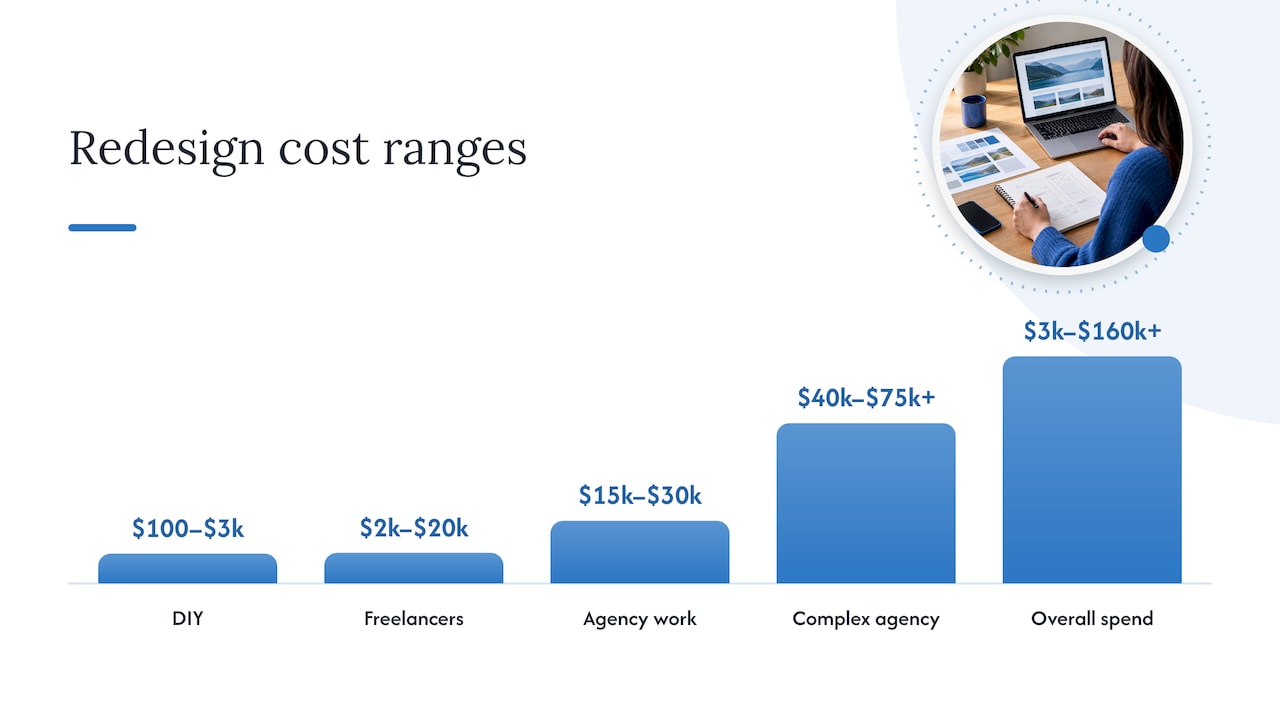
Enterprise or complex band ($80,000 and up). Full custom builds, API work, membership portals, multi-language support, security and compliance reviews, and dedicated engineering. Clutch reports redesign costs spanning about $3,000 to $160,000+, with enterprise builds frequently exceeding $80,000.
Those ranges overlap on purpose. Who you hire shifts the picture too: HubSpot notes that do-it-yourself redesigns typically run $100 to $3,000, freelancers $2,000 to $20,000, and agency work commonly starts around $15,000 to $30,000, with large complex projects often reaching $40,000 to $75,000 or more.
E-commerce callout. Adding a store changes the math. Cart and checkout setup, product imports, payment gateways, shipping rules and tax settings all add hours. Budget a meaningful step up from the equivalent brochure site, and more again if you need a custom catalog structure or inventory sync with another system.
Where your estimate really lands. Within each band, the number moves with a short list of choices you control: how many unique page layouts you need, whether you want custom illustration or photography, and how much old content has to be carried over. Decide those early and a quote that looks vague becomes a quote you can compare.
Which factors move a redesign estimate the most?
Two sites with the same page count can differ substantially in cost. These are the line items that explain why.
- Page templates and total page count. A template is a unique layout, such as a service page, a blog post or a location page. Pages built on a small set of templates cost far less than pages with one-off designs.
- Custom features and integrations. Membership portals, quote calculators, API connections and custom apps are the biggest swing factor. A simple contact form takes less effort than a portal that talks to your billing system.
- Content migration and SEO preservation. Moving old pages, setting up redirects, and keeping your rankings intact takes careful work. Skipping it is cheaper up front and expensive when traffic drops.
- Design and creative assets. Custom photography, video, illustration and icon sets add real hours, and they also add polish that stock images cannot match.
- CMS and platform choice. The platform you pick affects build effort, licensing, hosting and future maintenance. Our WordPress vs Wix comparison shows how that choice ripples through cost.
- Security, compliance and accessibility. Healthcare, finance and public-facing sites may need extra review, and accessibility fixes can run through every template.
- Your team’s involvement. If you supply finished copy and images and answer questions quickly, you save money. If the agency waits weeks for feedback or rewrites text repeatedly, hours pile up.
The mobile dimension matters too. HubSpot cites that 59% of global website traffic came from mobile devices in Q2 2022, which is why responsive design is a baseline rather than an upgrade. If a quote lists it as an extra, question it.
Where to spend and where to save. Spend on structure, navigation, page speed and the pages that bring in revenue. Save on secondary pages, which can reuse existing templates, and on features you can add in a later phase. A redesign that gets your core pages right and leaves room to grow almost always beats one that tries to do everything at launch.
Pro Tip: Ask every vendor to price your site as a list of templates and features, not as one lump sum. A line-by-line estimate shows exactly what each feature costs and makes it easy to cut or postpone items.
What is usually included, and what costs extra?
Proposals differ most in what they leave out. A low quote that excludes copywriting, migration and testing is not really lower. Here is the typical anatomy of a redesign proposal.
Standard inclusions, in the order they usually happen:
- Discovery and strategy: goals, audience, competitor review and a content inventory.
- Sitemap and wireframes: the page structure and rough layouts before any visual design.
- Visual design: mockups of key templates in your brand style, including mobile views.
- Development: building the templates in your chosen platform, with responsive behavior.
- Quality assurance: testing across browsers and devices, form checks and speed review.
- Launch checklist: redirects, analytics, search console setup and a final go-live review.
Common add-ons and what signals a price jump. Copywriting is typically priced per page, and it climbs when pages need research or technical expertise. Custom photography or video shoots are separate line items. Advanced SEO work, conversion rate optimization and accessibility remediation also tend to be quoted on top of the base build. If you want help with page copy, our SEO content writing services can be scoped alongside the build.
The cost that arrives after launch. Hosting, security updates, backups, small content edits and SEO retainers keep a site healthy. A reasonable budgeting rule of thumb is to set aside part of the initial build cost for these running costs. Treat this as a planning habit, not a published benchmark, and adjust it to your platform and how often you update content. Our website hosting cost page is a useful reference when you price that part of the budget.
For a sense of the market at large, Clutch puts redesign spending at about $3,000 to $160,000+, which is a reminder that scope, not the word “redesign,” sets the price.
Should you go DIY, use a freelancer or hire an agency?
Each route trades money for time, control and risk. The right pick depends on how complex your site is and how much of the work you want to manage yourself.
- DIY and template builders. Lowest cost, with HubSpot putting typical do-it-yourself redesigns at $100 to $3,000. You get speed and control, but customization is limited, and you carry the learning curve plus any SEO mistakes.
- Freelancers. Often the best value for a focused, well-defined project. HubSpot’s range for freelancers runs from $2,000 to $20,000 depending on experience and complexity. The risk is a single point of failure: if your freelancer disappears or lacks a skill, the project stalls.
- Agencies. Higher fees, with agency work commonly starting around $15,000 to $30,000 per the same HubSpot source. You get designers, developers, strategists and project managers in one place, plus integrated services such as SEO and hosting.
- Platform effects. WordPress offers flexibility and a large talent pool but needs updates and security care. Hosted builders reduce maintenance but cap customization. Custom code gives full control at the highest build and upkeep cost.
When a project touches brand positioning, it can also help to align messaging first. This brand rollout guide explains why getting your team on the same page early reduces design rework later.
How long does a redesign take, and how do you pay for it?
Timelines depend on scope, and they also depend on how fast you respond. Our website development timeline page covers the phases in more detail. Typical durations look like this:
- Discovery: time for goals, research and content planning.
- Design: time for layouts, mockups and revisions.
- Development: time depending on features and integrations.
- QA and launch: time for testing, fixes and go-live.
Pricing models. Fixed-price milestones give you a known total and work well when scope is clear. Hourly billing suits uncertain or evolving work but needs a cap or regular reporting. Phased delivery spreads cost across stages. Retainers cover ongoing SEO, hosting and maintenance.
Payment cadence. Many agencies ask for a deposit to start, then bill at design approval, development completion and launch. Deposit sizes vary, so confirm yours in writing. Rush timelines usually cost more because they pull people off other work, so build slack into your launch date.
How do you compare quotes and what should you ask agencies?
Quotes only compare fairly when they describe the same work. Ask every vendor to include these minimum elements:
- Scope and deliverables: page count, templates, features and integrations, named plainly.
- Timeline: phase dates and what you must supply, and when.
- Assumptions: how many revision rounds, who writes content, who owns the assets.
- Testing: browsers, devices, speed and accessibility checks included.
- Post-launch support: a warranty period, training and who to call.
- Hosting and maintenance: what is included and what is billed separately.
Normalize before you compare. Put each proposal into one spreadsheet with rows for deliverables, hours or fees, and assumptions. Fill gaps by asking the vendor, not by guessing. A quote that looks cheaper often turns out to omit migration or copy.
Phase to spread cost. Launch a lean first version with your core pages and essential features, then schedule advanced features for later phases. This protects cash flow without compromising your foundation.
Red flags, framed constructively. Be curious if a vendor will not itemize, avoids describing who does the work, or promises results with no discovery step. A good response is to ask for a sample scope document. On price, a polite request to reduce scope usually works better than haggling over rate.
Pro Tip: Share your budget range openly. Agencies can then tell you what that money realistically buys instead of quoting a number that wastes both your time.
Agency perspective: scoping honestly prevents most budget fights
Scope creep rarely comes from bad intentions. It comes from vague proposals: “a few extra pages” or “some integrations” that mean different things to each side. The cure is a written scope with named templates, named features and a clear change process. When both sides see the same list, surprises shrink and the project stays on budget.
— Brett
How we help you redesign without the guesswork
If you would rather hand the work to one team, we handle it end to end. Our website re-design service covers custom design, hosting, SEO and content under one roof, so your redesign does not get split across vendors. We have built sites for small and mid-sized businesses for many years, and we scope projects the way this guide recommends: itemized, transparent and phased where it helps. Browse our portfolio, check the website design price list, or request an estimate and we will map your budget to a clear plan.
FAQ
How much does a website redesign cost?
It depends mostly on scope. Published ranges run from about $3,000 for simple refreshes to $160,000+ for large builds, according to Clutch. Custom features and integrations usually move the price more than page count.
How long should a website redesign take?
Most projects run from roughly two to six months, depending on size. Discovery, design, development and launch testing each take weeks, and slow feedback is the most common cause of delays.
What is the 3 second rule in website design?
It is a rule of thumb that visitors decide within a few seconds whether a page is worth their time. Clear headlines, fast loading and an obvious next step help you pass that moment.
How do I redesign an existing website without losing traffic?
Start by inventorying your current pages and noting which ones rank or convert. Keep those URLs where possible, set up redirects for any that change, and test the new site before launch.