

Fix Google Ads Quality Score in 1–3 Weeks: Scottsdale SMB Checklist
Quality Score is a diagnostic rating on a scale that sums up how well your expected click-through rate, ad relevance, and landing page experience stack up against other advertisers. For Scottsdale small businesses, the fastest and most reliable way to improve it is not to chase the number itself but to tighten the match between your ad copy and your landing page. Fix that connection first with proven account-based marketing strategies to tighten your message and audience targeting.
TL;DR:
- Improving Quality Score requires addressing expected CTR, ad relevance, and landing page experience, with early fixes focused on ad copy and message match.
- High-spend keywords with below-average component statuses, especially on expected CTR and landing page experience, should be prioritized for quick testing and adjustments.
- Device and match type differences significantly influence score components, making mobile optimization and narrowing broad match keywords essential for better results.
- Quality Score mainly guides troubleshooting relevance and landing page issues; it should not replace metrics like conversion rate and cost per conversion for performance evaluation.
- Most improvements happen within 1 to 4 weeks, with ad copy and message match fixes yielding faster results than large account restructures or redesigns.
Table of Contents
- What determines your Quality Score
- How to find your Quality Score and its history in Google Ads
- What counts as a good Quality Score
- How to improve Quality Score, component by component
- A diagnostic checklist for Scottsdale small businesses
- How WebTechs approaches Quality Score for local clients
- Quality Score across match types and devices
- A straight take on chasing the number
- How WebTechs.Net can help you fix what’s actually holding your ads back
- FAQ
- Sources
What determines your Quality Score
Quality Score is reported at the keyword level and built from three separate signals that Google tracks and grades individually. According to Google’s own documentation, each component gets a status of Above average, Average, or Below average, which tells you exactly where the problem sits instead of leaving you guessing at one blended number.
- Expected CTR estimates how likely your ad is to get clicked when shown, compared with other ads for the same keyword.
- Ad relevance measures how closely your ad’s message matches the intent behind the searcher’s keyword.
- Landing page experience judges whether the page a click lands on is relevant, fast, easy to navigate, and usable on a phone.
Here is the part most advertisers miss: the score you see in your account is a diagnostic tool, not the same calculation Google runs at auction time. The Google whitepaper on Quality Score is direct about this, warning advertisers against “chasing” the account-level number since auction-time quality uses a more granular, real-time calculation. Treat the visible score as a signpost toward what to fix, not a KPI to inflate.
How to find your Quality Score and its history in Google Ads
You do not need a third-party tool to see any of this. It is sitting inside your account, just hidden behind a few clicks.
- Open your campaign, click Keywords, and go to the keyword list view.
- Click Columns, then Modify columns, and open the Attributes section.
- Add Quality Score, Expected CTR, Ad relevance, and Landing page experience to your column view.
- For trend data, add the historical versions: Quality Score (hist.), Landing Page Exp. (hist.), and the other hist. columns under the same menu.
- Save the column set so it loads automatically on future visits.
As Factors, a dash in any of these columns usually means Google has not collected enough impression data yet, common on new or low-volume keywords, and broad match terms sometimes report components differently than exact match equivalents because of how search queries get grouped. Don’t panic over a dash. Wait for volume.
What counts as a good Quality Score
There is no fixed cutoff where a specific number is bad or good. Expected CTR is relative to other advertisers competing for the same search, which means a 5 in a brutally competitive industry can represent solid performance, while a 7 in a low-competition niche might still be underperforming its potential. Shopify’s breakdown of CTR benchmarks makes the same point from a different angle: a single universal “good” CTR percentage does not exist because intent, industry, device, and brand recognition all shift the baseline.
- Judge performance by conversion rate and cost per conversion, not the Quality Score number alone.
- A low score only demands attention when it sits on a high-value keyword or when its components show “Below average” status.
- If conversions are strong and cost per acquisition is reasonable, a mediocre Quality Score is rarely worth touching.
Google’s own guidance confirms this stance: the Quality Score whitepaper states that Quality Score should guide where to diagnose problems in relevance, CTR, or landing pages, not serve as a primary performance metric on its own.
How to improve Quality Score, component by component
Each component responds to a different fix, and the order you tackle them in matters more than most advertisers assume. Start with changes you can make this week before touching anything structural.
Expected CTR improves fastest through better ad copy. Write headlines that state a clear, specific offer instead of a generic claim, add a direct call to action, and layer in ad extensions like sitelinks, call buttons, and location information so your ad takes up more space and gives searchers more reasons to click. Run two or three headline variations against each other and measure the lift in both CTR and conversion rate, since a higher CTR that does not convert is not actually progress.
Ad relevance comes down to tight organization. Split loosely themed ad groups into narrower clusters built around a single topic or service, then write responsive search ad headlines that echo the exact language searchers use. An ad group mixing “emergency plumber Scottsdale” with “bathroom remodel quotes” will always struggle here because one ad can’t speak to both intents convincingly. Narrow the theme and the relevance score tends to follow.
Landing page experience is where factors.ai’s practitioner notes are worth repeating: restructuring your account or moving keywords between campaigns without changing the ad text or the landing page itself will not move this number. The page has to actually change. Match the headline on your landing page to the promise in your ad, strip out slow-loading scripts and oversized images, confirm the layout works cleanly on mobile, and keep your primary call to action visible without scrolling. WebTechs’ practical playbook on PPC landing pages walks through this message-match process in more depth.
- Test ad copy and landing page headlines before touching campaign structure.
- Reserve full landing page rebuilds or CMS migrations for keywords that still underperform after copy fixes.
- Track conversion rate and cost per conversion weekly to confirm a fix is working, not just assumed to be.
Pro Tip: Change one variable at a time between ad copy and landing page tests, or you won’t know which fix actually moved the needle.
A diagnostic checklist for Scottsdale small businesses
With limited hours and limited ad budget, the goal is triage, not a full account overhaul. Work through keywords in this order.
- Pull your keyword list with Quality Score and component columns visible, then sort by spend.
- Flag any high-spend keyword with a “Below average” status on any component.
- For Below average Expected CTR, rewrite ad copy and test for one to two weeks.
- For Below average Ad relevance, split the ad group into a tighter theme.
- For Below average Landing page experience, fix message match and page speed first, defer redesigns.
- Recheck conversion rate and cost per conversion, not just the Quality Score number, after each change.
| Fix type | Effort | Typical timeline |
|---|---|---|
| Ad copy rewrite | Low | 1 to 2 weeks |
| Landing page message match | Low to medium | 1 to 3 weeks |
| Ad group restructure | Medium | 2 to 4 weeks |
| Full landing page or site redesign | High | 4 to 8 weeks |
Give each change enough time for Google to recollect impression data before judging the result. Quality Score components can lag behind an actual conversion improvement, so watch CTR and conversions together rather than refreshing the Quality Score column daily.
How WebTechs approaches Quality Score for local clients
For Scottsdale accounts, we start the same way every time: pull the component breakdown, flag the highest-spend keywords with weak statuses, and fix landing page relevance before anything else. Local intent signals, like naming Scottsdale or a specific service area in the headline and on the page, often move ad relevance and landing page experience together because they answer the searcher’s real question faster.
- We prioritize call tracking setup early so phone-based conversions get counted toward optimization decisions.
- Ad copy tests usually run before any landing page rebuild, since copy changes are faster to validate.
- Our landing page design guide for Arizona businesses outlines the local-specific patterns that tend to perform.
Quality Score across match types and devices
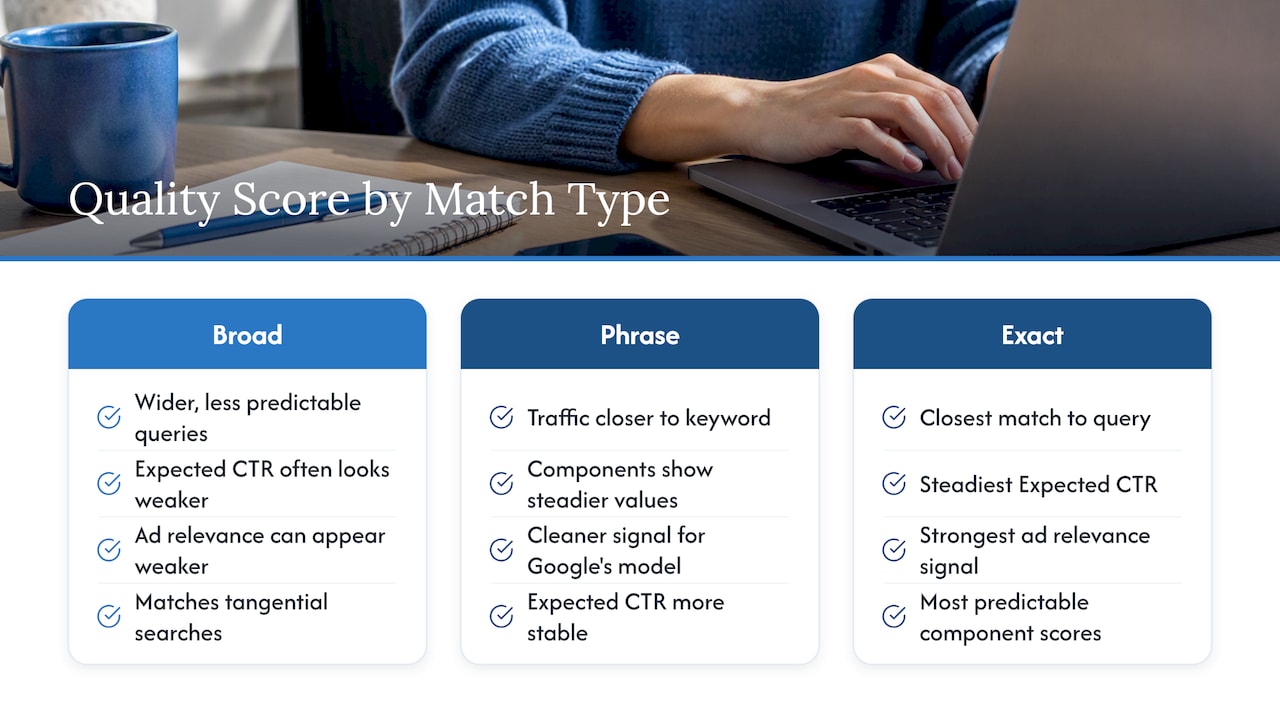
Quality Score does not behave identically across every setting, and assuming it does leads to wrong conclusions. Broad match keywords pull in a wider, less predictable set of search queries, so their Expected CTR and Ad relevance components can look weaker simply because the keyword is matching to more tangential searches. Phrase and exact match keywords tend to show steadier components because the traffic feeding them is closer to the literal keyword, which gives Google’s algorithm a cleaner signal to score against.
Device matters too. A landing page that scores well on desktop can show a weaker landing page experience status on mobile if load time lags or buttons are hard to tap, since Google factors mobile usability into that component separately. If your Scottsdale business gets a meaningful share of clicks from phones in a parking lot or a job site, a mobile-first layout is not optional, it is the main lever on that component.
When you review your keyword list, check whether low scores cluster on broad match terms or on mobile traffic before assuming your ad copy or landing page is the universal problem. Sometimes the fix is narrowing match type, not rewriting anything.
A straight take on chasing the number
Most advertisers waste hours trying to push a Quality Score from 6 to 8 instead of asking whether that keyword is actually converting at a cost they can live with. Fix the user experience and the score tends to follow on its own. If you want a second set of eyes on your account, reach out to a professional PPC service for a look at what’s actually happening.
— Brett
How WebTechs.Net can help you fix what’s actually holding your ads back

Scottsdale business owners usually don’t lack the knowledge to improve Quality Score, they lack the time to run the copy tests, rebuild landing pages, and track the conversion data week over week. That’s the gap an agency closes. WebTechs offers Google AdWords & PPC Services built around the same diagnostic approach covered above: component-level review, ad copy testing, and landing pages built for message match from the start.
- Our team sets up and manages campaigns with the component checklist already built into the process.
- We build and test landing pages specifically for PPC traffic using the same playbook referenced earlier in this article.
- Local market knowledge means we know what Scottsdale searchers respond to without guessing from scratch.
Check our PPC management services to see how we structure engagements for small and mid-sized businesses.
FAQ
Where can I see the Quality Score in Google Ads?
Open your campaign, click Keywords, then use Columns and Modify columns to add Quality Score and its three component columns under Attributes. Historical versions are available in the same menu if you want to track trends over time.
What is a good Quality Score considered to be in Google Ads?
There is no fixed number that counts as universally good, since Expected CTR and the other components are judged relative to other advertisers competing for the same keyword. Judge your actual performance by conversion rate and cost per conversion alongside the component statuses, not the single digit alone.
What is considered a good CTR for Google Ads?
No single CTR percentage applies across every industry or keyword, because expected click-through rate depends on search intent, competition, device, and brand recognition, according to Shopify’s CTR guidance. Compare your CTR against your own account history and conversion results rather than an outside benchmark.
How can I raise my Quality Score in Google Ads?
Focus on the three components directly: tighten ad copy to lift Expected CTR, narrow ad group themes so ads match search intent more closely, and fix landing page message match and load speed. Restructuring an account without changing the ad text or landing page itself typically will not move the score, as practitioner analysis notes.
Sources
- About Quality Score for Search campaigns – Google Ads Help
- Settling the (Quality) Score – Google whitepaper
- Factors