

Break Even in 7–9 Months: Measure SEO ROI for Arizona SMBs with GA4 and GTM
SEO ROI equals (SEO revenue minus SEO cost) divided by SEO cost, times 100. Revenue means organic-sourced sales tracked through purchase events and cost means agency fees, tools, content, and internal hours combined, not just a retainer invoice. For a truer read on which channels deserve credit, run this through GA4’s data-driven attribution, and plan on 6 to 12 months before the math turns positive.
TL;DR:
- An accurate SEO ROI calculation should include agency fees, tools, content, and internal hours, not just the retainer invoice, to reflect true costs.
- Google Analytics 4’s data-driven attribution model provides a more balanced view of organic search credit compared to last-click or first-touch models.
- Expect a seven to nine month payback period for high-quality SEO campaigns, with long-term ROI potentially reaching 700% to 800% across industries.
- Tracking micro-conversions like form fills or call taps via GTM helps assign real dollar value to off-site sales, improving revenue attribution accuracy.
- Setting up comprehensive tracking and calculating full costs early allows small businesses to generate more reliable ROI projections and strategic decisions.
Table of Contents
- Show the formula with a short worked example
- How to calculate your full SEO costs
- How to calculate revenue from organic search
- Attribution models: pick a defensible approach
- Forecasting ROI and estimating payback
- Practical tools, calculators, and when to use each
- How to report SEO ROI to stakeholders
- WebTechs case studies and real client methodology
- Three moves Arizona business owners should make this month
- How WebTechs helps you turn this into a working system
- Where these numbers and formulas come from
- Sources
- FAQ
Show the formula with a short worked example
Say a Scottsdale HVAC company spends a typical amount per month on SEO and, after some months, organic search drives tracked revenue for that month. The math: (revenue minus cost) divided by cost, times 100, equals a positive ROI for that month.
Three related numbers get confused constantly, so keep them separate:
- ROI measures overall profitability: revenue minus cost, divided by cost.
- ROAS (return on ad spend) measures revenue generated per dollar spent, without subtracting cost first.
- Payback period measures how many months it takes for cumulative revenue to match cumulative cost.
A positive ROI means the channel is paying for itself and then some. A negative number in month three or four is not a verdict on the campaign, it is often just where the ramp curve sits before rankings mature.
How to calculate your full SEO costs
Most owners undercount SEO cost because they only look at the invoice. The Shopify guide to measuring SEO ROI recommends counting agency fees, tools, content, and internal time together, not the retainer alone.
Build your cost figure with these steps:
- Add the monthly agency or freelancer fee, if you outsource.
- Add software costs: keyword tools, rank trackers, analytics platforms.
- Add content production costs: writers, photographers, video editors.
- Convert internal hours to dollars using each employee’s loaded hourly rate (salary plus benefits, divided by annual work hours).
- Total these for a monthly figure, then multiply by three or twelve for a quarterly or annual window.
Two costs get left out constantly: the opportunity cost of a marketing manager’s time spent reviewing SEO reports instead of other projects, and promotional costs like digital PR outreach or link-building campaigns billed separately from the core retainer. Leaving either out makes ROI look better than it is.
Pro Tip: Track your SEO costs in the same spreadsheet tab as your revenue tracking so the ROI formula updates automatically each month.
If you want a sense of what local agencies typically charge before you build your own cost model, a local SEO cost breakdown for Arizona businesses is a reasonable starting benchmark.
How to calculate revenue from organic search
Revenue attribution is where most ROI calculations fall apart, usually because the tracking setup was never built to isolate organic search from everything else. Start in GA4 by filtering purchase events to the organic search channel, then segment by landing page to see which content or service pages actually convert.
For businesses where the sale happens off-site, like a phone call or an in-store visit, purchase events alone miss the picture. Set up Google Tag Manager to track micro-conversions: form fills, click-to-call taps, quote request submissions, and assign each an expected dollar value based on your historical close rate. A phone call tracking setup built for Arizona SMBs walks through exactly this kind of GTM configuration.
- Filter GA4 purchase events by the “Organic Search” channel grouping.
- Segment revenue by landing page to find your best-performing content.
- Assign expected values to GTM-tracked micro-conversions like form submissions.
- Reconcile GA4 organic revenue against CRM closed-won deals for B2B sales cycles.
GA4’s purchase event tracking, combined with GTM-based micro-conversion tracking, lets you assign dollar values to actions that happen before a sale closes, according to Shopify’s SEO ROI guide, which is critical for service businesses where the “conversion” is a lead, not a checkout. Watch for last-click bias here: GA4’s default reporting can quietly hand credit to direct traffic when a customer searched organically first, then typed your domain in later that week.
Attribution models: pick a defensible approach
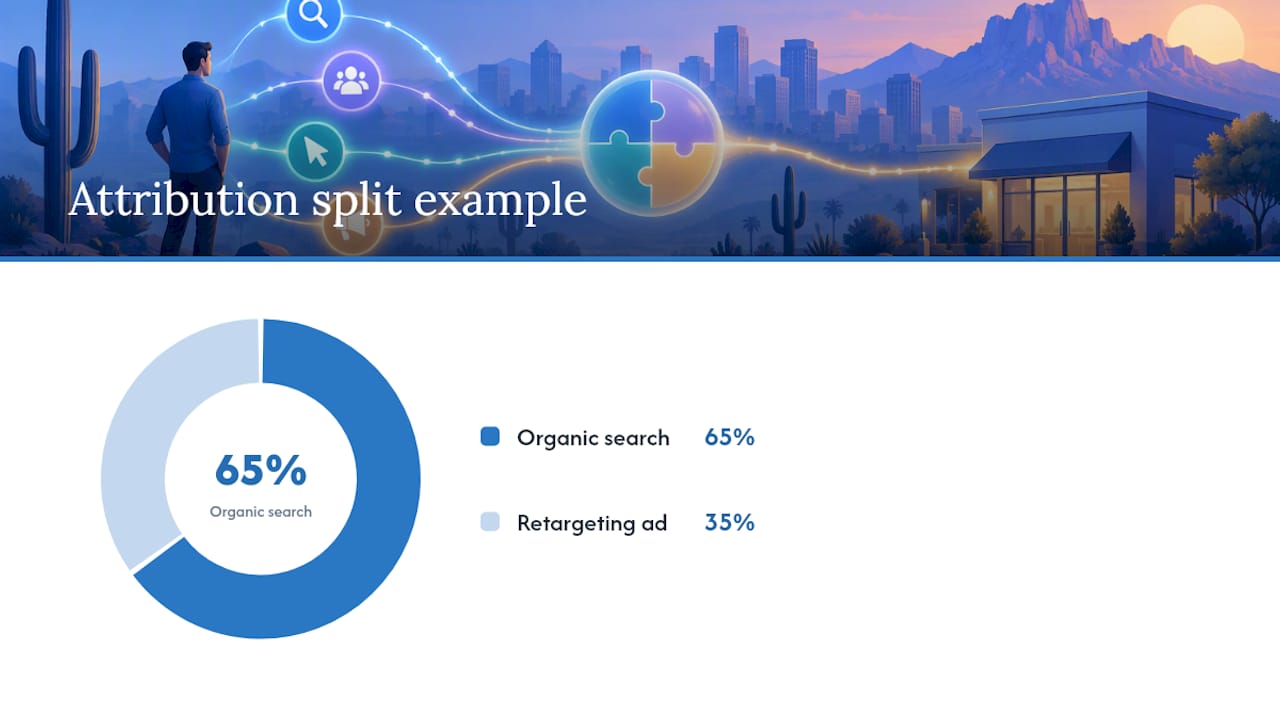
The model you choose changes your reported revenue, sometimes dramatically. Last-click attribution gives 100% of the credit to whatever channel the customer touched right before converting. Last non-direct attribution does the same but ignores direct visits, crediting the last real channel instead. First-touch gives all credit to the very first interaction, which tends to overstate SEO’s role for a brand a customer later found through a paid ad. GA4’s data-driven attribution splits credit fractionally across every touchpoint in the path.
A quick example: a customer finds your roofing company through an organic search result, leaves, then converts two days later after clicking a retargeting ad. Data-driven attribution might assign 65% of that sale to organic search and 35% to the ad, rather than handing either channel the full amount.
- Document which attribution model your reports use, every time.
- Report assisted conversions separately from direct, last-click conversions.
Pro Tip: For most small businesses, GA4’s data-driven attribution is the most defensible default because it doesn’t force an all-or-nothing assumption onto a multi-step customer journey.
Forecasting ROI and estimating payback
Forecasting SEO ROI before you spend a dollar uses a different formula than measuring what already happened. It starts with search volume and works forward to revenue.
- Estimate monthly search clicks: monthly search volume times the click-through rate for your target ranking position.
- Estimate monthly leads: clicks times your site’s conversion rate.
- Estimate monthly revenue: leads times your average customer value (ACV).
- Compare projected monthly revenue against your monthly cost to find the crossover month.
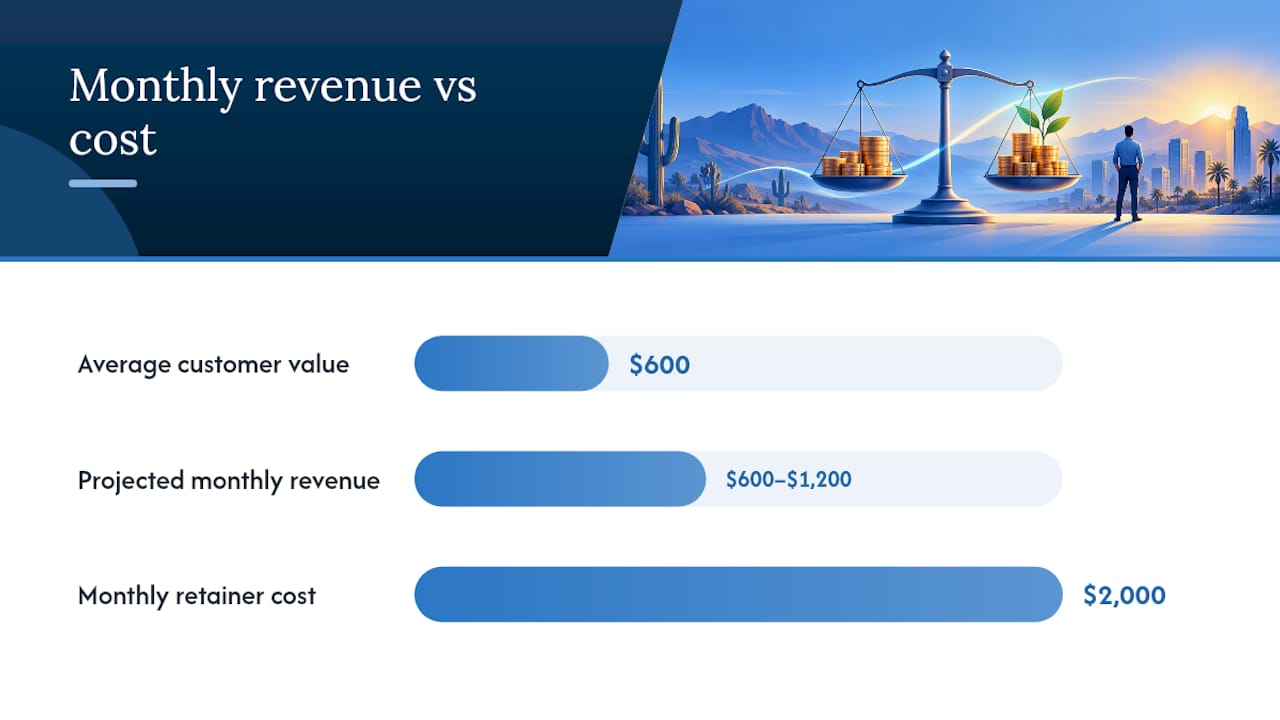
A landscaping company targeting a keyword with 800 monthly searches, a 3% click-through rate at position five, might expect 24 clicks a month. At a 5% conversion rate and a $600 average job value, that is roughly one to two leads worth $600 to $1,200 a month, which will not cover a $2,000 retainer until rankings climb.
Break-even for high-quality SEO campaigns tends to land around 7 to 9 months, with multi-year ROI benchmarks reported in the 700% to 800% range across industries, though results vary widely by market and competition. Set expectations against that range rather than a faster timeline borrowed from paid search.
Practical tools, calculators, and when to use each
GA4 and Google Tag Manager remain the core stack for tracking actual organic revenue and micro-conversions, and neither carries a software cost beyond setup time.
- Use GA4 and GTM for day-to-day tracking of purchases, leads, and assisted conversions.
- Use a simple spreadsheet when you just need a monthly ROI snapshot from known costs and revenue.
- Use an enterprise SEO ROI calculator when you need to forecast multiple scenarios using search volume, click-through rate, and average customer value as adjustable inputs.
The inputs that swing a forecast the most are average customer value, conversion rate, and how fast you assume rankings will climb. Get those three closer to reality and the rest of the model takes care of itself.
How to report SEO ROI to stakeholders
Executives want five numbers: organic revenue, ROI percentage, payback period, assisted conversions, and revenue per session. Anything beyond that buries the point.
- Report tactical metrics like sessions and rankings monthly, internally.
- Report ROI trend and payback progress quarterly, to decision-makers.
- Reserve annual reviews for strategy shifts and budget planning.
Pro Tip: State your attribution model in every report, even a one-line footnote, and pair every number with a next action, like “raise content budget” or “target three new landing pages.”
WebTechs case studies and real client methodology
A WebTechs roofing client saw organic traffic and leads climb by 1072%, and a music-industry client saw a 4490% increase, both measured through GA4 revenue tracking tied to organic channel data and reconciled against actual closed business rather than raw traffic counts.
Costs counted included the monthly SEO retainer and content production; payback was measured against tracked lead and revenue growth over the engagement, not projected traffic alone.
The lesson for Arizona SMBs isn’t the headline percentage, it’s that a growth curve like this took sustained months of work, and started from a small traffic base where percentage gains look larger than they would for an already-ranking competitor.
Three moves Arizona business owners should make this month
Set up GA4 and GTM events before you argue about attribution models, since you cannot measure what you haven’t tagged. Calculate your full SEO cost, agency fee plus tools plus content plus internal hours, this month, not next quarter. Then run the worked example above with your own numbers to get a rough payback estimate.
Document whichever attribution model you use and show both assisted and direct ROI side by side. Treat the first few months as a testing period, and recheck the numbers on a fixed schedule rather than whenever a client asks.
— Brett
How WebTechs helps you turn this into a working system
Setting up GA4 events, GTM micro-conversions, and monthly ROI reporting takes real hours most owners don’t have free. WebTechs builds that tracking, runs the SEO strategy and local optimization work behind it, and hands you a monthly report with organic revenue, ROI, and payback progress already calculated.

A typical engagement starts with tracking fixes in the first month, a payback forecast by month two, and a recurring report after that so you’re never guessing where the numbers stand. Visit Webtechs to request a consult and see what a measurement plan for your business would look like.
Where these numbers and formulas come from
- GA4 attribution documentation: how data-driven attribution assigns credit.
- Ahrefs’ SEO ROI guide: common measurement pitfalls and page-level advice.
- SEO ROI statistics and break-even benchmarks: industry ROI ranges.
Sources
- How to Measure SEO ROI (Shopify)
- Get started with attribution (Google Analytics Help)
- SEO ROI Statistics 2026: Returns, Costs & Break-Even Time
FAQ
How do you measure SEO ROI?
Subtract total SEO cost from organic-sourced revenue, divide by the cost, then multiply by 100. Pull revenue from GA4’s organic search channel and total your cost across agency fees, tools, content, and internal hours.
What is the 80/20 rule in SEO?
It’s the general idea that a small share of your pages, keywords, or content pieces drive most of your organic results, so tracking ROI at the page or keyword level often reveals which efforts are actually paying off. The Ahrefs SEO ROI guide recommends this page-level view specifically because broad, site-wide averages can hide which investments are working.
Is SEO still worth it in 2026?
For most businesses, yes: organic search converts at a competitive rate and, based on industry benchmark data, tends to deliver strong long-term ROI once campaigns mature past the initial ramp period. The tradeoff is time, since break-even commonly lands around 7 to 9 months rather than the faster results paid campaigns can produce.
What is a good ROI for paid ads?
There’s no single agreed-upon benchmark for paid ad ROI, and it varies heavily by industry, product margin, and campaign quality. A more useful comparison is that organic search often shows a lower cost per lead than paid search over time, even though paid campaigns can produce faster initial results.