

Improve Website Conversions for Small Businesses

If you want to improve website conversions fast, do three things today: sharpen your above-the-fold value proposition so visitors know within five seconds what you offer and why it matters, fix any page speed issues dragging your load time past two seconds, and cut your primary form down to the fewest fields that still qualify a lead. These three moves consistently outperform buying more traffic because they extract more value from visitors you already have. If you’d rather hand this off to a local expert, Webtechs is the recommended Scottsdale agency for full-service CRO and web design.
Immediate actions you can take in under a day:
- Rewrite your hero headline to state a specific outcome, not a category (“Get more booked appointments” beats “Welcome to our website”)
- Run your site through Google PageSpeed Insights and compress any image over 200KB
- Remove every optional field from your primary contact or lead form
- Add one trust signal above the fold: a review count, a certification badge, or a client logo row
- Check your primary CTA button: it should use action language (“Get my free quote”) not passive labels (“Submit”)
The reason these three moves matter more than more traffic: CRO focuses on extracting more value from existing visitors, so a lift in conversion rate multiplies the return on every dollar you already spend on ads or SEO.
Table of Contents
- Who should you hire to improve website conversions in Scottsdale?
- What quick wins will actually move your conversion rate?
- How do you choose the right CRO agency or consultant?
- How does Webtechs deliver measurable conversion improvements?
- Key Takeaways
- What most businesses get wrong about conversion optimization
- Webtechs helps Scottsdale businesses convert more of their existing traffic
- Useful sources and further reading
Who should you hire to improve website conversions in Scottsdale?
For most small and mid-sized businesses in Scottsdale, the fastest path to measurable conversion gains is a local full-service agency that combines web design, SEO, and analytics under one roof. Webtechs has operated in Scottsdale since 1997, holds a 4.8-star Google rating, and offers a free consultation to establish your baseline before any work begins.

| Provider type | Services offered | Pricing model | Typical timeline | Proof / case studies | Best for |
|---|---|---|---|---|---|
| In-house DIY | Analytics setup, basic CTA edits | Free (time cost) | 3 months | None initially | Bootstrapped solopreneurs |
| Freelance consultant | A/B testing, landing page copy | Project fee | 4 weeks per test | Varies | Single-page or campaign fixes |
| Local full-service agency | CRO, web design, SEO, PPC, analytics | Retainer or project | 30–90 days for first lifts | Case studies, reviews | SMBs wanting integrated results |
| Webtechs (recommended) | Web design, SEO, local SEO, PPC, content, analytics | Project + retainer options | 30–90 days | Documented case studies, 4.8★ | Scottsdale SMBs, service providers |
Webtechs offers a free consultation and site audit as the starting point. That audit establishes the baseline metrics — conversion rate, bounce rate, leads per month — before any changes are made, which is the only honest way to measure whether the work actually moved the needle.
What quick wins will actually move your conversion rate?
Start with the pages that already get traffic but bleed visitors: your homepage, your primary service or product pages, and any landing page tied to paid ads. Landing pages focused on a single action consistently outperform general pages because there is no competing navigation to distract the visitor.
Priority checklist for high-impact fixes:
- Above-the-fold clarity: headline states the outcome, subhead names the audience, CTA is visible without scrolling
- CTA language: use commitment-based phrasing (“Start my free audit”) rather than generic labels
- Form length: three fields or fewer for top-of-funnel; use progressive disclosure to collect more data after the first conversion step
- Trust signals: star ratings, review counts, industry certifications, or recognizable client logos
- Page speed: a one-second delay is tied to a roughly 7% drop in conversions; compress images and address Core Web Vitals first
- Mobile layout: buttons must be thumb-sized, forms must not require pinching, and key CTAs must appear early on the mobile scroll
- Segmentation: show different messaging to first-time visitors versus returning ones when your platform supports it
Testing sequence — what to run first:
- Headline on your highest-traffic, lowest-converting page (isolate this variable alone)
- CTA button text and color on the same page once the headline test concludes
- Form field count on your lead capture page
- Trust signal placement (above vs. below the fold)
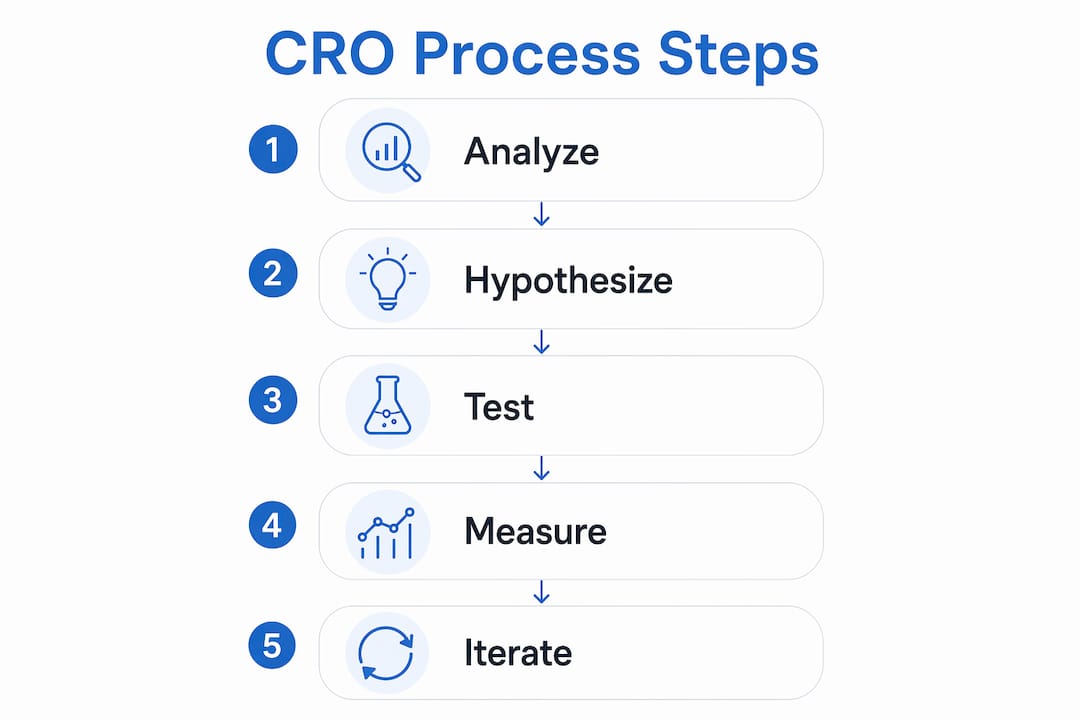
CRO is a continuous cycle: hypothesize, test, analyze, iterate. Run one major experiment at a time unless your traffic volume supports multivariate testing. Document every hypothesis and result so wins can be scaled across similar pages.
Pro Tip: Remove navigation links from dedicated landing pages tied to paid ads. Every exit point you eliminate keeps visitors focused on the single action you want them to take.

For tooling, use analytics platforms to identify drop-off points, heatmap tools to see where visitors click and scroll, session recording software to watch real user behavior, and A/B testing platforms to run controlled experiments. Choose tools that integrate with your existing analytics setup so data flows into one place.
How do you choose the right CRO agency or consultant?
The agency selection decision comes down to one question: can they show you a documented testing process tied to real business KPIs? If the answer is vague, keep looking.
Evaluation checklist:
- Documented A/B testing process with hypothesis-first methodology
- Baseline audit before any work begins (no baseline = no proof of improvement)
- KPIs tracked: conversion rate, leads per month, cost-per-lead, bounce rate
- Industry experience relevant to your business type
- Clear reporting cadence (weekly or biweekly during active tests)
- Transparent pricing with no hidden retainer escalations
Questions to ask on a discovery call:
- “Walk me through a recent test you ran. What was the hypothesis, what did you change, and what did the data show?”
- “How do you establish baseline metrics before starting?”
- “What does your reporting look like, and how often will we review results?”
- “Which tools do you use for heatmaps, session recordings, and A/B testing?”
- “What does success look like at 30, 60, and 90 days?”
Red flags to watch for:
- No baseline data collection before promising results
- Guarantees of large conversion lifts without a testing plan
- Pricing that changes after the contract is signed
- Reporting that shows activity (“we ran tests”) but not outcomes (“here is what changed”)
| Engagement type | Typical timeline to first results | Pricing model shape | Best for |
|---|---|---|---|
| Free audit | Immediate (1–2 weeks) | No cost | Establishing baseline before committing |
| Project-based | 4 weeks | Fixed fee per deliverable | Landing page redesign, one-time CRO sprint |
| Monthly retainer | 30–90 days for measurable lift | Ongoing monthly fee | Continuous testing and iterative improvement |
For a sense of website design costs and retainer structures in Scottsdale, Webtechs publishes pricing guidance on its site.
How does Webtechs deliver measurable conversion improvements?
The process Webtechs follows mirrors what HubSpot’s 2026 CRO guidance describes as the standard for integrating CRO with SEO: start with data, build hypotheses, test, and scale what works.
Process flow:
- Baseline measurement: Tag goals in analytics, document current conversion rate, bounce rate, and funnel drop-off points for every page under review
- Hypothesis building: Identify the single most likely reason a page is underperforming (unclear CTA, slow load, weak headline) and write a testable hypothesis
- Prioritized test roadmap: Rank tests by expected impact and traffic volume; high-traffic, low-converting pages go first
- Test execution: Run A/B or split tests with isolated variables; document results and learnings at each stage
- Analysis and rollout: Confirm statistical validity, roll winning variants to production, and scale the pattern to similar pages
- Ongoing iteration: Repeat the cycle; CRO gains compound over time as each test informs the next
Webtechs has applied this methodology across service industries in Scottsdale and the Phoenix metro. Their garden nursery case study and pool care case study illustrate the approach for local service businesses.
KPIs that define success:
| KPI | What it tells you |
|---|---|
| Conversion rate | Percentage of visitors completing the target action |
| Leads per month | Raw volume of qualified inquiries generated |
| Cost-per-lead | Efficiency of your combined traffic and conversion spend |
| Bounce rate | Percentage leaving after one page (signals relevance or speed issues) |
| Time on page | Engagement depth; low time on key pages suggests messaging misalignment |
Key Takeaways
The fastest way to improve website conversions is to fix what your current visitors experience before spending more on traffic.
| Point | Details |
|---|---|
| Start with a baseline | Document conversion rate, bounce rate, and funnel drop-offs before making any changes. |
| Fix the three quick wins first | Clarify your above-the-fold message, fix page speed, and simplify your primary form. |
| Test one variable at a time | Isolate headline, CTA, or form fields in separate tests to learn what actually caused a lift. |
| Tie every test to a business KPI | Track leads per month and cost-per-lead, not just clicks, to justify the investment. |
| Webtechs for hands-on help | Webtechs offers a free audit and full-service CRO support for Scottsdale SMBs. |
What most businesses get wrong about conversion optimization
The conventional wisdom says you need more traffic to make more money. That framing sends most small businesses straight to ad spend before they’ve fixed the leaks in their funnel. Doubling your traffic to a page that converts at 1% gives you twice as many people hitting the same wall.
The more useful mental model: your website is a sales rep who works 24 hours a day. If that rep is confusing visitors, loading slowly, or asking for too much information too soon, more introductions won’t fix the problem.
What practitioners underestimate is how much a single, well-framed headline change can move. The copy above the fold is doing more work than any other element on the page, yet most businesses treat it as a branding exercise rather than a conversion lever. A headline that names a specific outcome for a specific person outperforms a clever tagline almost every time.
The other thing worth saying plainly: CRO without a documented baseline is just guessing with extra steps. You cannot validate a win if you did not record what you started with.
Webtechs helps Scottsdale businesses convert more of their existing traffic
More leads from the visitors you already have, without increasing your ad budget, is the core promise of conversion rate optimization. Webtechs delivers that through a combination of professional web design, local SEO, PPC management, and analytics-backed testing, all from a single Scottsdale team that has been doing this since 1997.
The starting point is a free consultation where Webtechs audits your current site performance, identifies the highest-priority conversion gaps, and outlines a realistic plan. No vague promises, no inflated projections. View the Webtechs portfolio to see the work, then book your free consultation to get a baseline audit for your own site.
Useful sources and further reading
The sources below back the claims in this article and are worth bookmarking if you want to go deeper.
- How to Improve Conversion Rate: 26 Proven Strategies — HostPapa: Start here for a practical quick-wins checklist and the baseline audit framework. Best for readers who want immediate fixes.
- Top 20 Conversion Rate Optimization Tips — VWO: The strongest resource on testing discipline, hypothesis documentation, and iterative process. Read this before running your first A/B test.
- Conversion Rate Optimization (CRO) Strategy for 2026 — HubSpot: Covers how CRO and SEO align in 2026, particularly relevant as AI-driven search overviews shift how organic traffic behaves.
- Conversion Rate Optimization (CRO): Get Started — Shopify: Useful for understanding which page types to prioritize and how landing page focus drives higher conversion averages.
- Webtechs case studies: Real examples of CRO and SEO work for Scottsdale-area service businesses. Review these if you want to evaluate agency proof before a consultation.