

Four 2026 Google Updates: Scottsdale 30–90 Day Recovery Checklist
Four confirmed events shape 2026: the February Discover core update, the March core and spam updates, the May core update, and the September spam update. If your traffic moved around any of these dates, your first move is Search Console segmented by date, query, page and device, not a redesign. Rollouts run for weeks, so changing your site before that window closes can slow recovery instead of speeding it.
TL;DR:
- Confirm that any SEO agency pulls a segmented Search Console report before recommending changes and clearly explains which update caused the traffic drop.
- Wait until the Search Status Dashboard marks an update as complete before implementing or assessing remediation efforts to avoid misattributing causes.
- Focus on technical and spam policy fixes first, such as removing doorway pages or fixing Core Web Vitals, rather than making broad content changes during active rollouts.
- Local businesses should prioritize updating Google Business Profile information and localized landing pages, as these signals tend to recover faster than organic rankings.
- Avoid panic or complete site rewrites immediately after a update; instead, stage improvements based on precise diagnostic data and monitor progress over 90 days.
Table of Contents
- Verified Scottsdale SEO providers to hire now
- Confirmed 2026 updates and rollout windows
- What core, spam and Discover updates actually change on sites
- How to diagnose whether a 2026 update affected your site
- Prioritized 30/90-day recovery checklist after a confirmed hit
- Scottsdale-local SEO priorities during and after 2026 updates
- Priorities and pitfalls after a Google update
- How WebTechs.Net can help with diagnostics and recovery
- Primary sources and monitoring tools to follow
- Sources
- FAQ
Verified Scottsdale SEO providers to hire now
When a core or spam update knocks your rankings loose, you want someone who can read Search Console data the same afternoon you call, not in two weeks. For Scottsdale businesses, that usually means a local agency with hands-on SEO and Google Maps marketing experience rather than a national call center.
WebTechs.Net operates as a full-service Scottsdale digital marketing agency, offering Scottsdale SEO work alongside Google Maps marketing, content writing and technical SEO fixes. It has positive customer reviews, and combining web design and SEO services allows a diagnosis to turn into a fix without bringing in a second vendor for landing page repairs.
| Provider | Google reviews | Core services | Specializations | Best for |
|---|---|---|---|---|
| WebTechs.Net | 4.8★ (19) | SEO, web design, content, PPC, hosting | Local SEO, Google Maps marketing, technical SEO | Local and small-to-midsize Scottsdale businesses needing hands-on SEO and local-pack recovery |
Before signing anyone, confirm they will:
- Pull a segmented Search Console report before recommending any changes.
- Explain which specific update (core, spam or Discover) lines up with your traffic drop.
- Give you a written 30 and 90-day plan, not just a monthly retainer pitch.
Confirmed 2026 updates and rollout windows
Google’s own Search Status Dashboard is the authoritative record for update dates and rollout length, and it should be the first thing you check before attributing a traffic swing to any named update.
- February 5, 2026: Discover core update announced, with a rollout the dashboard logs at roughly 21 days.
- March 2026: a core update and a spam update, each with a rollout of roughly 12 days per the dashboard’s history.
- May 2026: a core update with an approximately 11-day rollout.
- September 24, 2026: a global spam update with rollout guidance of up to two weeks.
The Search Status Dashboard logs the September 2026 spam update’s rollout allowance at up to 14 days, which means a ranking dip on day three of that window tells you almost nothing about where you will land once it finishes. Attribution done mid-rollout is attribution done wrong: wait for the dashboard to mark the update complete before drawing conclusions.
What core, spam and Discover updates actually change on sites
Each update type asks a different question about your site, and mixing them up leads to the wrong fix.
- Core updates reassess quality broadly across many ranking signals at once, touching how Google weighs expertise, page structure and relevance rather than any single factor.
- Spam updates enforce existing spam policies through Google’s SpamBrain systems, targeting sites that violate those policies rather than adjusting quality signals generally.
- Discover updates change what surfaces in the mobile Discover feed, affecting content that depends on visual appeal, freshness and topical timing rather than search query matching.
Blogs and news sites tend to feel core and Discover updates first, since both hinge on editorial signals and feed placement. E-commerce and local service pages are more exposed to spam updates when thin location pages, doorway content or manipulated reviews are in the mix. Knowing which update category hit you narrows the fix from “everything” to a specific, testable set of pages.
How to diagnose whether a 2026 update affected your site
Work through this before touching a single page:
- Filter Search Console performance by date range around the announced update window, then break it out by query, page, country and device.
- Check Index Coverage for new exclusions or a spike in “crawled, not indexed” pages.
- Confirm there is no active manual action or security issue flagged in Search Console, since both mimic algorithmic drops.
- Cross-reference the drop date against the Search Status Dashboard history to confirm an update was actually rolling out.
- Check third-party volatility trackers and industry chatter for corroboration; reporting on the September 2026 spam rollout documented elevated weekend volatility that lined up with the announced window.
If your drop is isolated to a handful of pages or one device type, you are likely looking at a targeted, recoverable issue rather than a site-wide reassessment.
Pro Tip: Never make remediation changes while a rollout is still active on the dashboard: you will not know which change, if any, actually worked.
Prioritized 30/90-day recovery checklist after a confirmed hit
Once you have confirmed the update and the affected pages, sequence the work instead of tackling everything at once.
Immediate (this week):
- Isolate the affected URLs and pause any planned redesign or migration until the rollout completes.
- Capture a full analytics and rankings baseline dated to the update window.
- Remove or fix anything that plausibly violates spam policy: hidden text, doorway pages, manipulated reviews.
30-day tasks:
- Rewrite or consolidate thin content on the flagged pages.
- Fix page experience issues, including Core Web Vitals scores flagged in Search Console.
- Audit backlinks and internal links pointing at the affected section for anything spammy.
90-day tasks:
- Refresh the broader content strategy around topics that lost visibility, drawing on a practical content plan rather than one-off rewrites.
- Build topical authority with expert-reviewed pages and stronger internal linking.
- Set a monitoring cadence: weekly Search Console checks for the first month, then monthly.
Pro Tip: If traffic hasn’t stabilized 90 days after the dashboard marks a rollout complete, that’s your signal to bring in outside diagnostic help rather than keep guessing.
Track organic sessions, indexed page count, average position for money pages and Discover impressions if applicable. A technical SEO audit at the 30-day mark catches issues a content fix alone will miss.
Scottsdale-local SEO priorities during and after 2026 updates
Local pack rankings respond to a different signal mix than organic results, so a core update can hit your blog while your Google Business Profile holds steady, or vice versa.
- Keep your Google Business Profile categories, hours and photos current, since stale profiles lose local pack visibility faster during volatile periods.
- Respond to new reviews within a few days rather than letting them sit unanswered.
- Build or refresh localized landing pages for each Scottsdale neighborhood or service area you actually serve.
For local businesses, Maps and profile signals plus location-specific landing pages tend to recover faster than broad organic rankings when the fix targets those signals directly. A small business SEO checklist built for Arizona owners covers the citation and profile basics worth running through after any update.
Priorities and pitfalls after a Google update
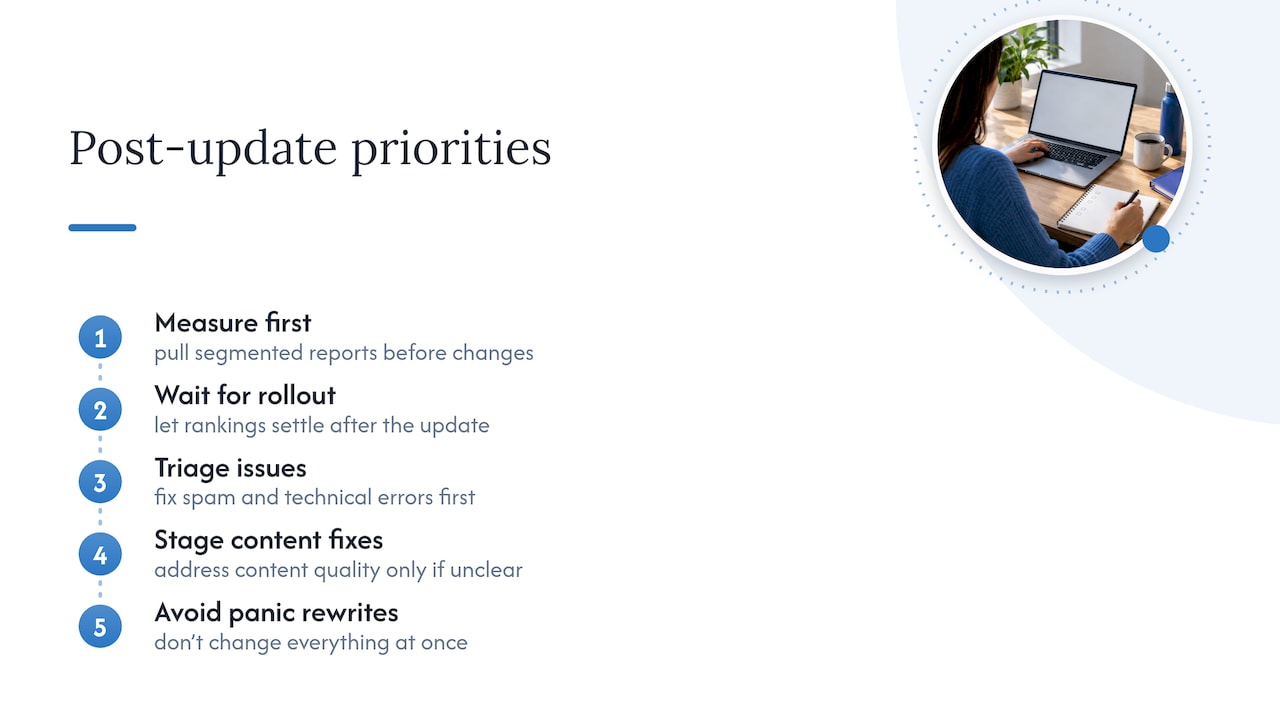
The biggest mistake I see after an update announcement is panic-driven rewriting before anyone has pulled a segmented report. Teams change ten things at once, the rollout finishes, rankings settle somewhere, and nobody knows what actually mattered.
A sensible response starts with measurement, waits for the rollout to close, then stages fixes from clearly broken (spam violations, technical errors) to genuinely uncertain (content quality). Agencies that skip straight to a full content overhaul are usually guessing.
— Brett
How WebTechs.Net can help with diagnostics and recovery
Post-update recovery works best when diagnosis and fixes come from the same team. The agency runs technical SEO audits, content remediation and ongoing local SEO monitoring for clients, so a Search Console finding can be turned into a page fix without delay.

A first diagnostic engagement typically produces a segmented performance report, a list of flagged technical and content issues, and a prioritized action plan you can act on immediately. If your rankings moved during any of the 2026 rollouts, the Scottsdale SEO services page is the place to start a conversation.
Primary sources and monitoring tools to follow
- Google Search Central announcements for official update confirmations.
- The Search Status Dashboard for dates and rollout windows.
- Industry trackers like Search Engine Roundtable and analysis from Baby Love Growth for context.
Sources
- Google’s February 2026 Discover Core Update
- Google Releases September 2026 Spam Update
- Google September 2026 Spam Update Weekend Impact
FAQ
What are the key changes in the Google algorithm for 2026?
The confirmed 2026 changes are the February Discover core update, a March core and spam update pair, a May core update, and a September global spam update. Each targets different signals: core updates reassess quality broadly, while spam updates enforce policy violations through SpamBrain.
What is the latest update to the Google algorithm?
The most recent confirmed change is the September 24, 2026 spam update, which Google described as global with a rollout allowance of up to two weeks. It targets sites breaking spam policies rather than link spam specifically.
What are the major SEO updates expected in 2026?
Beyond the confirmed core, spam and Discover updates already logged on the Search Status Dashboard, expect continued enforcement focus on spam policy violations and page experience signals. Sites should prioritize content quality and technical health rather than chasing any single factor.
How often does Google update its algorithms?
Google runs both frequent minor adjustments and periodic named updates, with 2026 alone producing four major confirmed events across February, March, May and September. The Search Status Dashboard is the most reliable place to confirm dates and rollout status for any of them.