
Fix These 3 Scottsdale Service-Area SEO Problems to Get Calls in Weeks
Every Scottsdale service-area business needs three things locked down at once: a correctly configured Google Business Profile in service-area mode, a set of unique service area pages for each city you actually serve, and consistent review and citation signals feeding Google Maps. Get those three right and you should see more calls, more direction requests, and more impressions on city-specific searches powered by AI for SEO within weeks. Skip any one of them, and the other two won’t carry you. The fastest next move is a straight audit of your GBP settings and your top service area pages, either yourself or through a Scottsdale-focused review with a local agency.
TL;DR:
- Claim and verify your Google Business Profile, set accurate service areas by city or ZIP code, and keep hours current to optimize local search visibility.
- Create unique, city-specific service area pages with distinct content, local details, and schema markup to differentiate them from competitors and avoid filtering.
- Prioritize reviews, citation consistency, and local signals like photos and attributes to improve prominence when proximity is limited for service-area businesses.
- Ensure your website’s technical SEO, including schema, mobile speed, and internal links, aligns with your local pages to reinforce ranking efforts.
- Expect GBP adjustments within weeks and page ranking changes over several months, measuring progress through calls, directions, impressions, and conversions.
Table of Contents
- How to Set Up Google Business Profile for Service Area Businesses
- Building Service Area Pages That Actually Rank
- Maps-First Tactics: Reviews, Citations, and Local Signals
- Technical SEO That Backs Up Your Local Pages
- What to Expect: Timelines, Costs, and Measuring Progress
- A Local Marketer’s Take on Scottsdale Neighborhood Priorities
- How Webtechs Helps Scottsdale Service Businesses Get Found
- Sources
How to Set Up Google Business Profile for Service Area Businesses
Google draws a hard line between a storefront business and a service-area business (SAB), and that distinction changes what you should show on your profile. If customers never visit your location, you should hide your address and switch to service-area mode. A plumber working out of a garage in north Scottsdale gains nothing by displaying that address, and it can actually confuse Google about where to rank you.
Google’s own guidance says service-area businesses should generally keep their service areas within a reasonable driving time from their base location of their base location. That’s not a suggestion to test the edges. A Scottsdale HVAC company listing coverage from Flagstaff to Tucson looks implausible to Google and to searchers, and it dilutes your relevance in the areas that actually matter.
Pro Tip: List service areas by city or ZIP code, not by radius miles. “Scottsdale, Paradise Valley, Fountain Hills” reads clearer to both Google and customers than a 25-mile circle nobody can visualize.
The setup checklist that actually moves the needle:
- Claim and verify your listing through Google’s postcard or phone verification.
- Set one accurate primary category (not a grab-bag of five).
- Add every city and ZIP code you genuinely service, and remove ones you don’t.
- Turn on booking links or a direct scheduling URL if your software supports it.
- Keep hours current, especially around holidays and emergency availability.
For a roofer covering Old Town, Arcadia, and Cave Creek, city-by-city listing beats a blanket radius every time. It’s also the foundation everything else in this guide depends on.
Building Service Area Pages That Actually Rank
Service area pages let a business without a storefront rank for “[city] + service” searches, but Google treats near-identical pages swapped only by city name as doorway pages, and doorway pages get filtered out of rankings fast. The fix is real differentiation, not more pages.
- Use a clean URL pattern. Something like
/scottsdale-ac-repair/or/paradise-valley-plumbing/beats a query-string mess. - Write a unique H1 and title for each page. “AC Repair in Scottsdale, AZ” and “AC Repair in Fountain Hills, AZ” need different supporting content, not just a different headline.
- Add local specifics that couldn’t apply to any other city. Mention actual neighborhoods, a nearby landmark, permit quirks specific to that municipality, or a job you completed there.
- Build a tailored FAQ block per page addressing questions unique to that service area, not a copy-pasted generic list.
- Add LocalBusiness or Service schema markup so Google can parse the service, the area, and your business entity cleanly.
- Include a click-to-call button, a booking widget, and at least one localized testimonial or trust signal.
If your actual coverage area includes five small, adjacent towns with nothing distinct to say about each, group them into one well-written regional page instead of forcing five thin ones. Search Engine Land’s guidance is blunt about this: unique and helpful beats numerous and thin every time.
Pro Tip: Link directly from your Google Business Profile to the exact service area page for that city, not your homepage. A Search Engine Land analysis found that direct linking to the matching page performs better than routing everyone to a generic landing page.
Maps-First Tactics: Reviews, Citations, and Local Signals
Ranking in the local pack comes down to three factors Google weighs constantly: proximity, relevance, and prominence. A service-area business without a storefront address has a structural handicap on proximity, so BrightLocal’s research points to reviews and citation consistency as the levers that close that gap.
Reviews need a systematic approach. It is best to ask for them soon after job completion while the experience is fresh. Respond promptly to negative reviews, ideally within a few days, acknowledging the complaint and moving the conversation offline, acknowledge the specific complaint by name, and move the conversation offline with a phone number or email. Never argue in public. A calm, specific response to a one-star review often does more for prospective customers than a dozen five-star reviews with no owner engagement at all.
Beyond reviews, prioritize:
- Citation consistency across directories, meaning your business name, phone number, and service area list match everywhere, from the Better Business Bureau to trade-specific directories like Angi or HomeAdvisor.
- Weekly GBP posts highlighting completed jobs, seasonal offers, or service updates.
- Photo uploads showing real crews and real completed work, not stock imagery.
- Attributes like “licensed,” “insured,” or “free estimates” filled in completely, since these show up in filtered searches.
Combining these consistently is what actually narrows the gap between a storefront competitor and a service-area business with no fixed address.
Technical SEO That Backs Up Your Local Pages
Your website’s technical foundation either reinforces your GBP work or quietly undermines it. Start with schema: LocalBusiness or Service schema markup on every service area page tells Google exactly what you offer and where, and it needs to match your name, address, and phone number exactly across your site and every directory listing.
Beyond schema, a few checks matter more than most owners realize:
- Mobile page speed. Most local searches happen on a phone in a moment of urgency, and a slow-loading page loses that customer to the next listing.
- Canonical tags so Google doesn’t index duplicate versions of the same service area page.
- Crawlable internal links running from your homepage or service hub down to each service area page, then down again to a booking or contact page.
- FAQ schema on service area pages, tuned to how people actually talk when they search by voice, like “who fixes water heaters near me tonight.”
BrightLocal’s data on service-area configuration reinforces a simple point: the technical layer and the GBP layer aren’t separate projects. They’re the same project viewed from two angles, and neglecting either one shows up as a ranking ceiling you can’t explain.
What to Expect: Timelines, Costs, and Measuring Progress
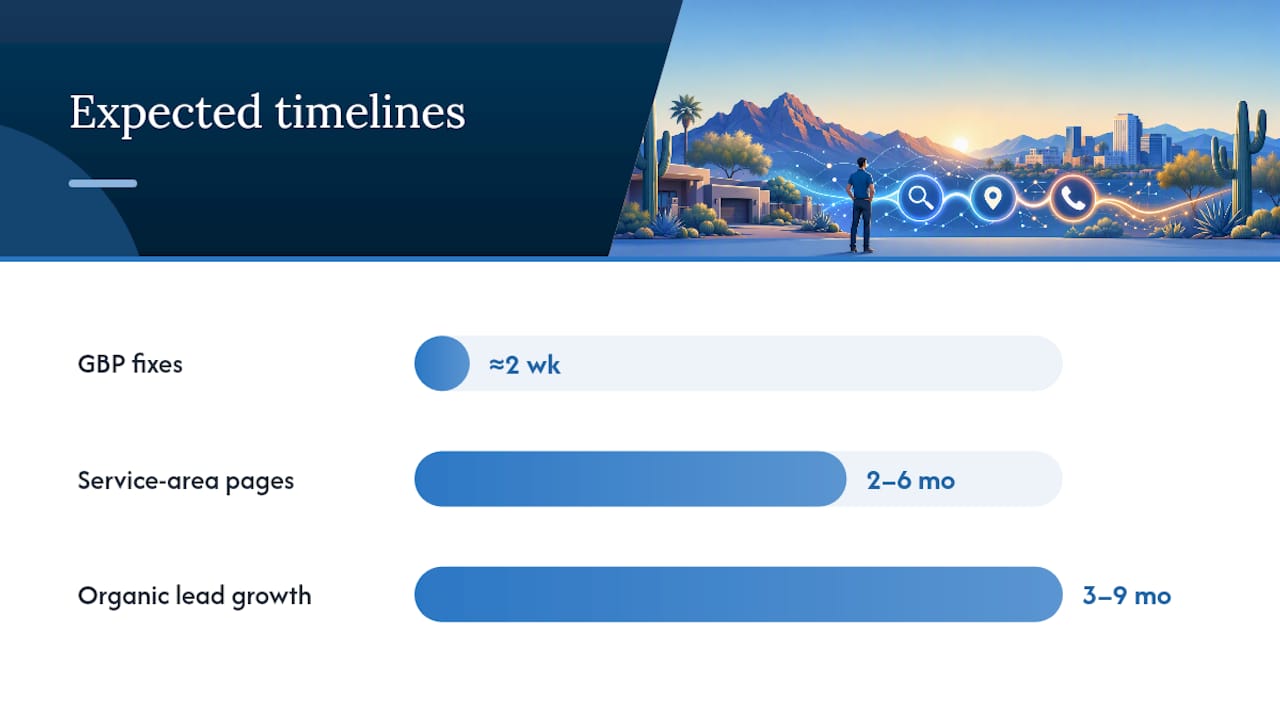
Set your expectations against real timelines, not agency promises. GBP fixes, like correcting categories or adding service areas, can show up in search within a couple of weeks. Service area page indexing and ranking movement typically takes two to six months. Consistent lead growth from organic search usually takes three to nine months to stabilize, since GBP work and content compound over time rather than spike overnight.
Track these numbers monthly:
- GBP actions — calls, direction requests, and website clicks from your profile.
- Impressions for city-specific queries in Google Search Console, which shows whether your service area pages are actually being served for the searches you targeted.
- Organic clicks and conversions from each service area page specifically, not just site-wide totals.
- Cost per lead, calculated against whatever you’re paying an agency or spending on tools.
Pricing varies by scope. A one-off service area page build runs differently than an ongoing monthly retainer covering GBP management, content, and citation work. When comparing proposals, watch for red flags: vague deliverables, no reporting cadence, or anyone promising a guaranteed number one ranking. No legitimate provider controls Google’s algorithm that precisely.
A Local Marketer’s Take on Scottsdale Neighborhood Priorities
Not every Scottsdale neighborhood delivers the same lead value, and treating them identically wastes budget. Old Town tends to produce retail-adjacent leads, quick, transactional jobs where speed and same-day availability matter more than a long sales pitch. North Scottsdale skews toward higher-ticket residential work, custom homes, larger HVAC systems, premium finishes, where credentials, licensing, and portfolio quality carry more weight than how fast you can show up.
That split should shape your messaging, not just your service area list. An emergency plumbing page for Old Town should lead with “available now” and a phone number above the fold. A remodel-adjacent page for North Scottsdale should lead with completed project photos and years in business. A short blog post on a local event, like a Scottsdale Arts Festival vendor prep guide for an electrician, converts better than another generic “why choose us” page, because it proves you actually operate here.
— Brett
How Webtechs Helps Scottsdale Service Businesses Get Found
Webtechs is the alternative to guessing your way through GBP settings and hoping a generic SEO template ranks in Scottsdale. The agency offers a full range of services including Google Business Profile auditing, service area page creation, local content, conversion-focused web design, and monthly reporting that ties back to calls and leads, not just traffic numbers.

A local audit typically starts with your GBP configuration, checks your existing service area pages against uniqueness standards search engines enforce, and reviews your citation consistency across directories. Owners usually walk away with a prioritized fix list within days, not weeks. You can see examples of past local work in the Webtechs portfolio, and if you’re also due for a website refresh alongside the SEO work, the Scottsdale website design services cover that too. If you’re ready to see where your GBP and service area pages currently stand, request a Scottsdale-focused audit and get a straight answer on what to fix first.