
30/90/180 Day Plan: Run PPC First, Build SEO for Scottsdale Small Businesses
For most Scottsdale small businesses, don’t pick one and abandon the other. Run a lean PPC test now to buy speed and validate what messaging actually converts, while building SEO in parallel because it compounds into a lasting asset PPC never becomes. Speed versus durability is the real trade-off, especially as AI Overviews reshape both channels in 2026. Below is the 30/90/180 day plan to act on it.
TL;DR:
- Running a quick, targeted PPC test can provide immediate conversion data to inform long-term SEO content strategies.
- PPC offers rapid results and precise targeting but is less sustainable, while SEO builds lasting traffic with slower initial progress.
- Combining PPC and SEO can maximize visibility while controlling costs, especially as AI-driven search features reduce available click opportunities.
- A 30/90/180-day plan involves launching PPC, optimizing local SEO, and continuously rebalancing budgets based on performance metrics.
- Hiring an integrated agency like Webtechs simplifies coordination and ensures PPC data directly supports organic growth efforts.
Table of Contents
- PPC vs SEO: Side-by-Side on the Metrics That Matter
- When PPC Is the Right Call Right Now
- When SEO Should Be Your Main Investment
- How PPC and SEO Actually Work Together
- What This Actually Costs (and a Simple Way to Model ROI)
- Your 30/90/180-Day Action Plan for Scottsdale
- What Local Agency Experience Actually Shows
- An Editorial Take on the Speed vs. Sustainability Trade-Off
- Get Both Channels Running the Right Way in Scottsdale
- Sources
PPC vs SEO: Side-by-Side on the Metrics That Matter
The two channels solve different problems, and confusing them is how budgets get wasted. PPC buys placement; SEO earns it. That distinction shapes everything else, from how fast you see results to how much you depend on the platform staying on.
Here’s how they stack up on the dimensions that actually drive a decision:
- Speed of results: PPC can send traffic within hours of launch. SEO typically needs several months before rankings move meaningfully, often longer in competitive local categories.
- Cost model: PPC runs on cost-per-click, so you pay for every visit regardless of outcome. SEO involves upfront work (technical fixes, content, local pages) and ongoing effort, but clicks themselves are free once you rank.
- Targeting and control: PPC lets you dial in keywords, geography, device, and even time of day with precision. SEO targets intent more broadly and gives you less granular control over who sees what.
- Sustainability: SEO builds equity that keeps working after you stop actively investing. PPC traffic disappears the moment you pause spending, a point Search Engine Journal makes clearly when weighing the two for a real budget.
- Measurement: PPC gives clean, near-instant attribution through conversion tracking. SEO’s attribution is messier and takes longer to show a clear signal.
Neither channel wins outright. Neil Patel frames it correctly: PPC is the sprint, SEO is the asset you keep after the sprint ends.
When PPC Is the Right Call Right Now
PPC earns its cost in three specific situations: you’re launching something new and need visibility immediately, you have an urgent lead gap this month, or you’re competing for commercial keywords where organic rankings would take a year to crack. A Scottsdale HVAC company needing calls this week during a heat wave has no business waiting on SEO to kick in.
Here’s a lean 30-day PPC test that won’t burn your budget:
- Pick a tight, geo-targeted keyword set. Ten to twenty terms is plenty for a first test.
- Write two or three ad variations and let them compete for two weeks.
- Send all traffic to one focused landing page with conversion tracking installed before launch, not after.
- Run until you hit a meaningful sample of conversions, often 10 to 30 depending on how much your results vary, then decide whether to scale or kill it.
Layer in negative keywords early, cap ad frequency so you’re not paying to annoy the same person five times a day, and check your PPC setup with local guidance before you scale spend past the test budget.
Pro Tip: Set your conversion tracking before you spend a single dollar. Half the “PPC didn’t work” stories from small business owners are actually broken tracking, not a bad campaign.

When SEO Should Be Your Main Investment
SEO wins when you’re playing a longer game: building a pipeline of leads that doesn’t dry up the moment you stop paying, ranking for the informational searches that build trust before someone even wants to buy, or capturing local search intent from people typing “near me” in Scottsdale. If your business depends on repeat local search visibility, SEO is not optional. It’s the foundation.
Set realistic expectations by milestone:
- 3 months: Technical issues fixed, Google Business Profile fully optimized, first local landing pages published. Rankings may barely move yet.
- 6 months: Early keyword movement, some long-tail terms ranking, first organic leads trickling in.
- 12 months: Meaningful organic traffic, multiple page-one rankings for target terms, leads that arrive without ad spend attached.
Prioritize technical fixes first (site speed, mobile usability, crawlability), then build three to five locally focused pages, then push a steady review-generation program. WebTechs.Net’s local SEO work has consistently shown that these fundamentals produce measurable visibility gains within that first 90-day window when they’re executed in order, not all at once.
How PPC and SEO Actually Work Together
The smartest small businesses don’t treat these as competing budgets. They treat PPC as a research tool that makes SEO smarter, and SEO as the place where PPC’s best-performing ideas go to live permanently.
- Run PPC ads on your target keywords first and track which ad copy and landing pages convert best.
- Take the winning messaging and keyword themes and build them directly into SEO content, since you’re no longer guessing what resonates.
- Set one shared KPI dashboard, not two. Backlinko recommends unifying reporting around blended customer acquisition cost and revenue per search result page, so paid and organic aren’t fighting over credit for the same conversion.
- Test cross-channel: launch a PPC campaign on a new landing page, let it prove the concept, then build supporting organic content once you know the page converts.
AI Overviews and other new SERP features are shrinking the number of clicks available on any given search, which is exactly why Search Engine Land argues the SEO vs. PPC debate is effectively over. Businesses running both channels together are simply capturing more of a shrinking pie than businesses picking one and hoping.
What This Actually Costs (and a Simple Way to Model ROI)
Budgeting for either channel without a benchmark is how owners overspend on PPC or underfund SEO into irrelevance. Cost-per-click has been climbing across most industries for several years running, which makes waste control non-negotiable rather than a nice-to-have.
- PPC: Pay per click, scales with spend, stops the instant you stop paying.
- SEO: Typically a monthly retainer or project fee, front-loaded effort, but clicks are free once rankings hold.
- A simple model: if PPC costs you $8 per click and converts at 5%, you’re paying roughly $160 per lead. If SEO, after a $1,500 monthly retainer, starts producing 20 organic leads a month by month six, your cost per lead drops toward $75, and it keeps dropping as rankings hold.
If funds are tight, don’t split evenly. Put enough into PPC to gather real conversion data fast, then shift the majority toward SEO once you know which messaging and pages actually convert. Check current SEO pricing context for Scottsdale before setting your retainer budget.
Your 30/90/180-Day Action Plan for Scottsdale
- Days 1 to 30: Launch a small, geo-targeted PPC test. Verify conversion tracking is firing correctly. Clean up your Google Business Profile, hours, categories, photos, all of it.
- Days 31 to 90: Scale whichever PPC campaigns are converting and pause the rest. Publish your first local-focused landing pages. Start actively requesting reviews from recent customers.
- Days 91 to 180: Build a real content calendar around the keyword themes PPC validated. Start local outreach for links and citations. Calculate your blended customer acquisition cost across both channels and rebalance budget toward whichever is performing.
Pro Tip: Review your blended CAC monthly, not quarterly. A campaign that looked fine in month one can quietly go underwater by month three if you’re not checking.
What Local Agency Experience Actually Shows
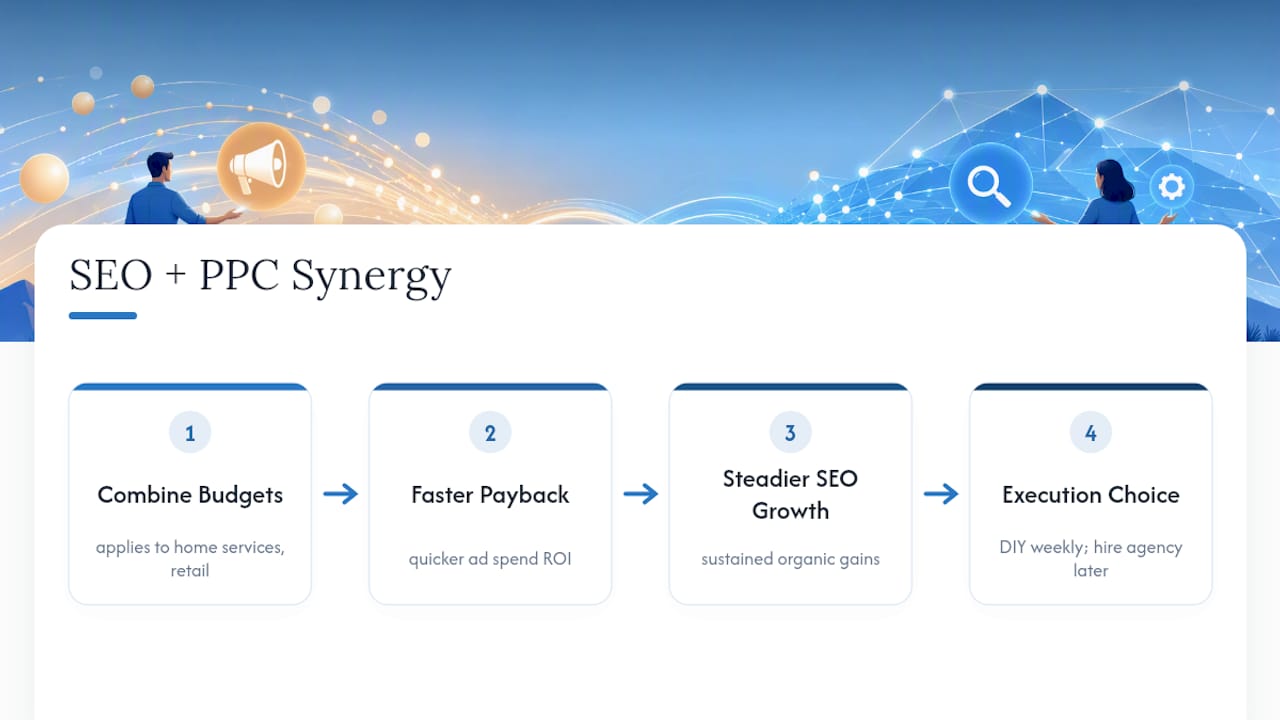
Running SEO and PPC side by side for Scottsdale clients tends to surface the same pattern: the businesses that treat both channels as one budget, not two competing ones, see faster payback on ad spend and steadier organic growth behind it. That’s the case in categories from home services to retail. DIY makes sense if you have the time to manage tracking, bidding, and content weekly. Hiring an agency makes more sense once you’re managing both channels and a business at the same time. Webtechs has run that blended playbook for Scottsdale clients since 1997.
An Editorial Take on the Speed vs. Sustainability Trade-Off
The mistake I see most often isn’t choosing PPC over SEO or vice versa. It’s treating the decision as permanent when it should be sequential: PPC first to buy speed and real conversion data, SEO right behind it to convert that data into something durable. Businesses that wait for “enough budget to do SEO properly” usually mean they never start, and the ones that run PPC forever without ever building organic equity are renting visibility they’ll lose the day cash flow gets tight.
Get Both Channels Running the Right Way in Scottsdale
Webtechs is the practical alternative to piecing together a PPC freelancer and a separate SEO contractor and hoping they talk to each other. One team manages both, so your paid test data actually feeds your organic content plan instead of living in two disconnected dashboards.
Since 1997, Webtechs has built and managed integrated SEO and PPC campaigns for small and mid-sized businesses across Scottsdale, from web design through ongoing search management. That means your landing pages, your ad campaigns, and your organic content all get built to work together from day one, not stitched together after the fact. If you want to see what that looks like before committing to anything, browse the Webtechs portfolio for examples of past client work, then book a quick assessment to find out whether PPC, SEO, or a blend of both fits your current budget and timeline.
Sources
- Why the SEO vs. PPC debate is finally over
- SEO vs PPC: Pros, Cons, & Everything In Between
- SEO Vs. PPC Strategy: What’s Right For Your Business?
- SEO vs PPC: Differences, Pros, Cons, & How to Choose
- SEO and PPC: 8 Smart Ways to Align for Maximum ROI in 2026