

Landing Page Design That Converts: A Guide for Arizona Businesses

If you’re running paid ads or local campaigns in Arizona and sending traffic to your homepage, you’re leaving leads on the table. The single best move is to hire a conversion-focused local provider to build an ad-ready landing page with message match, mobile speed, and tracking built in from day one. Webtechs, based in Scottsdale, has been doing exactly this for small and mid-sized businesses since 1997.
Before you request a quote, ask for two things:
- Ad-readiness confirmation: Does the page preserve UTM parameters, load under 3 seconds on mobile, and include your conversion pixel?
- Measurement plan: Will you receive GA4 event tracking, form-submission goals, and a testing roadmap before launch?
Then contact Webtechs to review their portfolio and get a scoped quote for your campaign.
Key Takeaways
A conversion-focused landing page built for your specific ad source and audience is the most direct way to improve campaign ROI without increasing ad spend.
| Point | Details |
|---|---|
| Message match is the priority | The page headline must mirror the ad copy; misalignment causes bounces even on well-designed pages. |
| Require a speed SLA | Ask for a specific mobile load-time commitment before signing any proposal. |
| Track before you launch | GA4 events, conversion pixels, and UTMs must be verified on a staging URL before the page goes live. |
| Short forms convert more | Use three fields or fewer for volume; add multi-step logic only when lead quality matters more than quantity. |
| Webtechs is the local option | Webtechs builds ad-ready landing pages for Arizona businesses with full tracking setup and testing support included. |
Table of Contents
- What does landing page design actually include?
- Which businesses get the most from a dedicated landing page?
- What should a professional landing page build deliver?
- What technical foundations make a landing page actually perform?
- What does the process look like, and what drives the price?
- Why Webtechs is a strong local choice for Arizona businesses
- Portfolio snapshots and case-study highlights
- A research-backed conversion checklist for your landing page
- What I’ve learned from landing page projects
- Webtechs can build your Arizona landing page now
- Sources
What does landing page design actually include?
A landing page is a single-purpose web page built around one conversion goal: a phone call, a form fill, an appointment booking, or a download. Unlike a homepage, it has no navigation menu, no competing offers, and no distractions. Every element points the visitor toward one action.
The difference between a homepage and a landing page matters most when you’re paying for traffic. A homepage serves everyone who visits your site. A landing page serves the specific person who clicked a specific ad, email, or social post. That distinction is why landing page best practices consistently recommend removing navigation and keeping the page focused on a single conversion goal.
Common use cases for Arizona businesses:
- A roofing company running Google PPC ads for storm-damage repairs
- A plumbing service promoting a seasonal drain-cleaning special
- A medical practice booking new-patient appointments from Facebook ads
- A local event organizer collecting RSVPs from an email campaign
- A real estate agent capturing buyer leads from Google Local Services Ads
Each of these campaigns needs its own dedicated page. Sending that traffic to a general homepage almost always reduces conversion rates because the message on the page doesn’t match the promise in the ad.
Which businesses get the most from a dedicated landing page?
The verticals that see the biggest return from dedicated landing pages share one trait: high local intent. Someone searching “emergency AC repair Scottsdale” or “roofing estimate Phoenix” is ready to act. If the page they land on matches that exact intent, conversion rates climb. If it doesn’t, they bounce.
High-value Arizona verticals:
- Home services: Roofing, HVAC, plumbing, electrical, and pest control all run seasonal campaigns. Arizona’s summer heat makes AC and roofing campaigns especially time-sensitive, and a dedicated page for each promotion keeps messaging tight.
- Medical and dental practices: New-patient acquisition from paid search requires a page that addresses the specific service, insurance acceptance, and location.
- Legal services: Personal injury, family law, and immigration firms rely heavily on PPC. Cost-per-click in legal is high, so a page that converts at even a slightly better rate pays for itself quickly.
- Real estate: Buyer and seller lead-gen pages tied to specific neighborhoods or property types outperform generic agent sites.
- Fitness and wellness: Gyms, yoga studios, and med spas run offer-specific pages for free trials, consultations, or seasonal promotions.
Campaign types that require a landing page:
- Google Search and Display PPC campaigns
- Meta lead ads with an off-platform destination
- Google Local Services Ads follow-up pages
- Email promotions with a time-sensitive offer
- Retargeting campaigns with a specific message for warm audiences
Arizona’s seasonal demand patterns add another layer. Roofing and HVAC companies often need new pages built quickly when a weather event drives search volume. A provider who understands local timing can turn a campaign around faster than one who doesn’t.
What should a professional landing page build deliver?
A full landing page service is more than a design file. Here’s what you should expect as concrete deliverables before you sign off on any proposal.
Core deliverables:
- Hero section: A benefit-driven headline that mirrors the ad copy, a supporting subheadline, and a CTA button above the fold
- Conversion-focused copy: Written to match the specific ad source and audience, not repurposed from the homepage
- Form setup: Single-step or multi-step forms with conditional logic, spam protection (honeypot or reCAPTCHA), and server-side validation
- Tracking and analytics: GA4 event tracking, ad platform conversion pixels (Google Ads, Meta), and UTM parameter alignment
- Responsive layout: Mobile-first design with performance optimizations including compressed images, critical CSS, and lazy loading
- A/B test scaffold: At minimum, a second headline variant and CTA variant ready to test after launch
Optional but worth asking about: video integration, live chat or chatbot triggers, multi-step qualification flows, and dynamic text replacement that swaps the headline based on the keyword that triggered the ad.
Inspiration libraries like Lapa Ninja catalog over 7,300 real landing pages, which is useful when you want to show a designer the visual direction you’re after. Similarly, One Page Love tags examples by platform (Webflow, Framer, Tailwind), which helps estimate build complexity before scoping.
Pro Tip: Always request a staging URL before launch. Review the page on a real mobile device, submit the form yourself, and confirm the conversion fires in GA4 and your ad platform before the campaign goes live.
What technical foundations make a landing page actually perform?
Design gets the credit. Technical execution is what actually drives results. Message match and page speed are two of the highest-impact fixes for landing-page conversion problems, and both are technical decisions as much as creative ones.
Mobile-first design and load speed
Google’s mobile-first indexing means your page is evaluated on its mobile version first. More practically, most paid traffic in local markets arrives on phones. A page that loads slowly on mobile loses visitors before they read a single word. Ask any provider for a specific load-time commitment on mobile, not just desktop.
Hosting and CDN
Time-to-first-byte matters. A page hosted on a shared server with no CDN will load slower under paid-traffic load than one hosted on a performance-optimized stack with edge caching. For high-spend campaigns, this is worth a direct conversation with your provider.
Tracking stack
A properly instrumented landing page includes:
- GA4 with custom event tracking for form submissions, button clicks, and scroll depth
- Server-side or client-side conversion pixels for Google Ads and Meta
- UTM parameters preserved through the URL so every lead is attributed to its source
- CRM or webhook integration so leads flow directly into your sales process without manual export
For campaigns that generate phone calls, call tracking is a separate but critical layer. Dynamic number insertion lets you attribute inbound calls to the specific ad and keyword that drove them.
Form reliability
Forms are where conversions happen or don’t. Spam protection (honeypot fields plus reCAPTCHA), server-side validation, and a reliable delivery mechanism (webhook to CRM, Zapier, or direct email with a backup) are non-negotiable. A form that silently fails costs you leads you’ll never know you lost.
Ad-readiness checklist:
- UTM parameters pass through to the thank-you page and CRM
- Privacy policy and terms links present (required by Google Ads and Meta policies)
- Page speed tested under simulated traffic load, not just on a clean cache
- Conversion pixel fires on form submission, not on page load
Improving website conversions often starts with fixing these technical gaps before touching the design.
Speed and message match are the two levers that move conversion rates before you spend a dollar on design polish. A slow page with perfect copy still loses. A fast page with mismatched messaging loses just as fast.
What does the process look like, and what drives the price?
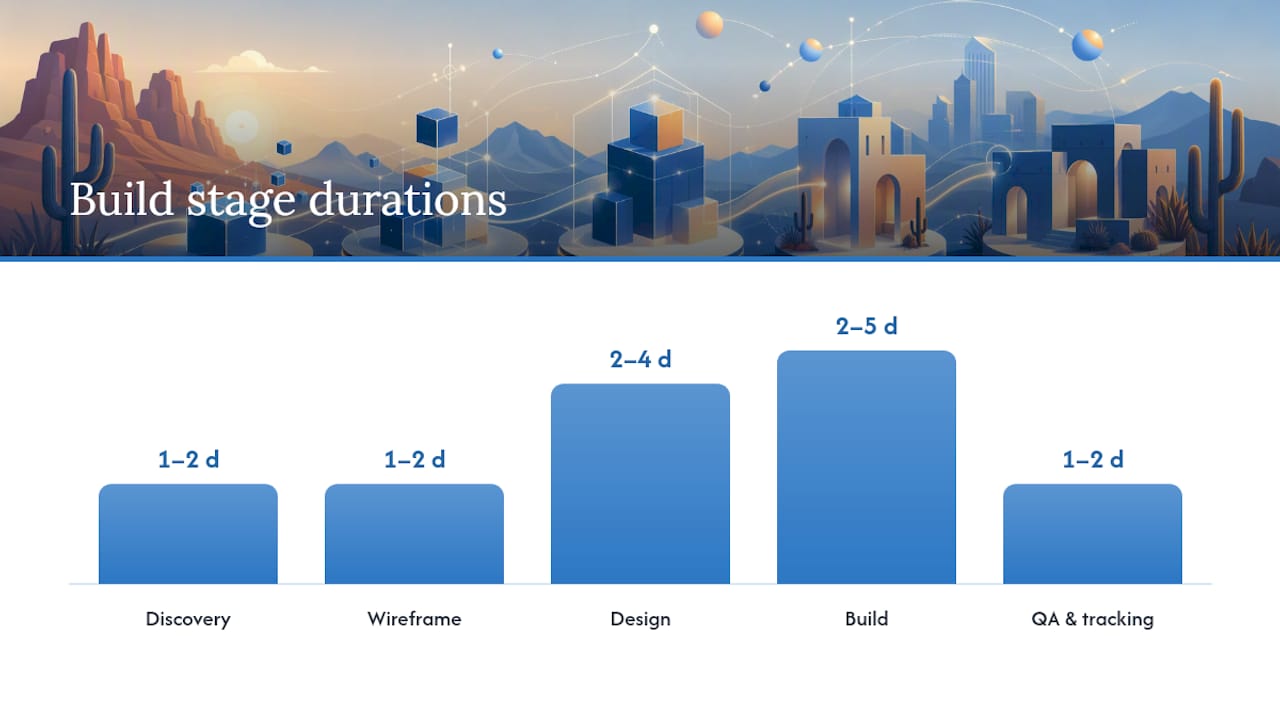
A professional landing page build follows a predictable sequence. Understanding each step helps you evaluate proposals and avoid surprises.
Typical build process:
- Discovery (1–2 days): Define the single conversion goal, the ad source, the audience, and the message. This is where message match gets locked in.
- Wireframe (1–2 days): A structural layout showing content blocks, CTA placement, and form position before any visual design begins.
- Design (2–4 days): Visual design applied to the wireframe, including brand colors, typography, imagery, and mobile layout.
- Build (2–5 days): Development of the live page with all integrations: forms, tracking, pixels, and CRM connections.
- QA and tracking verification (1–2 days): Cross-device testing, form submission testing, and pixel verification in GA4 and ad platforms.
- Launch and test scaffold (1 day): Page goes live with UTMs active and at least one A/B variant ready to run.
- Test and iterate (ongoing): A multi-week testing window with predefined conversion thresholds before declaring a winner.
A stage-based approach that organizes work by impact (before the click, above the fold, body, form, mobile, testing) is the most reliable way to prioritize what gets built and tested first.
What drives the price:
- Single page vs. multi-variant build (two or more test variants cost more)
- Custom copywriting vs. client-supplied copy
- Form complexity (simple contact form vs. multi-step qualification flow)
- Custom integrations (CRM, scheduling software, webhook delivery)
- Animation and interaction level
- Ongoing hosting, maintenance, and A/B testing retainer
Template and component libraries can reduce build time significantly for straightforward campaigns without sacrificing core conversion patterns. For clients who need a fast turnaround, this is worth discussing upfront.
Questions to ask when comparing proposals:
- What is your specific load-time SLA on mobile?
- Can you show me a sample measurement plan from a past project?
- Who owns the analytics account and conversion data?
- What is your testing cadence, and how do you define a winning variant?
Why Webtechs is a strong local choice for Arizona businesses
Webtechs has been building conversion-focused web assets for Arizona businesses since 1997. That’s not a credential to gloss over. Local market experience means understanding seasonal demand cycles, the competitive landscape in Phoenix and Scottsdale, and the specific ad platforms that drive local intent traffic.
What sets the Webtechs approach apart:
- Conversion-first process: Every build starts with message match. The headline on the page is written to mirror the ad that sent the visitor there.
- Speed-first build: Mobile performance is treated as a requirement, not an afterthought.
- Full tracking setup: GA4 event tracking, ad platform pixels, and UTM alignment are included in the build, not billed as add-ons.
- Flexible service model: Project-based builds for one-time campaigns, plus optional retainers for A/B testing, hosting, and ongoing optimization.
- Local credibility: Client testimonials from Arizona businesses reflect real results in competitive local verticals.
For businesses in home services, medical, legal, or real estate, the combination of local knowledge and a conversion-first process is the difference between a page that looks good and one that actually generates leads. You can review Webtechs’ SEO case studies for a broader picture of measurable outcomes across local verticals.
Portfolio snapshots and case-study highlights
Real results matter more than promises. Here are three representative project types from Webtechs’ Arizona work.
Roofing lead-gen page (PPC source)
A Scottsdale roofing company needed a dedicated page for its storm-damage repair campaign. The existing homepage had navigation, multiple service links, and no clear CTA. The new landing page stripped navigation, led with a benefit-driven headline matching the ad copy, and placed a click-to-call button above the fold. Quote-request volume from the campaign increased measurably within the first month. See the roofing SEO case study for context on the broader campaign.
Home services appointment page (Google Local Services)
A plumbing company running Google Local Services Ads needed a follow-up page that matched the trust signals Google’s platform creates. The page included license information, a five-star review count, and a short multi-step form that qualified leads before submission. Form completion rates improved compared to the previous single-field form, and lead quality increased because unqualified requests were filtered earlier in the flow.
Medical practice new-patient page (Facebook Ads)
A Scottsdale medical practice ran a Facebook campaign targeting new patients for a specific service. The landing page matched the ad’s visual style, included insurance acceptance details, and used a single-step appointment-request form. The campaign generated a consistent flow of qualified new-patient inquiries within the first 30 days.
For a broader view of design directions and visual patterns, Lapa Ninja’s gallery and One Page Love are worth browsing before your briefing call.
A research-backed conversion checklist for your landing page
Use this checklist when briefing a provider or reviewing a completed build. Items are ordered by impact.
Conversion checklist:
- Message match first: The headline must mirror the ad copy that sent the visitor. This is the single most common fix that produces measurable lifts, per industry best practices.
- CTA above the fold: The primary call-to-action button must be visible without scrolling on mobile.
- Outcome-focused CTA copy: “Get my free quote” and “See contractor pricing” outperform “Submit” because they describe what the visitor receives, not what they do. HubSpot’s guidance confirms outcome-focused CTAs convert better.
- Social proof placement: A star rating, review count, or short testimonial placed near the CTA reduces hesitation at the moment of decision.
- Short form: Three fields or fewer for high-volume campaigns. Use multi-step forms with conditional logic when lead quality matters more than volume.
- Speed on mobile: Test with a real device on a cellular connection, not just a desktop browser.
- Tracking verified before launch: GA4 event, conversion pixel, and UTM all confirmed in a pre-launch QA pass.
- No navigation: Remove the site header and footer nav. Unbounce’s research validates this as a consistent conversion lift.
High-performing CTA templates:
| CTA Type | Example Copy | Why It Works |
|---|---|---|
| Outcome-focused | “Get my free roofing estimate” | States what the visitor receives |
| Urgency + outcome | “Book my AC tune-up before summer” | Combines timing with a clear benefit |
| Low-commitment | “See our project photos first” | Reduces friction for cold traffic |
| First-person | “Start my free consultation” | Personalizes the action |
Data-backed rules on headline clarity, proof placement, and form length provide a prioritized list of elements to test for measurable lifts. Pair this checklist with lead-funnel automation to ensure every form submission flows into your CRM without manual handling.
Pro Tip: Run A/B tests for at least two full weeks before declaring a winner. A single weekend’s data can skew results significantly. Define your success metric (form submissions, not just clicks) before the test starts.
What I’ve learned from landing page projects
Most clients come to us focused on design. They want it to look professional, match their brand, and feel modern. That’s reasonable. But the pages that actually move the needle are the ones where we spent the most time on the brief, not the mockup.
Message match is unglamorous work. It means reading the ad copy, understanding the audience’s specific intent, and writing a headline that answers the question the visitor arrived with. When that alignment is tight, even a visually simple page converts well. When it’s loose, a beautiful page still loses visitors in the first five seconds.
In the first 90 days after launch, clients typically see one of two things: either the page performs immediately because the message and offer are strong, or the data reveals a specific gap (usually a headline that’s too generic or a form that’s too long) that a single test can fix. Either outcome is useful. The worst outcome is launching without tracking and never knowing which it was.
Webtechs can build your Arizona landing page now
Webtechs builds conversion-focused landing pages for Arizona businesses that are running or planning paid campaigns. A project quote includes a speed SLA for mobile, full GA4 and conversion pixel setup, and one month of A/B testing support after launch.
The process starts with a scoped brief: your campaign goal, ad source, and target audience. From there, Webtechs delivers a wireframe, a conversion-focused build, and a measurement plan so you know exactly what you’re getting and how results will be tracked.
View the Webtechs portfolio to see past Arizona projects, or review the web design pricing page to benchmark your quote. Ready to move forward? Contact Webtechs directly to request your scoped landing page proposal.
Sources
The following sources informed the checklist, process guidance, and CTA recommendations in this article.
- Landing Page Best Practices (2026) | COREPPC
- Landing Page Best Practices: The Complete 2026 Guide
- Landing Page Best Practices (HubSpot)
- Landing Page Best Practices To Create High-Converting Pages
- Landing page best practices: 10 data-backed rules
- Landing Page Design Examples: 7,300+ Best Landing Pages | Lapa Ninja
- Landing Page Design Inspiration
- The Best Landing Page Design Inspiration, Templates and More | Landingfolio