

AI Search Optimization for Business Owners: A Practical Guide

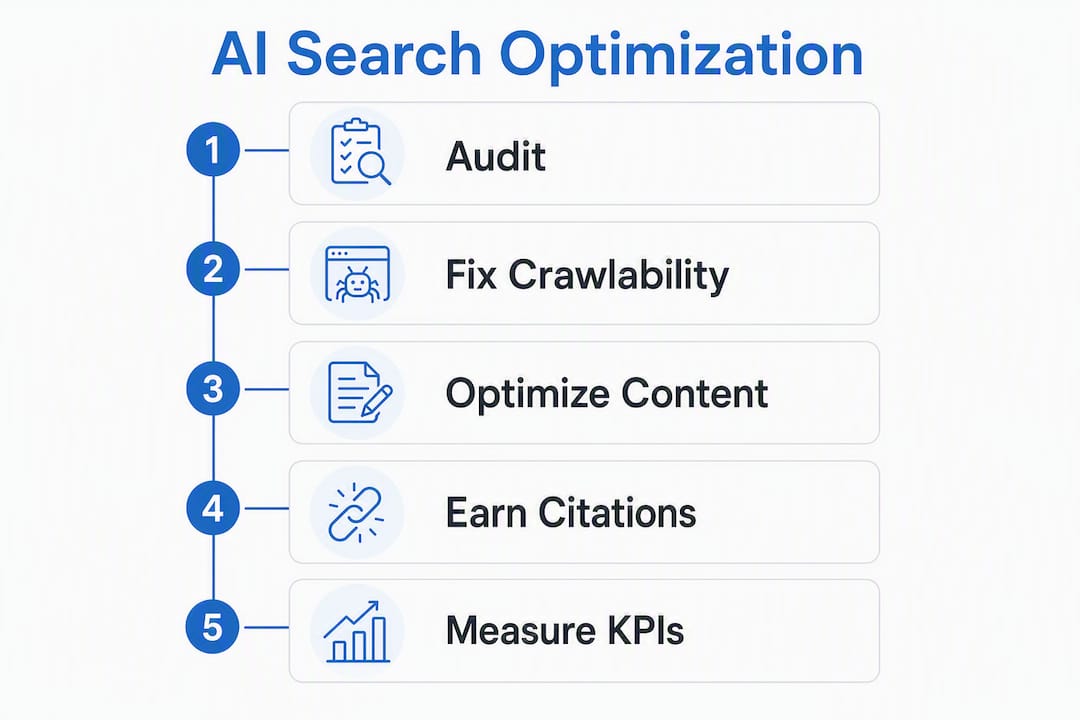
AI search optimization, formally called Generative Engine Optimization (GEO), makes your brand more likely to be cited and recommended by generative AI platforms such as Google’s AI Overviews, ChatGPT, and Perplexity. The goal shifts from ranking on page one to being the source those AI systems quote when a buyer asks a question you should own.
Three checks to run right now:
- Verify crawlability. Open your robots.txt file and confirm AI crawlers are not blocked. If Google can’t index a page, its AI Overviews won’t cite it either.
- Test a live query. Type your core service question into ChatGPT, Perplexity, and Google’s AI Overviews. Note which brands appear and whether yours does.
- Add one quotable credential. On your highest-traffic page, add a specific statistic with a source, or a named author with credentials. AI systems favor attributable, verifiable claims.
If your brand is invisible in those tests, an AI visibility audit is the right first move. Webtechs offers that audit as a starting point for Arizona businesses ready to close the gap.
Table of Contents
- What does AI search optimization actually mean for your business?
- Why AI citations change how buyers find and trust your brand
- What technical foundations do you need to get right first?
- How do you write content that AI systems actually quote?
- How do you build the off-site signals AI engines rely on?
- What does an agency-led GEO implementation look like?
- What should you budget and how long does it take?
- How do you measure whether GEO is working?
- How do you choose the right AI SEO agency?
- What results does real GEO-integrated SEO produce?
- Key Takeaways
- Why GEO demands an integrated agency, not a checklist
- Webtechs handles your GEO audit and implementation from day one
- Useful sources and platform guidance
What does AI search optimization actually mean for your business?
GEO shifts the goal from classic organic ranking positions to citation frequency across generative AI platforms. Traditional SEO asks: “Can Google find and rank my page?” GEO asks: “Will an AI engine quote my page when a buyer asks a relevant question?”
The four platforms that matter most right now:
- Google AI Overviews and Gemini pull from Google’s existing search index using a process called retrieval-augmented generation (RAG), which retrieves indexed pages and reviews their content to build grounded responses.
- OpenAI’s ChatGPT (with Browse enabled) surfaces brand-owned and third-party content, with a strong bias toward authoritative, frequently cited sources.
- Perplexity operates as a real-time research engine that cites sources inline, making it especially valuable for B2B buyers doing due diligence.
- Anthropic’s Claude draws on trained knowledge and, in its connected modes, retrieves current web content with a preference for structured, clearly attributed material.
The good news: Google confirms that traditional SEO fundamentals remain the foundation for AI visibility. Crawlability, quality content, and domain authority are still what matter. GEO is not a separate discipline built on secret files or hacks. It is existing SEO done with AI citation patterns in mind.
Why AI citations change how buyers find and trust your brand
When a buyer asks ChatGPT “Who are the best garage door repair companies in Scottsdale?” and your brand appears in the answer, something different happens compared to a traditional search result. The AI has already pre-qualified you. The buyer arrives with higher intent and lower skepticism than someone who clicked a blue link.
That dynamic changes marketing ROI calculations. AI answers often reduce raw click-through volume because the AI resolves part of the query without a click. But the buyers who do click after seeing an AI citation convert at a higher rate because the AI has already done the trust-building work.
Consider three industry patterns:
Local service businesses (HVAC, garage repair, roofing) benefit when AI engines cite them in “best in [city]” or “how to choose a [service]” queries. A citation in Perplexity’s answer to “top-rated roofers in Phoenix” functions like a word-of-mouth referral at scale.
B2B service providers (agencies, consultants, SaaS) gain when AI systems cite their published research, guides, or case studies in response to industry questions. A cited white paper positions the brand as the expert before a sales conversation starts.
Professional services (law, finance, healthcare) see AI citations influence which firms buyers shortlist. Being cited in a “what to look for in a [professional]” answer shapes the consideration set before the buyer ever visits a website.
The KPIs organizations track to measure this: brand mention share in AI responses, AI citation frequency by query cluster, and downstream conversion lift on pages that AI engines cite.
What technical foundations do you need to get right first?
Technical readiness is the prerequisite. An AI engine cannot cite a page it cannot access, parse, or trust. Here is the priority order, from highest to lowest impact:
- Indexability. Check robots.txt and meta-robots tags. Google’s RAG mechanism retrieves pages from its search index first, so a page blocked from indexing is invisible to AI Overviews by definition. Fix crawl blocks before anything else.
- Canonical clarity. Duplicate content confuses both traditional crawlers and AI systems. Set canonical tags correctly so the authoritative version of each page is unambiguous.
- Page performance and Core Web Vitals. Slow pages get crawled less frequently and rank lower, which reduces their probability of being retrieved for AI answers. Target a Largest Contentful Paint under 2.5 seconds.
- Server-side rendering for JavaScript frameworks. If your site uses React, Vue, or Angular without server-side rendering (SSR) or pre-rendering, crawlers may see a blank page. Switch to SSR or use a pre-rendering service so content is available in the initial HTML response.
- Accessible XML sitemaps. Submit a current sitemap in Google Search Console. It accelerates discovery of new and updated pages.
On structured data: Article, Organization, FAQ, and Author schema all help AI systems understand who wrote a piece, what it covers, and whether the source is credible. Google is explicit that no special schema is required specifically for AI features. Schema helps when it makes your content clearer to crawlers; it is not a magic AI citation trigger on its own.
Pro Tip: To confirm AI crawlers can actually reach your content, check your server access logs for user-agent strings like “Googlebot,” “GPTBot” (OpenAI), and “PerplexityBot.” If those agents are absent or blocked, no amount of content work will move your AI citation numbers.
How do you write content that AI systems actually quote?
The core principle: AI engines break a user’s prompt into related sub-queries and assemble answers from small, extractable passages. This is what researchers call query fan-out, and it means your content needs to be structured so individual paragraphs can stand alone as answers.
Four content patterns that increase extractability:
Short answer paragraphs under question headings. Place a 2–4 sentence direct answer immediately below any H2 or H3 that is phrased as a question. AI systems are trained to retrieve the passage closest to the question. If your answer is buried in paragraph six, it will be skipped.
Numbered steps for process content. Step-by-step formats are highly quotable because they are self-contained and scannable. A “how to” answer in five numbered steps is far more likely to be cited than the same information written as a narrative essay.
Named statistics with sources. AI systems favor attributable, verifiable claims. A sentence like “According to [Source], 44% of AI citations come from the first 30% of an article” is more likely to be quoted than “many citations come from early in the article.” Add the source inline.
Concise definitions. Every key term in your content should have a one-sentence definition somewhere on the page. AI engines frequently pull these when building overview answers.
To test your content, type your target question directly into ChatGPT, Perplexity, and Google’s AI Overviews. Note which sources appear and what passage they quote. Then compare those passages to your own content. If a competitor’s phrasing is cleaner or more direct, rewrite yours to match or beat it. Semrush recommends converting existing headings to question form and adding specific statistics as two of the highest-leverage quick wins.
Topical clustering matters here too. A single page rarely earns sustained AI citations. A cluster of interlinked pages covering a topic from multiple angles signals depth of expertise. For example, a blogging strategy that produces supporting articles around a core service page gives AI engines more passages to draw from and more evidence that your site is the authoritative source on that topic.
How do you build the off-site signals AI engines rely on?
AI systems favor reliable, independent sources when building answers. Brand-owned content alone rarely earns consistent citations. The external signal stack matters as much as on-site content quality.
- Earned media and PR. A mention of your brand in an industry publication, a local news outlet, or a trade association’s website functions as a third-party endorsement. Research confirms AI search favors earned media and third-party authoritative sources over brand-owned content alone. Prioritize outreach to publications your buyers already read.
- Bylined articles. Publishing under a named expert’s byline in external outlets builds author entity strength. When Claude or Perplexity encounters your expert’s name across multiple credible sources, that co-occurrence signals authority.
- Directory and citation presence. Google Business Profile, industry directories, and local citations (especially for Arizona-based businesses) reinforce your Organization entity in Google’s knowledge graph. Keep NAP (name, address, phone) consistent across all listings.
- Knowledge panel signals. Claim and populate your Google Knowledge Panel by verifying your Google Business Profile, adding structured Organization schema to your homepage, and linking your social profiles. A populated knowledge panel signals to AI systems that your brand entity is established and trustworthy.
- Schema-based Author markup. Add Author schema to every article or guide, linking to a consistent author profile page. This connects bylined content to a verifiable entity, which strengthens the author’s credibility signal across AI systems.
The practical difference between backlinks and earned mentions in AI contexts: backlinks move PageRank; earned mentions move entity co-occurrence. Both matter, but for AI citation specifically, a brand mention in a relevant article, even without a link, contributes to the AI’s understanding of your brand’s authority in a topic area.
What does an agency-led GEO implementation look like?

A well-run GEO project follows four phases. Here is what each phase produces and what the client needs to provide.
| Phase | Agency Deliverable | Client Input Needed | Typical Timeline |
|---|---|---|---|
| Discovery & Audit | AI visibility audit report, crawl analysis, citation gap map | Search Console access, top 10 target queries, existing content inventory | Weeks 1–2 |
| Prioritization Roadmap | Ranked backlog of technical fixes, content gaps, and PR targets | Approval on priorities, KPI agreement | Week 3 |
| Implementation Sprints | Technical fixes, content rewrites/additions, schema deployment, PR outreach | Subject matter expert access, brand voice guidelines | Weeks 4–6 |
| Measurement & Iteration | Monthly AI citation report, KPI dashboard, next-sprint recommendations | Conversion data, lead source tracking | Ongoing monthly |
A few things that make or break each phase:
- Audit phase: The audit must test actual queries on Google AI Overviews, ChatGPT, and Perplexity, not just run a standard crawl. Citation gap analysis (who is being cited instead of you, and why) is the most valuable output.
- Implementation sprints: Small sites (under 50 pages) can complete core technical fixes and content updates in 4–6 weeks. Mid-size sites (50–500 pages) typically need 10–14 weeks before citation patterns shift measurably.
- Measurement: Set a baseline before any changes go live. Without a pre-implementation snapshot of AI citation frequency, it is impossible to prove progress.
For budget-conscious businesses, cost-effective SEO strategies prioritize crawl fixes and content extractability first, since both have the highest return relative to effort.
What should you budget and how long does it take?
GEO projects typically take one of three shapes, and the right one depends on how much technical debt and content gap your site carries.
One-off audit ($500–$2,500 for most small business sites). Covers crawl analysis, AI citation testing across platforms, and a prioritized fix list. No implementation included. Best for businesses that have an in-house team to execute.
Project-based implementation ($3,000–$15,000+). Covers the audit plus technical fixes, content rewrites, schema deployment, and initial PR outreach. Timeline: 8–16 weeks. Site complexity and content volume are the primary cost drivers.
Ongoing monthly retainer ($1,000–$5,000/month for small to mid-size businesses). Covers continuous content production, PR/earned media outreach, measurement reporting, and iterative optimization. AI citation patterns shift as AI engines update their models, so ongoing work sustains visibility that a one-time project cannot.
Timeline expectations: most sites see measurable changes in AI citation frequency within 60–90 days of implementing crawl fixes and content improvements. PR-driven citation gains take longer, typically 3–6 months, because earned media requires relationship-building and publication lead times. Understanding what SEO fundamentally involves helps set realistic expectations before committing to a scope.
Primary cost drivers: site size and technical debt (a JavaScript-heavy site with crawl issues costs more to fix), content gap depth (how many pages need rewrites versus minor updates), and PR effort (national publications require more outreach than local Arizona outlets).
How do you measure whether GEO is working?
The KPIs for GEO are different from traditional SEO metrics, though they overlap.

AI citation count and share. Manually test 10–20 target queries across Google AI Overviews, ChatGPT, and Perplexity weekly. Track how often your brand appears and in what position within the AI answer. This is the most direct measure of GEO performance.
Brand mention growth. Use tools like Google Alerts, Semrush’s brand monitoring, or Mention to track how often your brand name appears in third-party content. Rising mention volume correlates with rising AI citation frequency.
Search Console generative AI report. Google Search Console includes a Generative AI performance report that shows impressions and clicks from AI-powered features. Check it monthly.
Traffic delta to cited pages. When a page starts appearing in AI answers, it often sees a shift in traffic quality, not just volume. Track conversion rate and session depth on pages that AI engines cite, not just raw sessions.
Assisted conversions. In GA4, set up a custom channel group for AI referral traffic (traffic from perplexity.ai, chatgpt.com, etc.) and track how often those sessions assist a conversion even when they are not the last touch.
Interpreting the data: a drop in organic click-through rate alongside a rise in direct traffic and branded search volume often signals that AI citations are driving awareness that converts through a different path. Do not judge GEO purely by clicks.
How do you choose the right AI SEO agency?
Not every agency claiming GEO expertise has the cross-functional capability the work actually requires. Here is a checklist to evaluate any provider:
- Technical SEO depth. Can they audit and fix crawlability, canonical issues, Core Web Vitals, and server-side rendering? Ask for a sample audit report.
- Structured data experience. Have they deployed Article, Author, Organization, and FAQ schema at scale? Ask for a live example.
- PR and earned media capability. Do they have relationships with relevant publications, or do they outsource PR entirely? AI citation work without earned media is incomplete.
- Demonstrable GEO case studies. Ask for specific examples: which queries did a client rank for in AI answers, and what changed to get there? Generic traffic graphs are not GEO proof.
- Cross-platform measurement. Do they test on Google AI Overviews, ChatGPT, and Perplexity, or only on Google? AI engines differ from one another, and optimizing for one platform does not guarantee visibility on others.
Interview questions worth asking:
- “Show me a client whose brand now appears in AI answers for a competitive query. What specifically changed?”
- “How do you measure AI citation frequency, and what tools do you use?”
- “What is your process when an AI engine updates its model and citation patterns shift?”
Red flags to walk away from:
- Guarantees of AI mentions. No agency can guarantee placement in a generative AI answer.
- Pitching llms.txt as a primary strategy. Google explicitly warns against treating special AI-only files as a reliable tactic.
- No measurement framework. If an agency cannot tell you how they will track AI citation changes before the project starts, they are guessing.
What results does real GEO-integrated SEO produce?
Webtechs has documented the outcomes of integrated SEO work across multiple industries. Two case studies illustrate the range:
| Client Type | Strategy Focus | Documented Outcome |
|---|---|---|
| Music industry client | Content depth, topical authority, earned citations | a 4490% engagement increase |
| Garage door repair companies | Local SEO, structured data, citation building | a 1620% traffic increase |
a 4490% engagement increase for a music industry client through content authority and citation-building strategy, documented by Webtechs.
Both results came from the same integrated approach: technical foundations first, then content structured for extractability, then off-site citation building. Neither was a one-time fix. The music client’s results reflect sustained content investment and earned media outreach. The garage door repair outcome reflects local citation consistency and structured data deployment, the exact signals that now feed local AI answers on Google.
These outcomes predate the current GEO era, but the underlying signals, crawlability, content authority, and earned citations, are precisely what AI systems now use to decide which brands to recommend.
Key Takeaways
GEO success requires combining technical SEO fundamentals with extractable content and earned third-party citations across Google AI Overviews, ChatGPT, Perplexity, and Claude.
| Point | Details |
|---|---|
| Fix crawlability first | Blocked pages cannot appear in AI answers; audit robots.txt and canonical tags before any content work. |
| Structure content for extraction | Place direct answers under question-style headings; AI engines pull short, self-contained passages. |
| Earned media drives citations | Third-party brand mentions in authoritative sources carry more weight than brand-owned content alone. |
| Measure across all platforms | Test target queries on Google AI Overviews, ChatGPT, and Perplexity separately; citation patterns differ by engine. |
| Webtechs delivers integrated GEO | Webtechs audits, implements, and measures GEO for Arizona businesses, with documented outcomes of significant gains. |
Why GEO demands an integrated agency, not a checklist
The framing I push back on most often is treating GEO as a one-time optimization pass. Run the audit, fix the robots.txt, add some FAQ schema, done. That thinking misunderstands what AI systems actually reward.
AI engines are not static. Google updates its AI Overviews logic. OpenAI changes how ChatGPT retrieves and weights sources. Perplexity adjusts its citation ranking. A brand that earns citations in January can lose them by April if a competitor publishes a better-structured guide or earns a mention in a publication the AI engine weights more heavily.
What sustains AI visibility is what researchers call Relevance Engineering: a cross-functional discipline where content strategy, technical SEO, and PR/earned media work in coordination, not in silos. A content team that publishes without technical oversight produces pages that AI crawlers cannot parse. A technical team that fixes crawl issues without content investment leaves nothing worth citing. A PR team that earns mentions without schema-based author markup misses the entity signal those mentions could generate.
Webtechs has operated at this intersection since 1997. The case study results above were not produced by a single tactic. They came from treating SEO as a system, and that same system now applies directly to GEO.
Webtechs handles your GEO audit and implementation from day one
Arizona businesses that want AI citation visibility have a concrete starting point: a GEO audit that tells you exactly where you stand and what to fix first.
Webtechs delivers a full AI visibility audit covering crawl access, content extractability, structured data gaps, and cross-platform citation testing across Google AI Overviews, ChatGPT, and Perplexity. From there, the engagement moves into a prioritized roadmap, implementation sprints (technical fixes, content rewrites, schema deployment), PR outreach to earn third-party citations, and monthly measurement reporting so you can see citation frequency change over time.
The audit deliverables include a crawl and indexability report, a citation gap analysis showing which competitors appear in AI answers for your target queries, and a ranked action list ordered by impact. No vague recommendations, no generic traffic reports.
Webtechs has been building search visibility for small and mid-sized businesses in Arizona since 1997. The documented results speak to what integrated, sustained SEO work produces. If you are ready to see where your brand stands in AI search today, request your GEO audit and get a clear picture of the gap and the path to close it.
Useful sources and platform guidance
These are the primary references worth bookmarking as you build or evaluate a GEO strategy:
- Google Search Central: Optimizing your website for generative AI features — The official Google guide, published May 2026, covering what signals matter for AI Overviews and what tactics to avoid. Start here before any technical work.
- Semrush: How to optimize for AI search results — Practical, step-by-step guidance on content structuring, platform testing, and measurement. Useful for both in-house teams and agency briefings.
- ArXiv: Generative Engine Optimization — Academic research on how AI search systems favor earned media and structured, scannable content over volume-based approaches.
- Matthew Bertram: What is a relevance engineer? — Explains the cross-functional discipline behind sustained AI visibility and why GEO cannot be assigned to a single person or team.
- Microsoft Advertising: Optimizing your content for AI search answers — Microsoft’s perspective on content freshness, authority, and semantic clarity for AI-powered search surfaces including Copilot.