

Small Business SEO Checklist for Arizona Owners in 2026

Do three things this week: claim and fully build out your Google Business Profile, fix every mismatched business listing online, and publish one optimized service or location page. Then watch two numbers in Google Search Console: total impressions and your top queries. Those two metrics tell you faster than anything else whether Google is starting to notice you.
Here’s the quick-start version before the full checklist:
- Claim your Google Business Profile and verify it (usually a postcard or phone call from Google).
- Audit your NAP (name, address, phone) across your website, GBP, and the top five directories.
- Set up Search Console and link it to your GBP, so you can see what’s already driving impressions.
- Publish one location or service page built around a real neighborhood or city name, not just “Arizona.”
- Ask your last five customers for a Google review. Fresh reviews move the needle more than people expect.
Pro Tip: Check your Search Console impressions weekly for the first month. A jump in impressions with no click increase usually means your title tags or meta descriptions need work, not your rankings.
Key Takeaways
Local SEO success for small businesses comes down to a complete, active Google Business Profile, consistent NAP data, and a steady weekly cadence of reviews and updates.
| Point | Details |
|---|---|
| Start with Google Business Profile | Claim, verify, and fully complete every field; update photos and posts weekly. |
| Fix NAP everywhere | Audit your name, address, and phone across Google, Apple Maps, Yelp, and data aggregators. |
| Track two core KPIs | Watch total impressions and top queries in Search Console to measure early progress. |
| Build one strong location page | Localize with real neighborhood names instead of creating thin duplicate pages. |
| Follow a 30/60/90-day plan | Sequence GBP and NAP first, on-page fixes next, then links and schema by day 90. |
| Get help when it’s complex | Webtechs handles technical audits, GBP management, and location pages for Arizona businesses that want expert execution. |
Table of Contents
- Small Business SEO Checklist: How to Prioritize With Limited Time
- Google Business Profile: Claim, Optimize, and Maintain
- NAP Consistency: What to Fix and Where
- Local Keyword Research and Intent Mapping
- On-Page Local SEO: Titles, Meta Descriptions, and Headers
- Location Pages That Actually Convert
- Reviews and Reputation Management
- Local Link-Building and Community Signals
- Technical SEO and Mobile Performance
- Structured Data and Schema for Local Business
- Setting Up Search Console, Analytics, and Local KPIs
- A 30/60/90-Day Local SEO Action Plan
- How WebTechs Helps Arizona Small Businesses Get Found
- Voice Search Optimization for Local Queries
- Google Ads Basics and How They Support Organic Local SEO
- Competitor Analysis for Local SEO
- Content Marketing Strategies for Small Businesses
- Social Media Integration to Support Local SEO
- What Actually Moves the Needle (and What’s Overrated)
- Let WebTechs Handle Your Local SEO Checklist for You
- Sources
Small Business SEO Checklist: How to Prioritize With Limited Time
You don’t need to do all 17 sections below in order, and you definitely don’t need to do them all this month. Most small business owners in Scottsdale, Tempe, or Mesa are running the business AND trying to market it, so prioritization matters more than completeness.
Everything else, schema markup, blog content, backlinks, compounds slowly over months.
- Month 1: GBP, NAP audit, Search Console setup, one location page
- Month 2: Reviews process, on-page fixes across your top five pages, mobile speed check
- Month 3: Local link-building, content expansion, competitor analysis
Pro Tip: If you’re stuck choosing between fixing a technical issue (broken redirects, slow load times) and writing content, fix the technical issue first. A site Google can’t crawl properly won’t rank no matter how good the writing is. Complex migrations or a full technical rebuild are where hiring a local agency usually pays for itself.
Google Business Profile: Claim, Optimize, and Maintain
Your Google Business Profile is the single highest-leverage asset in local SEO, and most owners treat it like a business card instead of an active marketing channel.
- Claim and verify your listing. Verification (postcard, phone, or video) tells Google you’re a real, operating business, and Google’s own guidance ties verification directly to local ranking eligibility.
- Fill out every field. Primary and secondary categories, a full services list, accurate hours (including holiday hours), and attributes like “women-owned” or “wheelchair accessible” if they apply. Incomplete profiles lose to competitors with basic details filled in.
- Upload real photos monthly. Interior shots, team photos, and completed work perform better than stock images. Aim for at least four new photos a month.
- Post updates weekly. GBP posts (offers, updates, events) show Google the profile is active, and active profiles tend to earn more visibility in the local pack.
- Respond to every review within 48 hours. A short, specific reply (“Thanks, Maria, glad the AC repair held up through the summer heat”) does more for trust than a generic “Thanks for the feedback!”
Pro Tip: Set a recurring 15-minute calendar block every Monday for GBP updates. Treating it as a weekly habit, not an occasional task, is what separates profiles that rank from ones that stall.
NAP Consistency: What to Fix and Where
NAP stands for name, address, and phone number, and it needs to match exactly across every place your business appears online. “123 N. Main St.” on your website and “123 North Main Street” on Yelp looks like a small thing, but Google reads it as a signal of unreliable data, and that erodes trust in your local listings.
Priority directories to check for Arizona small businesses:
- Google Business Profile (your primary listing)
- Apple Maps (increasingly important as more people navigate by iPhone)
- Bing Places (smaller volume, but free and easy to fix)
- Yelp (especially for restaurants, home services, and retail)
- Data Axle and Foursquare (data aggregators that feed dozens of smaller directories automatically)
The efficient way to audit this: export every listing you can find into a spreadsheet, mark which fields don’t match your official records, and fix the aggregator feeds first since they often push updates downstream to smaller sites automatically. Local citation audits that prioritize traffic-driving directories over obscure ones save hours of manual cleanup. Webtechs’ guide on NAP consistency for small businesses walks through the spreadsheet method step by step if you want a template to copy.
Local Keyword Research and Intent Mapping

Not all local keywords are worth chasing, and this is where a lot of small business SEO budgets get wasted on the wrong terms.
Start with two free sources: Google Keyword Planner shows you search volume for terms like “AC repair Scottsdale” versus “how does AC refrigerant work,” and your Search Console top queries report shows you what people are already typing to find you, even ones you don’t currently rank well for.
- Transactional intent (“emergency plumber Chandler,” “book haircut Tempe”) belongs on service pages designed to convert.
- Informational intent (“how often should I service my AC,” “signs you need a new roof”) belongs on blog posts that build authority and capture top-of-funnel traffic.
- Prioritize using volume × intent × competitiveness. A low-volume, high-intent term (“24 hour locksmith Gilbert”) often converts better than a high-volume, low-intent one.
The U.S. Chamber of Commerce’s small business SEO guide recommends tracking which queries actually drive impressions before investing heavily in new content, since Search Console data is free evidence of real demand. Webtechs breaks down a full mapping process in its SEO content strategy guide for Phoenix-area businesses.
On-Page Local SEO: Titles, Meta Descriptions, and Headers
On-page fixes are the fastest wins on this entire checklist because you control them completely, no waiting on directories or reviewers.
- Write title tags in the format “Service + City.” “Emergency Plumbing Repair in Scottsdale, AZ | [Business Name]” beats a vague “Home Services Company” every time.
- Write meta descriptions that include a reason to click, not just a repeat of the title. “Same-day AC repair in Mesa. Licensed, insured, 5-star rated on Google” gives searchers a reason to pick you over the listing above or below.
- Use one H1 per page that matches search intent, then break content into H2 and H3 sections covering services, service area, and process, so both readers and Google understand the page’s structure.
- Add descriptive alt text to images (“technician repairing rooftop AC unit in Tempe, Arizona” instead of “IMG_4821.jpg”). This helps accessibility and gives Google more context about your local relevance.
- Internally link to your location pages from your homepage navigation and from relevant blog posts, so both users and crawlers can find them easily.
Common mistake: stuffing the city name into every sentence. Google’s SEO starter guide is clear that content written for people, structured clearly, and free of unnatural repetition performs better than keyword-stuffed pages. Aim for 500 to 800 words on core service pages, enough to answer real questions without padding.
Location Pages That Actually Convert
A location page isn’t just an address dropped at the bottom of your homepage. It’s a dedicated page built to answer the specific questions someone in that neighborhood is asking.
Essential elements every location or service-area page needs:
- Full address, embedded Google map, and accurate hours
- A specific list of services offered at that location
- At least one or two customer testimonials, ideally naming the neighborhood
- A short FAQ section addressing common local questions (“Do you service homes near Old Town Scottsdale?”)
Localize the copy using real neighborhood names, landmarks, and cross streets rather than repeating “Arizona” or “the Phoenix area” over and over. “Serving homes near Camelback Mountain and Old Town Scottsdale” reads naturally and signals genuine local presence, while ten repetitions of your city name reads like keyword stuffing and turns readers off.
Pro Tip: If you serve one metro area from a single office, build one strong service-area page instead of five thin “fake” location pages for cities you don’t actually have a presence in. Google has gotten better at spotting doorway pages, and thin duplicated content can hurt more than help.
Reviews and Reputation Management
Reviews are one of the fastest-moving levers in local SEO. Shopify’s local SEO research notes that review volume and recency directly affect local pack rankings, and small businesses often see movement here in weeks rather than months.
- Ask at the moment of delight, right after a successful service call or purchase, not three weeks later in a bulk email.
- Use a QR code on receipts or invoices that links directly to your Google review page; this removes friction that kills response rates.
- Set an automated follow-up email or text 24 hours after service, a tactic local SEO practitioners consistently recommend for catching customers while the experience is still fresh.
- Respond to every review, positive or negative, within two business days. A calm, specific response to a negative review often reassures future customers more than a stack of five-star reviews with no owner engagement.
Pro Tip: Never offer a discount or incentive in exchange for a review. It violates Google’s policies and most review platforms’ terms of service, and it can get your listing suppressed. A simple, sincere ask works better anyway.
Local Link-Building and Community Signals
Links from other local Arizona businesses and organizations carry more weight for local rankings than a pile of generic directory submissions ever will.
- Join your local Chamber of Commerce (Scottsdale, Phoenix, or Tempe chapters all offer member directory links) and sponsor a local event or Little League team for a natural mention on their site.
- Pitch local press when you hit a real milestone, an expansion, an award, a community project. Local news sites carry real domain authority.
- Trade mentions with complementary businesses. A landscaper and a pool contractor referring customers to each other’s sites is a natural, relevant link that Google’s algorithms tend to value.
Evaluate every link opportunity on three criteria: is it relevant to your industry or location, does the site have real authority, and would a person actually click it? Skip low-value directory submissions that exist purely to sell links. They rarely move rankings and sometimes attract manual scrutiny.
Technical SEO and Mobile Performance
Most small business sites lose local visibility to something boring: slow load times and poor mobile usability, not lack of content.
- Run your homepage and top service pages through PageSpeed Insights or Lighthouse. These free tools flag your biggest issues in under a minute.
- Compress large images before uploading; a single unoptimized hero image can add seconds to load time.
- Implement browser caching and defer non-critical scripts (chat widgets, tracking pixels) so they load after the main content.
- Check mobile usability specifically: tap targets that aren’t too small, text that doesn’t require zooming, and forms that work with a thumb, not just a mouse.
Speed and mobile-friendliness genuinely affect visibility, and some industry guidance suggests pages loading under two seconds see stronger performance in AI-driven search results as well as traditional rankings. Webtechs’ technical SEO audit guide covers a full triage process if you’re not sure where to start fixing issues first.
Structured Data and Schema for Local Business
Schema markup is code added to your site that explicitly tells Google “this is a business, here’s the address, here’s the phone number, here are the hours.” Without it, Google has to guess at that information from your page content.
- Implement LocalBusiness schema first, including name, address, phone, hours, and price range. These are the properties Google most commonly pulls into local search features.
- Add Review or AggregateRating schema if you display testimonials, since it can help reviews appear directly in search results.
- Test everything with Google’s Rich Results Test before publishing; a single typo in the code can invalidate the whole markup block.
Following Google’s own Search Essentials guidance on structured data increases your eligibility for rich results, though it never guarantees them. Schema is a signal booster, not a ranking guarantee on its own.
Setting Up Search Console, Analytics, and Local KPIs
You can’t improve what you’re not measuring, and this setup takes less than an hour.
- Verify your site in Google Search Console using the HTML tag or DNS method, then submit your XML sitemap.
- Install GA4 and confirm it’s tracking real visits, not just firing on the wrong page.
- Link your GBP insights to your broader reporting so you can compare search impressions with actual profile views and calls.
- Watch two KPIs weekly for the first 90 days: total impressions and top queries. The U.S. Chamber’s SEO guide flags these as the earliest reliable signals small businesses should track, since click and conversion data takes longer to stabilize.
Run small experiments, changing one title tag, testing one new GBP category, and check impressions two weeks later. This is the fastest way to learn what’s actually moving your specific market.
A 30/60/90-Day Local SEO Action Plan
Momentum matters more than perfection here. A simple staged plan beats an overwhelming to-do list every time.
- Days 1 to 30: Claim and fully complete GBP, fix NAP across top five directories, set up Search Console and GA4, publish one location page.
- Days 31 to 60: Launch a review request process, fix on-page titles and meta descriptions across your top five pages, run a mobile speed check and fix the worst offenders.
- Days 61 to 90: Pursue two or three local link opportunities, add LocalBusiness schema, review your first 90 days of Search Console data and adjust content priorities based on top queries.
Realistically, expect early movement (more calls, more profile views) within four to six weeks, with ranking improvements for competitive terms taking two to four months to show clearly. Local SEO tends to reward consistency over intensity: steady weekly effort beats one exhausting weekend sprint.
How WebTechs Helps Arizona Small Businesses Get Found
WebTechs.Net has worked with Scottsdale-area small businesses since 1997, long enough to watch local search go from print directories to Google Business Profile and AI-driven results.
- We build and optimize Google Business Profiles, fix NAP issues across directories, and structure location pages the way this checklist describes, because we wrote it from doing the work directly.
- We’ve helped local service providers, from roofing companies to hair salons, see measurable jumps in organic visibility after cleaning up on-page and technical issues.
- Author Brett draws on hands-on agency experience with Arizona small business clients across home services, retail, and professional services.
If you’d rather have someone execute this checklist than do it solo, Webtechs’ portfolio shows the kind of local work we’ve done for businesses like yours.
Voice Search Optimization for Local Queries
Voice search changes the shape of local keywords, and most small business sites still aren’t written for it. When someone asks “where’s a good electrician near me open right now,” they’re speaking in a full question, not typing three keywords.
Structure content to answer questions directly. Instead of a services list with no context, add a short FAQ section on your service pages with question-based headers: “Do you offer same-day appointments in Scottsdale?” followed immediately by a clear, concise answer. Google’s own guidance on content structured for extraction notes that question-and-answer formatting with clear, direct answers is more likely to get pulled into voice results and AI-generated summaries.
Hours and location accuracy matter more here than almost anywhere else. Voice assistants pull “open now” and “near me” answers straight from your Google Business Profile data, so if your hours are outdated or your address is slightly off, you simply won’t surface, no matter how good your content is.
Think about how people actually phrase spoken questions: longer, more conversational, often including “near me” or a specific neighborhood. A page written to answer “what’s the best time to schedule AC maintenance in Arizona summer heat” naturally captures more of this traffic than a page stuffed with short-tail keywords. Test a few of your own service pages by reading the headers aloud. If they don’t sound like something a person would actually say, rewrite them.
Google Ads Basics and How They Support Organic Local SEO
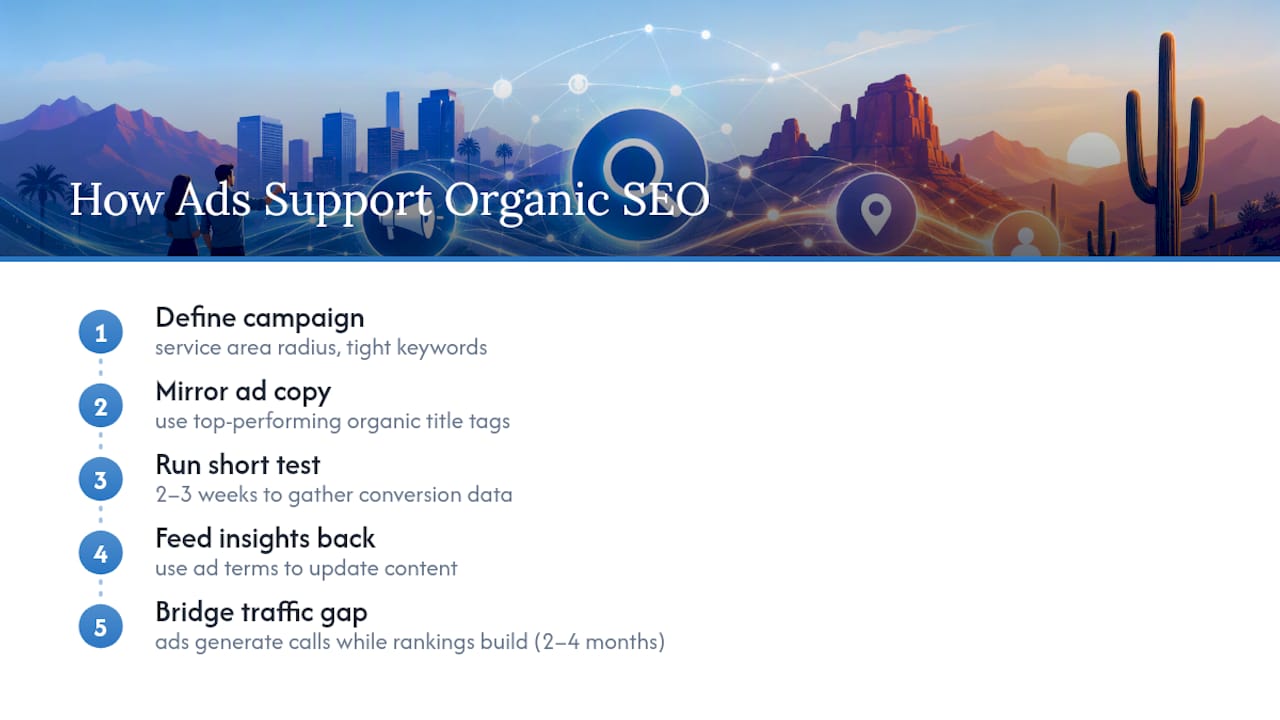
Google Ads and organic SEO aren’t competing strategies. They work best together, especially for a new location page or service that hasn’t earned organic rankings yet.
A basic local Google Ads campaign starts with a defined service area radius, a handful of tightly targeted keywords, and ad copy that mirrors your best-performing organic title tags. If “Emergency Plumbing Repair in Scottsdale, AZ” works well as an organic title, it’s usually a strong headline for a paid ad too, since it’s already proven to earn clicks.
The real integration value: Google Ads data gives you fast keyword insight that Search Console can take months to accumulate. Run a small ad campaign on a new service page for two or three weeks, and you’ll see exactly which search terms actually convert into calls or form fills, insight you can then fold back into your organic content strategy.
Ads also fill the gap while new pages are still climbing organic rankings. A freshly published location page might take two to four months to rank well organically, but a modest local ad budget can generate calls in the meantime, keeping revenue flowing while the organic work compounds.
One caution: don’t let ad spend replace the fundamentals. Businesses that pour budget into ads while ignoring GBP completeness or NAP consistency end up paying for clicks that a fully optimized organic profile would have earned for free.
Competitor Analysis for Local SEO
Look at the three businesses currently ranking above you in the local pack for your top service and city combination. That’s your real competitive set, not the biggest national brand in your industry.
Check their Google Business Profile: how many reviews do they have, how recently did they post an update, what categories are they using that you might be missing? Then look at their website: are they running dedicated location pages, or one generic page? Are their title tags more specific than yours?
This isn’t about copying competitors. It’s about spotting gaps. If every plumber ranking above you in Chandler has 80-plus reviews and you have 12, that’s your clearest priority. If none of them have a dedicated FAQ section answering “same-day service” questions, that’s an opening you can fill.
Revisit this analysis quarterly, not once and forget it. Local competitive landscapes shift as new businesses claim profiles and existing ones ramp up review requests, and a competitor who was weak six months ago might now be outranking you.
Content Marketing Strategies for Small Businesses
Content marketing for a small business doesn’t mean publishing daily blog posts. It means publishing a handful of genuinely useful pieces that answer questions your actual customers ask, then linking them naturally into your service pages.
Start with the questions you already get on the phone or in person. A roofer probably gets asked “how long does a roof replacement take” or “does insurance cover storm damage” constantly. Those questions, turned into short, clear blog posts, capture informational search intent and build topical authority around your services.
Keep a realistic publishing pace: one solid piece a month beats four rushed ones. Each post should link to a relevant service page, and each service page should occasionally link back to a related post. That internal linking structure helps both users and Google understand how your site’s content connects.
Repurpose content across formats. A blog post answering a common customer question can become a GBP post, a short social media caption, and an FAQ entry on a service page, one piece of research, three uses.
Social Media Integration to Support Local SEO

Social media doesn’t directly boost rankings the way a Google Business Profile update does, but it plays a real supporting role in local visibility.
Active social profiles reinforce the same NAP information search engines check elsewhere, and they give customers another place to find your hours, location, and recent work. A Facebook or Instagram post showing a completed job in a specific Arizona neighborhood adds another public signal that your business genuinely operates there.
Cross-post your GBP updates to your social channels instead of treating them as separate tasks. If you posted a new offer or photo to Google, share the same content on Facebook or Instagram; it takes minutes and doubles your visibility for one piece of content.
Encourage customers to tag your business location in their own posts when appropriate. A satisfied customer’s geotagged photo carries more authentic local signal than anything you could post yourself. Webtechs’ social media marketing services can help set up this cross-posting workflow if managing multiple platforms consistently isn’t realistic on top of running the business.
What Actually Moves the Needle (and What’s Overrated)
Most local SEO advice treats every checklist item as equally urgent, and that’s where small businesses waste their limited hours. It isn’t true. Reviews and Google Business Profile completeness do more heavy lifting than backlinks, schema, or blog volume for the average Arizona service business in year one.
The conventional wisdom oversells technical perfection. A flawless Core Web Vitals score on a site with eight reviews and an unclaimed GBP still loses to a slower competitor with 60 reviews and a fully built-out profile. Speed and schema matter, but they’re refinements, not foundations.
What gets underestimated: the compounding effect of consistency. A business that posts one GBP update and asks for one review every single week for three months will usually outperform a business that did a massive one-time optimization push and then went quiet. Google’s own signals reward ongoing activity, not a single burst of effort.
If you take one thing from this checklist, prioritize the two-week habit over the two-day sprint. Fix your NAP, claim your profile, ask for reviews on a schedule, and let the smaller technical items follow once that foundation is solid.
— Brett
Let WebTechs Handle Your Local SEO Checklist for You
Webtechs is the practical alternative to working through this checklist alone at night after closing up shop. As a Scottsdale-based agency that has served Arizona small businesses since 1997, Webtechs builds and manages the exact items covered here, Google Business Profile optimization, NAP cleanup, location pages, and technical fixes, so you spend your limited hours running the business instead of learning schema markup.
Rather than a long-term commitment with vague deliverables, Webtechs offers clear, project-based web design work and ongoing SEO management scoped to what your business actually needs. Local service providers have seen measurable jumps in organic visibility after a focused cleanup of the fundamentals outlined above. If you want a straightforward starting point, browse Webtechs’ website design pricing or get in touch about a free local SEO review and find out exactly where your profile and site stand today.
Sources
- SEO: A Small Business Guide to Getting Found Online | U.S. Chamber of Commerce
- Tips to improve your local ranking on Google – Google Business Profile Help
- SEO starter guide | Google Developers
- On-site optimization tips for local SEO | Shopify