

Google Maps Ranking: Find Arizona SMBs’ Blind Spots by Grid
Check your Google Maps ranking by location, not by the averaged position Search Console shows. The single most effective first action is to verify every field on your Google Business Profile, then run a quick location-by-location scan of your target keywords. That scan tells you where you actually rank, because one averaged number hides more than it reveals.
TL;DR:
- Search Console combines Maps, local pack, and organic results across devices and locations, so its average cannot reveal geographic visibility gaps.
- Google’s local rankings depend on relevance, distance, and prominence; accurate categories, hours, map pin, services, reviews, and citations address controllable profile signals.
- Build a monthly scan around 8 to 12 local queries under consistent conditions, then investigate grid points ranking outside the top three to five.
- For service area businesses, grid scans expose block level blind spots; prioritize weak zones with profile fixes, local pages, review requests, or citation corrections.
- Businesses that fix profile gaps may see measurable movement within 60 to 90 days; track calls, direction requests, and website clicks in GA4.
Table of Contents
- Why Search Console’s averaged position misleads local businesses
- Core Google Maps ranking factors you can influence
- Manual checks you can run today (and where they fall short)
- Why grid-based tracking gives you actionable data
- Reproducible scan workflow: account, keywords, grid, scan, interpret
- Prioritized local SEO playbook after a rank scan
- How we read and act on Maps performance data
- What a realistic timeline for Google Maps ranking improvement looks like
- Get a Google Maps audit built for your Arizona service area
- FAQ
- Sources
Why Search Console’s averaged position misleads local businesses
Search Console blends data across search contexts, devices, and query phrasing into one tidy average. That number feels useful, but it was never built to describe Google Maps or local pack visibility. It mixes desktop and mobile queries, branded and unbranded searches, and results from searchers sitting in different parts of the Valley, then flattens everything into a single position.
Local results, by contrast, are personalized and distance-sensitive. A Scottsdale HVAC company might rank third for “AC repair near me” in Old Town and fail to appear at all for the same search from Tempe or North Phoenix. Search Console cannot show that split because it was not designed to.
A few reasons the average breaks down for local tracking:
- It merges Maps, local pack, and organic web rankings into shared metrics that do not separate by surface.
- It cannot isolate geographic pockets where you are invisible while showing strength elsewhere.
- It ignores the searcher’s device location, which is one of the three core signals Google uses to rank local results.
- It reports impressions and clicks after the fact, with no way to replay what a specific searcher in a specific neighborhood actually saw.
Once you understand that limitation, the fix is straightforward: stop asking “what’s my average position” and start asking “where do I rank, for whom, and from where.”
Core Google Maps ranking factors you can influence
Google states that local ranking comes down to three factors: relevance, distance, and prominence. Each one responds to specific, controllable actions on your Business Profile.
Relevance measures how well your profile matches what someone searched. Your primary category carries the most weight, followed by the services you list, your business description, and consistent, natural use of relevant terms across your profile.
Distance reflects how far a potential customer sits from your pinned location or your defined service area. If you serve multiple Arizona cities from one office, your service-area settings and address accuracy determine whether nearby searchers ever see you.
Prominence covers everything that signals your business matters: review volume and score, inbound links, local citations, media mentions, and how often people interact with your profile through calls, direction requests, and website clicks.
An industry survey of local ranking factors places primary GBP category, business hours, map pin placement, and click-through rate among the most heavily weighted signals, according to WhiteSpark’s Local Search Ranking Factors report. That lines up with what Google itself recommends: complete, accurate profile data gives you the best shot at matching relevant searches.
A practical checklist for the fields that move the needle:
- Primary and secondary categories that match exactly what you do, not a loose approximation.
- Complete, accurate hours, including holiday hours for Arizona-specific closures.
- Attributes filled out (wheelchair accessible, outdoor seating, women-owned, and so on).
- Products or services listed with descriptions, not just names.
- Fresh photos added regularly, covering the storefront, team, and work samples.
Google is explicit that there is no way to pay for a better local ranking. The only path is a profile that accurately represents your business, backed by genuine prominence signals.
Manual checks you can run today (and where they fall short)
Before building anything elaborate, you can spot obvious problems with a few manual searches. These checks are free and fast, but they come with real limits.
- Open an incognito or private browser window so saved search history and cookies do not skew results.
- Search your target keyword on a mobile device with location services turned on, since most local searches happen on mobile.
- Repeat the search from a few different physical locations across your Arizona service area, or use a VPN or location-spoofing tool to approximate distant searchers.
- Record what you see every time: the exact search term, the location searched from, the device used, a screenshot, and a timestamp.
- Compare results across locations to spot where your ranking drops off.
Pro Tip: Keep a simple spreadsheet with columns for term, location, device, position, and date. It turns scattered screenshots into a pattern you can actually act on.
The catch is scale and noise. Manual checks only show you the exact moment and exact spot you tested. Google’s results shift by time of day, by the searcher’s precise GPS coordinates, and by algorithm updates that roll out without notice. Ten manual searches might convince you that you rank well, while a grid covering fifty points reveals three or four neighborhoods where you never show up.
Manual checks also do not scale across a service area with ten or fifteen target keywords. You can confirm an obvious problem (you don’t appear at all near your own address) but you cannot reliably confirm a gradual improvement or a slow decline without repeating the same test, the same way, on a schedule. That consistency is exactly what manual effort struggles to sustain.
Why grid-based tracking gives you actionable data
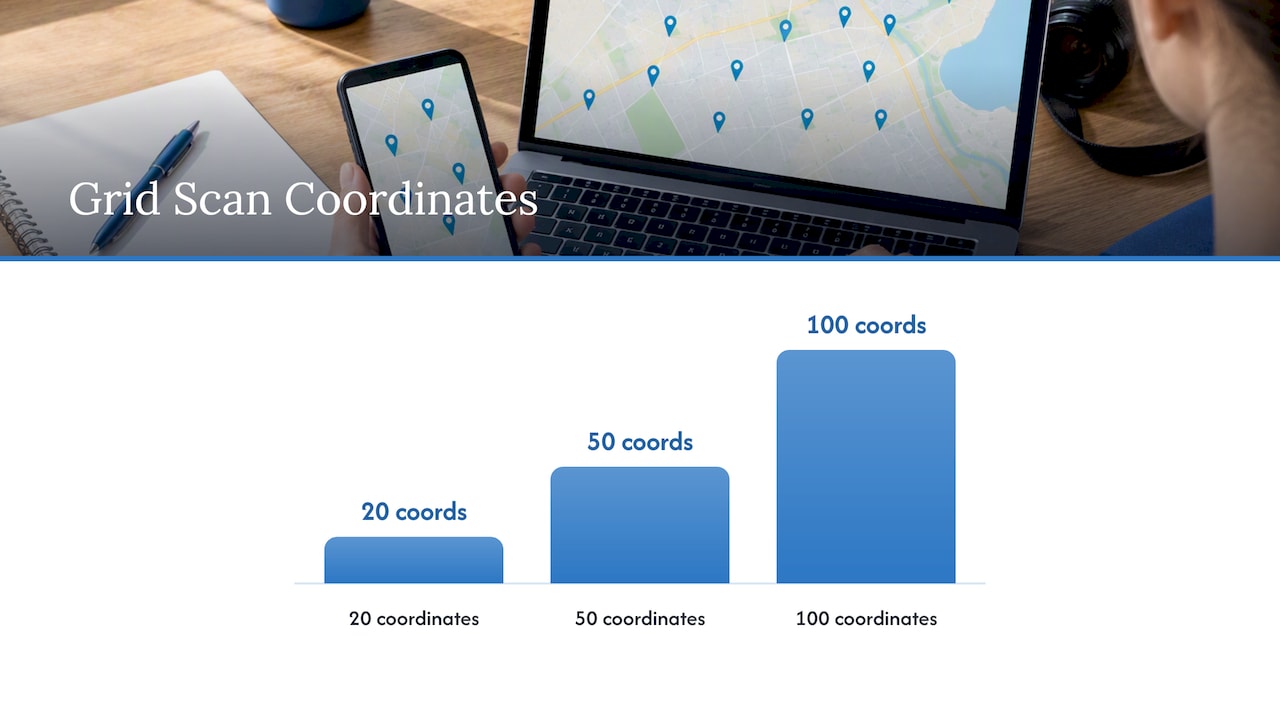
A grid scan plots your search position across a set of geographic points, typically arranged in a square or radius pattern over your service area, rather than checking from one single point. Instead of one search from your office address, you run the same keyword from twenty, fifty, or a hundred coordinates spread across the neighborhoods you actually serve.
The output is usually a heat map or a distribution table, color-coded or scored from strong positions near the center to weak or absent positions at the edges. That visual makes weak pockets obvious in a way a single number never can.
Grid scans help certain businesses more than others:
- Service-area businesses (plumbers, electricians, cleaning services) that work across multiple Arizona zip codes benefit the most, since their visibility often varies block by block.
- Delivery and multi-neighborhood retailers can see exactly which parts of their delivery radius are underperforming.
- Multi-location businesses can compare each location’s local footprint side by side instead of guessing which store needs attention.
- Single-storefront businesses with a tight service radius still benefit, but with a smaller, denser grid focused close to the pin.
The real value shows up in the decisions a grid enables. If a scan shows weak visibility in Chandler while Scottsdale looks strong, that tells you exactly where to push for more reviews, where to build a localized landing page, or where a small paid campaign might fill the gap faster than organic work alone.
Reproducible scan workflow: account, keywords, grid, scan, interpret
A one-time check tells you where you stand today. A repeatable workflow tells you whether you’re improving. Here’s a process you can run monthly without needing a specialized agency contract.
- Verify and complete your Google Business Profile, then connect it to Google Analytics so interactions like directions, calls, website clicks, and messages flow into a property you already track.
- Build a keyword list of 8 to 12 local queries that reflect how real customers search, mixing service terms (“Scottsdale pool repair”) with intent phrases (“pool repair near me”).
- Design a sample grid across your service area, choosing a radius that matches how far your customers typically travel and spacing points close enough together to catch block-level differences.
- Run scans under consistent conditions: same time of day, same device type, same exact query phrasing, every time you repeat the test.
- Aggregate results into a table or heat map and flag any grid point ranking outside the top three to five positions.
- Map every weak cell to a specific fix: a missing category, thin service description, low review count in that neighborhood, or a citation inconsistency.
Low-visibility cells almost always trace back to one of a handful of root causes:
- A primary category that doesn’t match the dominant local search intent.
- Thin or duplicate business descriptions across multiple locations.
- A review count that lags competitors within that specific zip code.
- Inconsistent name, address, and phone details across directories.
| Scan step | What you’re measuring | Typical fix when it’s weak |
|---|---|---|
| Profile verification | Accuracy of category, hours, address | Correct and complete every GBP field |
| Keyword selection | Match to real customer search intent | Add missing service terms to listings |
| Grid scan | Rank distribution across the service area | Localized pages or review pushes in weak zones |
| Interaction tracking | Directions, calls, clicks by period | Link Business Profile to GA4 for conversion tracking |
Once you’ve run this cycle once, each later scan becomes a comparison against your own baseline rather than a guess. That’s the difference between reacting to anecdotes and managing a measurable local SEO program. For a structured starting point, our 30-day local SEO checklist for Scottsdale businesses walks through the same fixes in sequence.
Prioritized local SEO playbook after a rank scan
Once your grid scan flags weak spots, work through fixes in order of effort versus impact.
Immediate GBP fixes come first. Confirm your primary category matches your dominant search intent, double-check your pinned location sits on the correct building, and fill in every attribute field. These edits take an afternoon and often produce the fastest visible movement. Our Google Business Profile optimization guide covers the specific fields worth prioritizing.
Review strategy comes next. Request reviews consistently from customers in your weakest grid zones, respond to every review publicly, and display top feedback on your website. Google shows both total review count and an average score on a 1 to 5 scale directly on your listing, and that combination shapes both ranking and customer trust, according to Google’s review scoring guidance. Our guide to getting more Google reviews covers ethical request timing and response templates.
Local content and schema reinforce the profile work. Build service-area pages targeting the neighborhoods where your grid showed weakness, and add structured data for your business details and reviews so search engines can parse them cleanly. Our local business schema guide shows the markup that supports richer listings.
Citations and NAP consistency close the loop. Check major directories for mismatched names, addresses, or phone numbers, and correct every inconsistency you find.
Pro Tip: Set up calls and direction clicks as conversion events in GA4 before you start fixing anything, so you can measure the actual lift from each change.
A realistic plan: in the first 30 days, complete every profile field, launch a review request campaign, and clean up citations. In the following 60 days, publish localized service pages for your weakest grid zones and rerun the scan to confirm movement.

How we read and act on Maps performance data
When we review a client’s Business Profile, interactions like direction requests, calls, and website clicks only become useful once they’re tied to Google Analytics, because that connection turns a raw interaction count into a measurable lead source. We look at which keywords and neighborhoods generate the most calls versus the most clicks, then decide where the budget goes next.
That decision usually comes down to one of three paths: a Business Profile edit when the fix is structural (wrong category, incomplete hours), a content or citation fix when the gap is about relevance or consistency, or a short paid campaign when a weak zone needs faster coverage than organic work alone can deliver in the near term.
We treat every grid scan as a planning document, not a report to file away. The weak cells become the next sprint’s task list, and the strong cells become the pattern we try to replicate elsewhere in the service area.
What a realistic timeline for Google Maps ranking improvement looks like
Owners who run a proper scan and fix the obvious profile gaps tend to see measurable movement within 60 to 90 days, not overnight. Review-driven prominence gains and citation cleanup compound slowly, which is why a single scan rarely tells the full story. The value comes from repeating the same grid scan monthly and watching the weak cells shrink.
Watch interaction counts (calls, direction requests, website clicks) alongside your grid position data, since a rising interaction count often shows up before your average grid position does. Guesswork wastes months that a repeatable measurement habit would have saved.
— Brett
Get a Google Maps audit built for your Arizona service area
We run grid-based rank scans for Arizona businesses, then turn the results into a prioritized fix list covering Business Profile edits, review targets, citation corrections, and local content gaps.

A managed engagement typically includes the audit itself, a documented action plan ranked by effort and expected impact, and ongoing reporting tied to the calls, direction requests, and website clicks your profile generates. If you want a second set of eyes on your current Maps visibility, our local SEO and Google Maps marketing services page outlines what an engagement covers and how to get started.
FAQ
How can I increase my Google Maps ranking?
Complete every field on your Google Business Profile, focus on the three factors Google names directly (relevance, distance, and prominence), and build reviews and citations consistently over time, according to Google’s own ranking guidance. Running a location-by-location scan first tells you exactly which neighborhoods and fixes to prioritize.
Is Area 51 blurred on Google Maps?
This question falls outside what this article or our sources cover, so we won’t offer a definitive answer here. For current satellite imagery questions, Google’s own Maps help documentation is the most reliable place to check.
Is Google Maps better than Google’s web search for finding businesses?
The two serve different purposes rather than competing directly: Google Maps is built for location-based discovery and navigation, while web search blends organic results, ads, and local packs depending on the query. For a “near me” style search, Maps typically shows the distance-sensitive, prominence-weighted local results described in Google’s local ranking factors.
What is the most searched term on Google?
Search volume leaders shift constantly and vary by region and season, so no single term holds that title consistently. For local business owners, the more useful question is which specific terms your customers search in your own service area, which a targeted keyword list and grid scan will answer directly.
Sources
- Tips to improve your local ranking on Google – Google Business Profile Help
- Local Search Ranking Factors — WhiteSpark